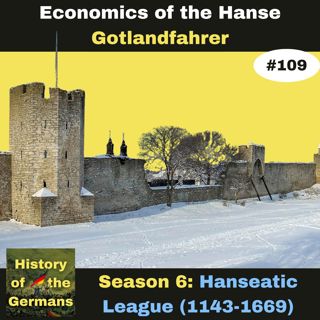
Ep. 109: The Hanseatic League (12th century) - The Economics - Gotlandfahrer

Ep. 109: The Hanseatic League (12th century) - The Economics - Gotlandfahrer

If I put the word Hanseatic into Google Search I get as result number 4 “Hanseatic King’s Lynn -Visit West Norfolk”. I can say with absolute confidence that there is not a single German individual, place or organisation that a small town in England would choose to not just associate with but incorporate itself into its history, safe for the Hanseatic League. They may play Zedoch the Priest at the coronation but that is because both Handel and Price Charles are considered English with German roots. Kings Lynn calling itself a Hanseatic city is a different thing. And it happens in many other places, Bergen is proud of its Hanseatic past as is Visby in Gotland or the Dutch former members of the League.

The love of all things Hanseatic goes so far that it even overrides the German fascination with all things car related. As you may know, the German system of numberplates is strictly hierarchical. The first 1, 2 or 3 letters indicate the place where the vehicle is registered at the time. The more letters, the smaller the town or county of registration. For instance, WES stands for Wesel and STD for Stade, two of the smaller members of the Hanseatic League. The two-letter cities are plentiful and some, like LG stands for Lüneburg and BS for Brunswick. Only the largest cities get to proudly display just one single letter – for instance K for Cologne, B for Berlin and F for Frankfurt.

But what about Germany’s second largest city, the Free and Hanseatic City of Hamburg? Does your honourable Hamburg merchant drive round in a car ostentatiously displaying a proud single H? No, of course he doesn’t. His numberplate is HH, standing for Hansestadt Hamburg, leaving the single H to the inland Hanoverians. Other Hanseatic cities like Bremen, Lübeck, Wismar, Rostock, Greifswald and Stralsund also proudly carry an additional H on their numberplate, a subtle reminder to everyone that their hometowns are different and dare one say, superior to other cities.

How can an organisation that had hardly any permanent institutions traded rather pedestrian commodities like grain, Hering, furs and beeswax and ceased to exist in 1669 still stir so many peoples’ hearts with pride, that is what we will try to figure out in this podcast series.

The music for the show is Flute Sonata in E-flat major, H.545 by Carl Phillip Emmanuel Bach (or some claim it as BWV 1031 Johann Sebastian Bach) performed and arranged by Michel Rondeau under Common Creative Licence 3.0.

As always:

Homepage with maps, photos, transcripts and blog: www.historyofthegermans.com

If you wish to support the show go to: Support • History of the Germans Podcast

For do it yourself merchandise go to: Merchandise • History of the Germans Podcast

Facebook: @HOTGPod

Threads: @history_of_the_germans_podcast

Bluesky: @hotgpod.bsky.social

Instagram: history_of_the_germans

Twitter: @germanshistory

To make it easier for you to share the podcast, I have created separate playlists for some of the seasons that are set up as individual podcasts. they have the exact same episodes as in the History of the Germans, but they may be a helpful device for those who want to concentrate on only one season.

So far I have:

The Ottonians

Salian Emperors and Investiture Controversy

Fredrick Barbarossa and Early Hohenstaufen

Frederick II Stupor Mundi

Saxony and Eastward Expansion

The Hanseatic League

The Teutonic Knights

The Holy Roman Empire 1250-1356

The Reformation before the Reformation

The Empire in the 15th century

The Fall and Rise of the Habsburgs

Bibliography:

Philippe Dillinger: Die Hanse

Die Hanse, Lebenswirklichkeit und Mythos, curated by Jürgen Bracker, Volker Henn and Rainer Postel

Rolf Hammel-Kieslow: Die Hanse

And special thanks for the translation of the Artlenburg Privileg to Dr. Jenny Benham.

And special thanks to Dr. justyna Wubs-Montzewicz whose research I found eye-opening

Avsnitt(247)

Ep. 213: Friedrich III (1440-1493) – Duping the Duke of Burgundy

Ep. 213: Friedrich III (1440-1493) – Duping the Duke of Burgundy

How long can an emperor not be an emperor. The official record stands at 25 years, that is how long Friedrich III had stayed out of the core areas of the Holy Roman Empire. That meant 25 ears of Imper...

6 Nov 202534min
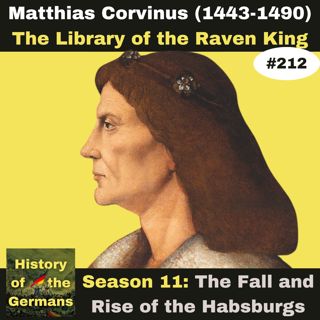
Ep. 212:  Matthias Corvinus (1443-1490) – The Library of the Raven King

Ep. 212: Matthias Corvinus (1443-1490) – The Library of the Raven King

Today we will talk a lot about Matthias Corvinus, the legendary renaissance king of Hungary whose library outshone that of the Medici in Florence and whose standing army was one of the greatest – and ...

30 Okt 202540min
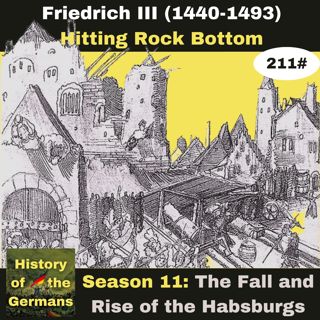
Ep. 211: Friedrich III (1440-1493) – Hitting Rock Bottom

Ep. 211: Friedrich III (1440-1493) – Hitting Rock Bottom

It is November 1462 and the emperor Friedrich III and his young family are huddling together in the cellars of the Hofburg. The citizens of Vienna are shooting cannonballs into the 13th century castle...

23 Okt 202536min
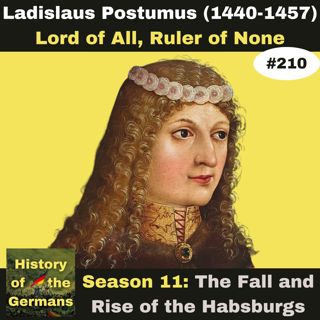
Ep. 210: Ladislaus Postumus (1440-1457) - Lord of all, Ruler of No One

Ep. 210: Ladislaus Postumus (1440-1457) - Lord of all, Ruler of No One

Our journey today will take us away from the emperor Friedrich III who will spend most of the episode holed up in his castle at Wiener Neustadt, fretting and gardening.Instead we look at the dramatic ...

16 Okt 202536min
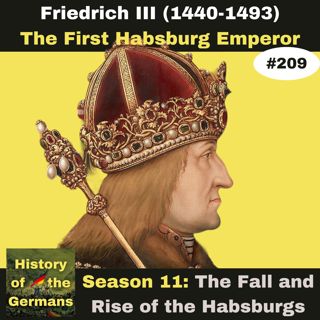
Ep. 209 – Friedrich III (1440-1493) - The First Habsburg Emperor

Ep. 209 – Friedrich III (1440-1493) - The First Habsburg Emperor

Today we – and the Habsburgs – stride back on to the grand stage of European politics. Not with a titan of history or monarch whose long and fruitful reign resonates across the centuries, but with Fri...

2 Okt 202541min
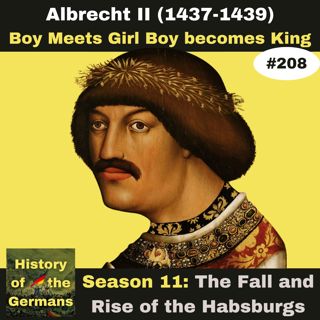
Ep. 208: Albrecht II (1438-1439) - Boy Meets Princess, Boy Becomes King

Ep. 208: Albrecht II (1438-1439) - Boy Meets Princess, Boy Becomes King

Last week we saw the family slowly climbing out of the hole that Friedrich IV of the Tyrol had dug them. But despite all these consolidation efforts, the family was still in the second league of Europ...

25 Sep 202538min
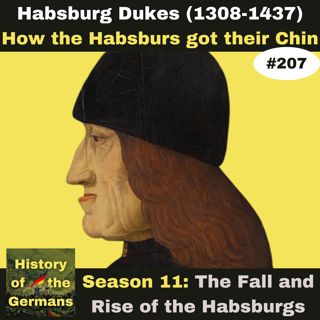
Ep.207: Habsburg Dukes (1308-1437) - How the Habsburgs got their Chin

Ep.207: Habsburg Dukes (1308-1437) - How the Habsburgs got their Chin

“The Habsburgs ruled half of Europe with a chin that entered the room five minutes before they did,” is one of those witticisms that made the 19th century so amusing. But by then the Habsburg jaw had ...

18 Sep 202533min
Ep. 206: Habsburg Dukes (1308-1437)– Division, Destruction and Degradation

Ep. 206: Habsburg Dukes (1308-1437)– Division, Destruction and Degradation

Success for a princely family in the Late Middle Ages has a lot to do with reproductive luck. Not having any offspring, in particular no male offspring is a bit of a knockout. But having too many sons...

11 Sep 202534min

Populärt inom Utbildning

rss-bara-en-till-om-missbruk-medberoende-2
historiepodden-se
det-skaver
nu-blir-det-historia
harrisons-dramatiska-historia
alska-oss
not-fanny-anymore
roda-vita-rosen
johannes-hansen-podcast
rss-foraldramotet-bring-lagercrantz
allt-du-velat-veta
sektledare
rss-viktmedicinpodden
sa-in-i-sjalen
rss-sjalsligt-avkladd
rss-om-vi-ska-vara-arliga
i-vantan-pa-katastrofen
rss-max-tant-med-max-villman
rss-basta-livet
rikatillsammans-om-privatekonomi-rikedom-i-livet