
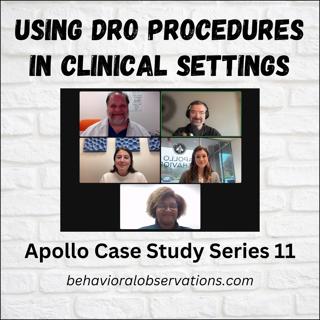
Using DRO Procedures in Clinical Settings: Apollo Case Study Series 11
Dr. Jim Moore, Chief Clinical Officer of Apollo Behavior, joins me in the 11th installment of the Apollo Case Study Series. In this podcast, Jim also brought three of his Apollo colleagues into the discussion: Lydia Lindsey, Christina Nylander, and Lauren Elliott. We started off the show with Lydia providing some background on her ABA career and how it brought her to Apollo. Spoiler alert: we managed to fit in a shout-out to Auburn University's ABA program (insert the obligatory "War Eagle" chant! (note: Christina and Lauren were guests in ACSS episodes Six and Nine, respectively). This conversation centered around the use of Differential Reinforcement of Other (DRO) behavior procedures that the Apollo team implemented with two clients. As such, we discuss the following From a conceptual perspective, is DRO a reinforcement or punishment-based intervention? Why they chose this procedure over a more specific FCT intervention. The importance of determining a precise Inter-Response Time. How to avoid ratio strain. How to successfully fade DRO schedules. Balancing the effectiveness and efficiency of behavioral interventions. The importance of accurately re-setting the DRO interval. Coaching behavioral technicians to implement this procedure correctly, even when it is challenging to do so (see Dr. Claire St. Peter's excellent work in the general area of Treatment Integrity too). The Seven Steps to Instructional Control (disclosure: Amazon Associates link). The "London Cabbies Test." The importance of conducting client-oriented research in clinical settings. If you are interested in learning more about Apollo Behavior, you can follow them on Instagram, LinkedIn, or visit their website here.
17 Nov 20231h 9min
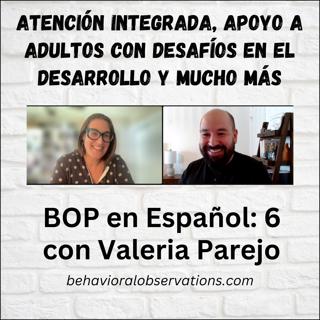
BOP en Español 6: Atención integrada, apoyo a adultos con desafíos en el desarrollo, sexualidad, ABA en Brasil, certificación QABA y más con Valeria Parejo
Si no queda claro con el título, este episodio está lleno de temas que son algo esotéricos para la corriente dominante de practicantes de análisis de conducta. Sin embargo, la conversación con Valeria nos aterriza varias veces en la relevancia de la atención integrada para optimizar la colaboración e integración de esfuerzos por parte de profesionales de la salud y equipos multidisciplinarios; la necesidad de la educación proactiva de habilidades relacionadas a la sexualidad y las oportunidades para darles más y mejores apoyos a adultos con desafíos en el desarrollo. Una vez más los temas abundan pero espero que despierten curiosidad y finalmente los inspiren a recorrer caminos menos convencionales pero importantes como lo ha sido para la multifacética carrera de Valeria.
10 Nov 20231h 1min
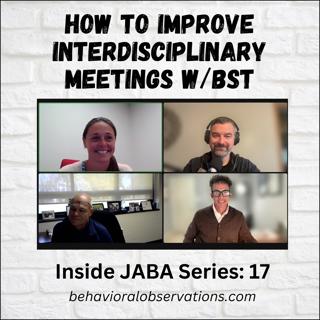
How to improve interdisciplinary meetings with Behavior Skills Training: Inside JABA 17
Frank Bird and Dr. Jill Harper join me, along with JABA Editor in Chief, Dr. John Borrero, in the 17th installment of Behavioral Observations' Inside JABA Series. Both of our guests hail from Melmark. Jill is their Senior Director of Professional Development and Training, and Frank is the Executive Vice President of Clinical Services of this storied institution. As an aside, if you're not familiar with Melmark, we spend a few minutes talking about its history, mission, current services, and more. However, we spent the majority of this podcast discussing the paper Jill and Frank published with their colleagues that you can find in the Fall 2023 issue of JABA. The paper is called, Teaching clinicians and nurses to prepare for and present at interdisciplinary meetings through behavioral skills training. If this sounds like a familiar topic, you're correct. We covered how to improve the and productivity of meetings in my first conversation with Dr. Florence DiGennaro-Reed almost two years ago. While there's something Dilbert-esque about examining the precision and efficiency of meetings, like so many things we talk about on this podcast, my guests make the case as to why this is important in their context. At the same time, reading this paper made me reflect on the various "processes" I have in place for a number of tasks that I have to do. I use quotes to underscore that fact that for so many of these activities, I don't have written procedures for, and probably should put some thought to this. Maybe you're in the same boat? Let me know either way by going to the newly revamped behavioralobservations.com and leaving a comment on the shownotes page for this episode. While you're there, consider signing up for the email list. By doing so, you'll get episode show notes delivered straight to your inbox. Also, this episode, along with many, many others, is eligible for BACB Continuing Education. In fact, it's eligible for highly sought-after supervision CEUs, second only the the even-more-highly-sought-after ethics CEUs! To learn more, head to the CEUs page of the site. If you don't see this one right away, check back in a couple of days and it will be there. Thank you so much for supporting the show with your Patreon membership!
7 Nov 20231h 9min
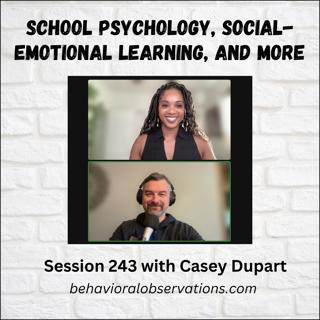
School Psychology, Social-Emotional Learning, and More: Session 243 with Casey Dupart
In Session 243, Dr. Casey Dupart joins me to talk about School Psychology, and in doing so, we touched on a range of related topics including the challenges of military families, multi-tiered systems of supports, socio-emotional learning, school refusal, educational policy, and so much more. As you'll hear in the interview, Casey has been a School Psychologist in various roles across several states. She also provides consultation and training through her company, Embracing Resilience. And while we're on that topic, she has a few webinars and workshops coming up on topics like Multidisciplinary Collaboration and Improving School Climate and Culture. You can find links to these events at the shownotes for this episode, or simply go to Embracingresiliance.org and click the services tab here. I believe BCBAs serving in public school settings may be an increasing area of practice. According to the BACB, about 12% of the BCBA and BCBA-D certificants work in educational settings. Also, I was invited to speak about low-tech interventions for disruptive classroom behavior at the recent BABAT conference, and I was honestly shocked to how many attendees were interested in this topic, particularly given the many other excellent talks that were going on in the same time slot. As some of you may already know, I've been working with Anika Costa and Dr. Paulie Gavoni on a project called thebehavioraltoolbox.com to provide BCBAs and other school-based professionals trainings and tools to help them perform more successfully in these settings. Our first course, Ready, Set, Consult! is now available, and we've been really pleased with the feedback that we've gotten from our initial participants. We're also hard at work on getting our second course ready. This one is based off of the talk I gave at the recent BABAT conference. Our working title currently is, When NOT to FBA: 5 Quick Strategies for Improving Behavior in Classroom. I mention all of this to perhaps underscore the importance of being able to work both collaboratively and effectively in school settings. And I think this conversation with Casey will be helpful for BCBAs who are new to school settings, or who simply want to be more successful with the students they serve. Here are some links to resources, etc... we discussed during the podcast: Back to School with PBIS, Session 198. PBIS, School Mental Health, and Supporting Students with Trauma: Session 78. Other school-related BOP shows. CASEL: Fundamentals of Social Emotional Learning. Sold a Story Podcast. Chronic absenteeism article. More school refusal literature. ABA Inside Track episode on chronic absenteeism.
30 Okt 202349min
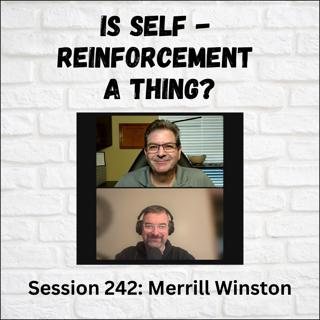
Is Self-Reinforcement a Thing? Session 242 with Merrill Winston
Merrill Winston returns to the podcast for what seems to be the umpteenth time (and if you didn't catch the SNL reference we discussed, see here). In this episode, we discuss a presentation he recently gave that dove into the seminal Catania paper, The Myth of Self-Reinforcement. In this episode Merrill distinguishes between procedures and processes, why what we think of as self-reinforcement is likely more attributable to negative reinforcement, and the age-old problem of the term "non-contingent reinforcement." Merrill also spends a few minutes discussing the contributions of Dr. Henry "Hank" Pennypacker, what he intends to talk about at this year's Stone Soup Conference (shameless plug: save at checkout using promo code PODCAST), and rounds out the episode with some more constructive ways to think about self-management. This was a fun episode, and if you enjoyed it, please consider sharing with friends and colleagues. This podcast is brought to you by: The Stone Soup Conference, which is taking place on October 20th. Use code PODCAST to save on your registration as well. Behavior University. Their mission is to provide university quality professional development for the busy Behavior Analyst. Learn about their CEU offerings, including their brand new 8-hour Supervision Course, as well as their RBT offerings over at behavioruniversity.com/observations. HRIC Recruiting. Barb Voss has been placing BCBAs in permanent positions throughout the US for just about a decade, and has been in the business more generally for 30 years. When you work with HRIC, you work directly with Barb, thereby accessing highly personalized service. So if you're about to graduate, you're looking for a change of pace, or you just want to know if the grass really is greener on the other side, head over to HRIColorado.com to schedule a confidential chat right away.
11 Okt 202359min
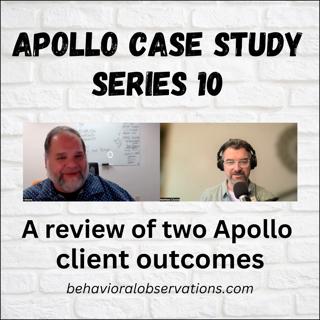
Apollo Case Study Series 10: A review of two client outcomes
Dr. Jim Moore and I get back together to talk about a few specific client outcomes that we thought would be helpful for the audience to learn about. In this podcast, we talked about: The general profile of learners across the Apollo clinics. They pace at which learners make progress in their programs. Skinner's Attitudes of Science. Universal Behavioral Protocols. The Seven Steps to Instructional Control. Rapport Building and Instructional Fading Prior to Discrete Trial Instruction: Moving From Child-Led Play to Intensive Teaching (Shillingsburg, et al., 2018). How Apollo's unique training approach contributes to increasing staff flexibility. PEAK training curricula implementation. The Gulf Coast ABA Conference, where Jim is talking more about RFT outcomes. Who is heavier, James Hetfield or Dave Mustaine? What are the P.R.I.D.E. skills Jim talked about? Some stories about insurance authorizations (towards the end). Whether our children are interested in Behavior Analysis. Jim closes the show by sharing that he has other cases he could discuss. Please let us know if you want more of these stories!
4 Okt 20231h 15min
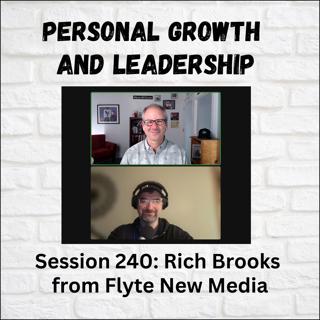
Personal Growth and Leadership: Session 240 with Rich Brooks
Rich Brooks returns to the podcast to talk about how he's grown as a business owner. And while he's in a different industry, there are tons of parallels to what we do in the world of Applied Behavior Analysis. Rich has historically discussed all things digital marketing (see here and here), but this is a more personal story of how he had to step out of his role as a website designer and marketer in order to effectively lead and grow his business, Flyte New Media. Also, I've finally taken my own advice and had his team tear down Behavioralobservations.com and rebuild it from the ground up. Yes, I finally had to invest in myself, just like Rich has done, and I couldn't be happier with the outcome! If you want to learn more about digital marketing, check out Rich's upcoming conference, The Agents of Change Digital Marketing Conference, which is going down in Portland, Maine on October 4th and 5th, and will be available virtually for those who aren't in striking distance of one of the coolest cities in the country. He also has a great podcast, which you can find at that site as well. If you have questions for Rich about anything digital marketing, or even restaurant recommendations in the greater Portland area, hit him up on LinkedIn.
27 Sep 20231h
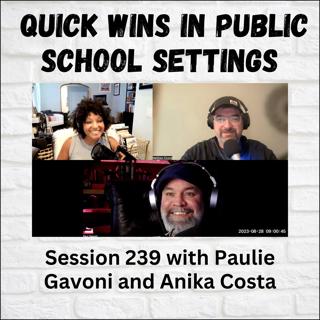
Quick Wins in Public School Settings: Session 239 with Anika Costa and Paulie Gavoni
Anika Costa and Dr. Paulie Gavoni joined me in Session 239 to discuss their latest book, Quick Wins: Using Behavior Science to Accelerate and Sustain School Improvement. In our conversation we talk about why they felt this book was necessary, who represents their ideal reader, and whether we ask too much of school leaders. That last point is something I've been thinking about a lot recently, as we oftentimes ask people with no background in behavior analysis to engage in complex activities like pinpointing performance indicators, diagnosing performance problems, and so on. We also talk about the distinction between leading and lagging indicators, viewing relationships as accomplishments, their Quick Walk protocol, and what things leaders should do before providing corrective feedback to staff members. Paulie and Anika are presenting what sounds like a great talk at this year's Stone Soup Conference, which by the way, if you decide to attend, you can save on your registration by using the promo code, PODCAST. Lastly, the three of us engaged in a little shameless self-promotion by talking about the project we've been working on called The Behavioral Toolbox, which is essentially an e-learning site we built for school-based professionals who are interested in learning how to improve student behavior in educational settings. We just launched our first course, Ready, Set, Consult! and we have many more in various stages of development. If you work in these types of settings, please check it out. I should also note that the courses we're designing aren't just for Behavior Analysts. We've done our best to communicate in plain English rather than behavioral jargon so that the content is as accessible as possible. To stay up to date on all things toolbox related, be sure to sign up for The Behavioral Toolbox's newsletter on LinkedIn.
20 Sep 202359min