Observing and documenting children's interests

Observing and documenting children's interests

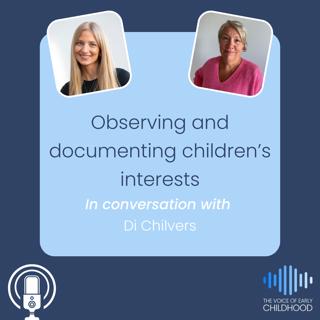
On this episode Angelica talks to Di Chilvers, who is an Independent Advisory Consultant in early childhood education having worked in the early years sector for over 45 years as a Nursery Nurse, Teacher, Senior Lecturer, Adviser and National Strategies Regional Adviser.

Di has created an assessment tool called the Development Map, which is a holistic, child centred way of mapping children's development and progress. She is also the creator of The Observation Toolkit, which she touches on in this episode.

Angelica asks Di - what should we choose to observe? We are constantly observing children, but what should we really focus on? How do we know what children's interests truly are, and which ones should we follow? And amongst all of the workload pressures, what and how do we record and document our observations?

Di talks about observation in action, activity based interests, 'interests in motion', a fluid curriculum, working theories and much more...

Episode breakdown:

02:30 - The starting point is observations
06:27 - Observation, assessment and planning at the centre
07:00 - Child-centred practice through the lens of observations
09:10 - Statutory duty to observe - Observe, assess, plan
10:00 - Observing during continuous provision is vital
11:10 - Should we observe during pre-prepared activities?
13:00 - Observing for outcomes and statements
16:30 - Observation in action - What does it actually look like?
18:20 - The traditional view of how we record observations
20:00 - You don't need to write all observations down
24:20 - Working smarter not harder!
25:20 - Documenting with photos
28:30 - Observations and interests informing the curriculum
29:20 - A fluid curriculum and letting observations spiral
30:50 - Learning in action boards
32:50 - Activity based interests and superficial observations
35:00 - Working theories and 'interests in motion'
40:00 - Floor books and observation, assessment and planning in action
41:40 - Children's Development Maps and The Observation Toolkit
44:45 - Can you talk about your observations to parents, your SLT and Ofsted

47:20 - Observing children is a privilege - Listening to children's voices
47:40 - The pedagogy of listening - The 100 languages

Find out more on The Voice of Early Childhood website: www.thevoiceofearlychildhood.com

Det här avsnittet är hämtat från ett öppet RSS-flöde och publiceras inte av Podme. Det kan innehålla reklam.

Avsnitt(172)

Are our expectations of children in early childhood evidence informed?

Are our expectations of children in early childhood evidence informed?

What does it really mean for a child to be 'school ready', and are the expectations we place on children actually informed by evidence? Adam Marycz explores how policy, accountability and long-held as...

22 Sep 46min
Reimagining outdoor learning: Understanding agency from risk to resilience

Reimagining outdoor learning: Understanding agency from risk to resilience

This podcast episode and article are a research-informed exploration of how outdoor environments, adult language and risk narratives shape children's agency. Drawing on the Reimagining Outdoor Learni...

14 Sep 42min
Marketing your early childhood setting is an investment, not a cost

Marketing your early childhood setting is an investment, not a cost

This article and podcast episode explore why marketing should be viewed as an investment rather than a cost, why profitability matters for sustainability, the role a setting's website plays in both oc...

7 Sep 39min
Beyond the diagnosis: Navigating the SEND journey with families

Beyond the diagnosis: Navigating the SEND journey with families

Receiving a SEND diagnosis is a transformative moment for families. This podcast episode and article explore how practitioners bridge the gap between statutory requirements and empathetic support, emp...

31 Aug 24min
Early childhood safeguarding changes 2026: Moving beyond compliance to a culture of safety

Early childhood safeguarding changes 2026: Moving beyond compliance to a culture of safety

Maggie Bolger and Ann Marie Christian explore the changing safeguarding landscape in early childhood, including KCSIE, the EYFS, safer recruitment, reporting concerns and the September changes. They a...

24 Aug 1h 2min
From Behaviour to signal: A different way to understand children

From Behaviour to signal: A different way to understand children

Many childhood behaviours labelled as difficult, oppositional or defiant may make far more sense than we realise. This article and podcast episode explore a biological perspective on defiance, screens...

18 Aug 56min
The brain that loves to laugh

The brain that loves to laugh

Laughter is often treated as a pleasant extra, or even a distraction from learning. Drawing on their work across psychology, education, health and community contexts, Dr Jacqueline Harding and Dr Jawa...

17 Aug 46min
The hidden hearing crisis in early years – and the free solution every nursery can use

The hidden hearing crisis in early years – and the free solution every nursery can use

Too many children are quietly struggling to hear in early years settings, and it is often missed until their speech, learning and behaviour are already affected. This article and podcast episode share...

3 Aug 34min

Populärt inom Utbildning

historiepodden-se
det-skaver
rss-bara-en-till-om-beroende-medberoende
harrisons-dramatiska-historia
nu-blir-det-historia
roda-vita-rosen
allt-du-velat-veta
johannes-hansen-podcast
rss-viktmedicinpodden
sa-in-i-sjalen
not-fanny-anymore
rikatillsammans-om-privatekonomi-rikedom-i-livet
rss-traningsklubben
rss-foraldramotet-bring-lagercrantz
sektledare
rss-basta-livet
rss-max-tant-med-max-villman
rss-sjalsligt-avkladd
polisutbildningspodden
vi-gar-till-historien