Cloud-Native Considerations for SMBs with Apurva Joshi

Cloud-Native Considerations for SMBs with Apurva Joshi

The conversation covers:


  • The difference between cloud computing and cloud-native, according to AJ
  • Whether it’s possible to have a cloud-native application that runs on-premise
  • The types of conversations that AJ has with customers, as VP of product. AJ also talks about the different types of customers that DigitalOcean serves.
  • How the needs of smaller teams tend to differ from the needs of enterprise users — and the challenges that smaller teams face when learning and implementing cloud-native applications.
  • Making decisions when using Kubernetes, and how it can be overwhelming due to the sheer number of choices that you can make.
  • Some of the main motivations that are driving smaller companies to Kubernetes. AJ also explains what he thinks is the best rationale for using Kubernetes.
  • Popular misconceptions about cloud-native and Kubernetes that AJ is seeing.
  • Why customers often struggle to make technology decisions to support their business goals.
  • AJ’s advice for businesses when making technology decisions.
  • Why startups are encouraged to start by using open source — and why open source wins in the end when compared to proprietary solutions.


Links


Transcript


Emily: Hi everyone. I’m Emily Omier, your host, and my day job is helping companies position themselves in the cloud-native ecosystem so that their product’s value is obvious to end-users. I started this podcast because organizations embark on the cloud naive journey for business reasons, but in general, the industry doesn’t talk about them. Instead, we talk a lot about technical reasons. I’m hoping that with this podcast, we focus more on the business goals and business motivations that lead organizations to adopt cloud-native and Kubernetes. I hope you’ll join me.


Emily: Welcome to The Business of Cloud Native. I'm Emily Omier, your host, and today I'm chatting with AJ. AJ, can you go ahead and introduce yourself?


AJ: Hey, I'm AJ. I’m vice president of product for DigitalOcean. I've been with the company for about 15 months. Before that, I spent about a couple of decades with Microsoft. I was fortunate to work on Azure for the last decade, and I had the opportunity to build some cloud services with the company.


Emily: And thank you so much for joining us.


AJ: Thank you, thank you for having me.


Emily: I always like to start out by asking, what do you actually do? What does a day look like?


AJ: [laughs]. It’s an interesting question. So, yes, the day is usually all over the place depending on the priorities and things that are in motion for a given quarter or a week, per se. But usually, my days involve working with the team around the strategic initiatives that have been planned, driving clarity around different projects that I [unintelligible]. Mainly working with leadership on defining some of the roadmap for the product as well as the company. And yeah, and talking to lots of customers. That's something that I really, really enjoy. And every other day I have a meeting or two talking to our customers, learning from them, how they use our products and how can we get better.


Emily: I'm going to ask more about those conversations with customers because that's what I find really interesting. But first, actually, I wanted to start with another question. What do you see as the difference between cloud computing and cloud-native?


AJ: The difference essentially, in a way, the cloud computing is a much bigger umbrella around how we as a technology industry are enabling other businesses to bring their workload to a more scalable, more efficient, more secure environment versus trying to host, optimize, or do things by themselves. And the cloud-native, in a way, it's a subset of a cloud computing where not necessarily you always have to have existing workloads or something that is prior technology that has been already built and you're looking for a place to host. In a way, when you're building something out, new, greenfield apps and whatnot, you're starting from scratch, you're building your applications and solutions that are cloud-native by definition. They're built for Cloud; they're born in Cloud, and are optimizing the latest and the greatest innovations that are present and as future-looking to help you scale and succeed your business, in a way.


Emily: Do you think it's possible to have a cloud-native application that runs on-premise?


AJ: There's a lot of [laughs] innovations happening in pockets, and especially from the top providers to enable those scenarios. But at the end of the day, those investments are essentially driven to help people and companies, especially on the larger scale, to buy some time to completely move to the public cloud where the industry takes their time to come up with the compliance, security requirements and [unintelligible]. So, you'll start to see—you might have heard about some of the investments these top cloud providers are doing about allowing and bringing those similar stack and technologies that they are building in a public cloud to on-premise or running on their own data center, in a way. So, it is possible, in bits and pockets to start with a cloud-native to run, on-premise, but that customer segment and the target is very, very different than the ones that start in a public cloud first.


Emily: I want to switch to talking about some of the conversations that you have with customers. I really like to understand what end users are thinking. What would you say when you talk to customers? What's the thing that they're most excited about?


AJ: Right. So, it depends on what segment of customers you're speaking with, right? DigitalOcean serves a very different set of customers than a typical large cloud providers do. We're focused more on individual developers, small startups, or SMBs. Again, when I say SMBs, it's a broad term, when I say SMBs the S with [unintelligible].


So, we focus mainly on two to ten devs team, and smaller companies and whatnot. So, their requirements are very different; their needs are very unique compared to what I used to talk, back in my past life, with enterprise customers. Their requirements are very unique and different as well. So, what I hear from the customers that I speak with recently, and have been speaking with for last over a year, is how can I make my business that is [unintelligible] on a cloud? And what I mean by that is how do I build solutions that are simple, easy to understand, and where I'm focused on building software and not really worrying about the complexity of the infrastructure, at the same time, keep the price in control and very simple and predictable.


And that resonates really, really well. The tons and tons of customers that I spoke with recently, they moved from large cloud providers to our platform because their business was not viable on those cloud providers. And what I mean by that...

Det här avsnittet är hämtat från ett öppet RSS-flöde och publiceras inte av Podme. Det kan innehålla reklam.

Avsnitt(275)

From Closed to Open: Shortening Sales Cycles with Stephen Goldberg

From Closed to Open: Shortening Sales Cycles with Stephen Goldberg

This week on The Business of Open Source, I chatted with Stephen Goldberg, co-founder of Harper, about the process of taking Harper from a closed-source software company to a open source company. I al...

6 Juli 33min
Does AI Make Open Core Models More Difficult? with Sam Alba

Does AI Make Open Core Models More Difficult? with Sam Alba

Today on The Business of Open Source I spoke with Sam Alba, co-founder of Mendral, formerly of Dagger, and the first hire at Docker. We talked a lot about about how AI is changing the developer tools ...

2 Juli 39min
Closed to Open Source Series: Doing Open Source "Right" with Ethan Arrowood

Closed to Open Source Series: Doing Open Source "Right" with Ethan Arrowood

One of the myths that swirl around the open source company ecosystem is that all open source companies started as an open source project that then suddenly got traction, and followed by the founders f...

22 Juni 40min
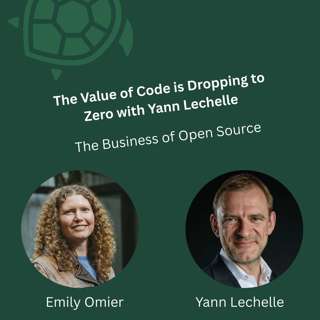
The Value of Code is Dropping to Zero with Yann Lechelle

The Value of Code is Dropping to Zero with Yann Lechelle

In this episode of The Business of Open Source, I talked with Yann Lechelle, Executive President of :Probabl.Perhaps the most interesting part of the conversation was about whether or not there is a r...

15 Juni 42min

Why the World Needs the Agentic AI Foundation with Manik Surtani

Why the World Needs the Agentic AI Foundation with Manik Surtani

In this episode of The Business of Open Source, I spoke with Manik Surtani, one of the co-founders of the Agentic AI Foundation and the CTO at the foundation. This is part of the series I’m working on...

8 Juni 34min

The AI-Induced Death of A Bug Bounty Program with Glauber Costa

The AI-Induced Death of A Bug Bounty Program with Glauber Costa

The Business of Open Source is back! I’m starting a series about AI and open source this week. I reached out to Glauber Costa, founder of Turso, after reading a post of his on LinkedIn about how bot-w...

1 Juni 43min

Changing Your Price Anchor with Anais Concepcion

Changing Your Price Anchor with Anais Concepcion

There’s a new episode of The Business of Open Source today! It’s been a while. I talked with Anais Concepcion about a program she’s been testing at Grist to give free activation codes for the enterpri...

11 Feb 32min

Earning Trust with Tom Hacohen

Earning Trust with Tom Hacohen

This week on The Business of Open Source, I spoke with Tom Hacohen, CEO and founder at Svix. We kicked off the conversation by talking about why Svix is an open core company… but Tom still initially d...

8 Okt 202535min

Populärt inom Business & ekonomi

badfluence
framgangspodden
varvet
dynastin
svd-tech-brief
uppgang-och-fall
rss-borsens-finest
avanzapodden
rss-inga-dumma-fragor-om-pengar
bathina-en-podcast
rss-dagen-med-di
tabberaset
fill-or-kill
market-makers
borslunch-2
rss-kort-lang-analyspodden-fran-di
lastbilspodden
rikatillsammans-om-privatekonomi-rikedom-i-livet
rss-dominoeffekten
rss-hos-psykologen