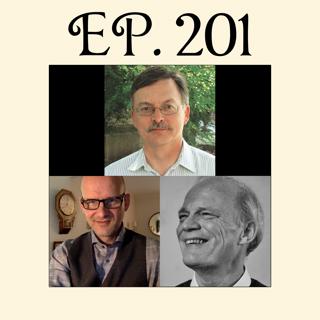
84: Henrik Jensen and David Dolan
HMA Podcast31 Dec 2019

84: Henrik Jensen and David Dolan

We have a very special show today, returning to the show the master classical improviser Professor David Dolan, from the Guildhall School of Music and Drama.

Also joining the program is Professor Henrik Jensen, from the Department of Mathematics at the Imperial College of London. He leads the Centre for Complexity Science, which engages in a range of research into the applied and fundamental aspects of complexity science.

For today's show, we'll be diving into the fascinating collaborative research that my two guests have doing for the last 10 years, involving studying the brain with improvised and non-improvised music and how it functions during each activity, quantifying improvisatory behavior, improvisation and communication between brains.

-----

1:13 How did you come up with the idea of the project?
2:35 Talking about levels of synchronization
4:43 Deriving information from the EEGs
7:01 Were the musicians from Guildhall?
7:36 Talking about the instrumentation of the players
7:51 Did you need a harmonic player like a harpist to provide structure?
8:55 Talking about the selection of the music
10:55 Million dollar question: Is the brain radically different between improvising and non-improvising musicians?
13:09 What does the index mean?
14:06 Talking about the Strict phase and the Let Go phase
17:02 In the Strict phase, was the music sight read or memorized?
18:12 How is memory different between the two phases?
19:11 Talking about sustained attention
22:58 Is the brain being used more when improvising or less, is the brain more relaxed during improvising?
25:46 Discussing levels of comfort and familiarity with improvisation?
27:20 The difference in brain function in the speed of the improvisation
31:26 What is happening when the brain is undergoing a "magic moment"?
32:39 Did you tell the audience that the improvisation was a secret?
33:07 Talking about the listener's experience during improvisation and non-improvisation
34:42 The Let Go portion had more interest in the listeners
35:29 If you could re-do the experiment with unlimited funding, what would you do?
36:48 If you had told the audience there was improvisation, would it have affected their answers?
38:19 Is the idea that Strict a left brain thing and Let Go a right brain thing a myth?
39:52 Is it just more fun to improvise?
41:53 What can you recommend people check out to follow up on this research?
45:21 Any other key takeaways from this research that we should mention?
46:30 What hypotheses do you suspect are the possible conclusions of this research?
49:37 Wrapping Up

Avsnitt(84)

201: Counterpoint Panel: Why "Harmony" Classes Fail, Fux Myths, Bach Traps & Better Methods

201: Counterpoint Panel: Why "Harmony" Classes Fail, Fux Myths, Bach Traps & Better Methods

Counterpoint is the "huge topic" that crowns the Neapolitan method and the Paris Conservatoire tradition—and yet it's often taught today in ways that leave students confused, discouraged, and musicall...

5 Jan 1h 24min

182: Giovanna Barbati (Partimento and Improvisation on the Cello)

182: Giovanna Barbati (Partimento and Improvisation on the Cello)

Today I speak to cellist and viola da gamba player Giovanna Barbati, whose repertoire extends from early to contemporary music and who has a special interest in improvisation. She appears frequently a...

3 Juni 20241h 41min

144: Sietze de Vries (Classical Improviser, Organist)

144: Sietze de Vries (Classical Improviser, Organist)

Professor Sietze de Vries, famed for his mastery in classical improvisation, joins the show to talk about his education, training, approach to music, music education, and demonstrates classical improv...

17 Maj 20241h 37min

158: Nicholas Baragwanath (Hexachordal Italian Solfeggio)

158: Nicholas Baragwanath (Hexachordal Italian Solfeggio)

Professor Nicholas Baragwanath, author of the groundbreaking "Solfeggio Tradition" (published by Oxford University Press), returns to the show to talk about Hexachordal Italian Solfeggio. This was the...

17 Maj 20241h 9min

157: Ewald Demeyere (Fedele Fenaroli's Partimenti and Pedagogy)

157: Ewald Demeyere (Fedele Fenaroli's Partimenti and Pedagogy)

Professor Ewald Demeyere returns on the show to discuss his critical edition of Fenaroli's partimenti collection and discusses Fenaroli's approach to pedagogy and partimento realization.

1 Apr 20241h 59min

154: Partimento Panel (Gjerdingen, Sanguinetti, van Tour, Cafiero)

154: Partimento Panel (Gjerdingen, Sanguinetti, van Tour, Cafiero)

In this episode, I am joined by eminent professors Robert O. Gjerdingen, Giorgio Sanguinetti, Peter van Tour, and Rosa Cafiero, in a special panel session about the subject of partimento. We discuss t...

1 Mars 20241h 32min

174: Niels Berentsen (1300-1500 Polyphony | Improvising Vocal Counterpoint)

174: Niels Berentsen (1300-1500 Polyphony | Improvising Vocal Counterpoint)

I talk to Professor Niels Berentsen about the beginnings of improvised counterpoint, the reconstruction of incomplete music by Johannes Ciconia, computational analysis of counterpoint, teaching 15th/1...

1 Feb 20241h 19min

167: Solfeggio Panel (Baragwanath, Gjerdingen, IJzerman, van Tour)

167: Solfeggio Panel (Baragwanath, Gjerdingen, IJzerman, van Tour)

Today we have a special episode dedicated to Solfeggio, featuring Professors Nicholas Baragwanath, Job IJzerman, Robert O. Gjerdingen, and Peter van Tour. The famed students of the 18th-century Neapol...

1 Feb 20241h 23min

Populärt inom Utbildning

historiepodden-se
rss-bara-en-till-om-missbruk-medberoende-2
det-skaver
nu-blir-det-historia
harrisons-dramatiska-historia
not-fanny-anymore
rss-viktmedicinpodden
johannes-hansen-podcast
allt-du-velat-veta
rss-foraldramotet-bring-lagercrantz
sektledare
roda-vita-rosen
i-vantan-pa-katastrofen
sa-in-i-sjalen
rss-max-tant-med-max-villman
rss-sjalsligt-avkladd
rikatillsammans-om-privatekonomi-rikedom-i-livet
sex-pa-riktigt-med-marika-smith
rss-relationsrevolutionen
rss-pa-insidan-med-bjorn-rudman