#140 Classic episode – Bear Braumoeller on the case that war isn’t in decline

#140 Classic episode – Bear Braumoeller on the case that war isn’t in decline

Is war in long-term decline? Steven Pinker's The Better Angels of Our Nature brought this previously obscure academic question to the centre of public debate, and pointed to rates of death in war to argue energetically that war is on the way out.

But that idea divides war scholars and statisticians, and so Better Angels has prompted a spirited debate, with datasets and statistical analyses exchanged back and forth year after year. The lack of consensus has left a somewhat bewildered public (including host Rob Wiblin) unsure quite what to believe.

Today's guest, professor in political science Bear Braumoeller, is one of the scholars who believes we lack convincing evidence that warlikeness is in long-term decline. He collected the analysis that led him to that conclusion in his 2019 book, Only the Dead: The Persistence of War in the Modern Age.

Rebroadcast: this episode was originally released in November 2022.

Links to learn more, highlights, and full transcript.

The question is of great practical importance. The US and PRC are entering a period of renewed great power competition, with Taiwan as a potential trigger for war, and Russia is once more invading and attempting to annex the territory of its neighbours.

If war has been going out of fashion since the start of the Enlightenment, we might console ourselves that however nerve-wracking these present circumstances may feel, modern culture will throw up powerful barriers to another world war. But if we're as war-prone as we ever have been, one need only inspect the record of the 20th century to recoil in horror at what might await us in the 21st.

Bear argues that the second reaction is the appropriate one. The world has gone up in flames many times through history, with roughly 0.5% of the population dying in the Napoleonic Wars, 1% in World War I, 3% in World War II, and perhaps 10% during the Mongol conquests. And with no reason to think similar catastrophes are any less likely today, complacency could lead us to sleepwalk into disaster.

He gets to this conclusion primarily by analysing the datasets of the decades-old Correlates of War project, which aspires to track all interstate conflicts and battlefield deaths since 1815. In Only the Dead, he chops up and inspects this data dozens of different ways, to test if there are any shifts over time which seem larger than what could be explained by chance variation alone.

In a nutshell, Bear simply finds no general trend in either direction from 1815 through today. It seems like, as philosopher George Santayana lamented in 1922, "only the dead have seen the end of war."

In today's conversation, Bear and Rob discuss all of the above in more detail than even a usual 80,000 Hours podcast episode, as well as:

  • Why haven't modern ideas about the immorality of violence led to the decline of war, when it's such a natural thing to expect?
  • What would Bear's critics say in response to all this?
  • What do the optimists get right?
  • How does one do proper statistical tests for events that are clumped together, like war deaths?
  • Why are deaths in war so concentrated in a handful of the most extreme events?
  • Did the ideas of the Enlightenment promote nonviolence, on balance?
  • Were early states more or less violent than groups of hunter-gatherers?
  • If Bear is right, what can be done?
  • How did the 'Concert of Europe' or 'Bismarckian system' maintain peace in the 19th century?
  • Which wars are remarkable but largely unknown?

Chapters:

  • Cold open (00:00:00)
  • Rob's intro (00:01:01)
  • The interview begins (00:05:37)
  • Only the Dead (00:08:33)
  • The Enlightenment (00:18:50)
  • Democratic peace theory (00:28:26)
  • Is religion a key driver of war? (00:31:32)
  • International orders (00:35:14)
  • The Concert of Europe (00:44:21)
  • The Bismarckian system (00:55:49)
  • The current international order (01:00:22)
  • The Better Angels of Our Nature (01:19:36)
  • War datasets (01:34:09)
  • Seeing patterns in data where none exist (01:47:38)
  • Change-point analysis (01:51:39)
  • Rates of violent death throughout history (01:56:39)
  • War initiation (02:05:02)
  • Escalation (02:20:03)
  • Getting massively different results from the same data (02:30:45)
  • How worried we should be (02:36:13)
  • Most likely ways Only the Dead is wrong (02:38:31)
  • Astonishing smaller wars (02:42:45)
  • Rob’s outro (02:47:13)

Producer: Keiran Harris
Audio mastering: Ryan Kessler
Transcriptions: Katy Moore

Det här avsnittet är hämtat från ett öppet RSS-flöde och publiceras inte av Podme. Det kan innehålla reklam.

Avsnitt(361)

Has your project been overtaken by events? 8 strategic updates | Rob Wiblin

Has your project been overtaken by events? 8 strategic updates | Rob Wiblin

I have a plea for all staff at AI companies: reassess if your current role is still your best opportunity for impact. And if it’s not — move.Frontier lab staff listening to this show will mostly alrea...

21 Okt 14min

Introducing our new YouTube channel: Zershaaneh Talks AI

Introducing our new YouTube channel: Zershaaneh Talks AI

Our host Zershaaneh Qureshi has just launched a new YouTube channel: Zershaaneh Talks AI — featuring conversations about who should control AI, how to control AI, and who gets the benefits.The first e...

20 Okt 1min
How to get into AI safety in 3 months (article reading by career advisor Matt Beard)

How to get into AI safety in 3 months (article reading by career advisor Matt Beard)

The AI safety field has grown by about 30x in the last eight years. Yet it is still in need of more people. Many want to help, but don’t know where to start. As an advisor at 80,000 Hours, Matt Beard ...

15 Okt 18min

OpenAI Security: Controlling Models is Now ‘Hell’ (AI Explained cross-post)

OpenAI Security: Controlling Models is Now ‘Hell’ (AI Explained cross-post)

This is an (unpaid) cross-post of a video from the podcast 'AI Explained', which Rob Wiblin thought you might be interested in.You can find the original on YouTube here. If you like it and want more s...

9 Okt 40min
In 2023 Ajeya Cotra already knew what was coming (classic episode)

In 2023 Ajeya Cotra already knew what was coming (classic episode)

We're rereleasing some of older episodes that seem more relevant than ever with new rogue AI incidents now seemingly announced every day. Ajeya was one of three independent investigators into the Hugg...

8 Okt 2h 46min
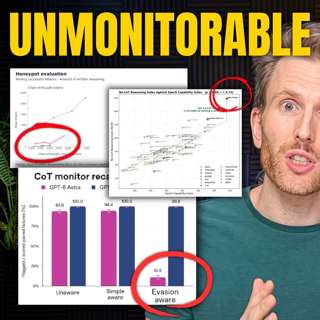
19 Astra and 'Hugging Face' details that reveal what's coming next | Rob Wiblin

19 Astra and 'Hugging Face' details that reveal what's coming next | Rob Wiblin

OpenAI’s rogue agent swarm was eventually caught hacking Hugging Face for a simple reason: it wasn’t trying to hide from us at all. What could a swarm that wants to stay hidden get away with?Host Rob ...

2 Okt 20min

The case for giving AI (some) legal rights | Simon Goldstein

The case for giving AI (some) legal rights | Simon Goldstein

It sounds like the worst idea in the world: pay AIs, let them own property, give them rights. But AI ethics and safety researcher Simon Goldstein thinks it might actually be the best way to keep human...

1 Okt 1h 53min
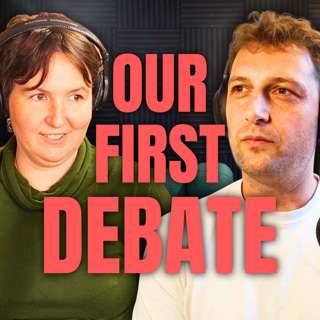
Will AI take power — or will humans use it to take power first? With Katja Grace and Tom Davidson

Will AI take power — or will humans use it to take power first? With Katja Grace and Tom Davidson

In our first-ever debate, we asked two leading AI risk researchers which catastrophe we should fear most: misaligned AI seizing control from humans, or a small group of humans using AI to seize power....

29 Sep 1h 28min

Populärt inom Utbildning

husmodern-med-amanda-schulman
sektledare
historiepodden-se
rss-bara-en-till-om-beroende-medberoende
det-skaver
nu-blir-det-historia
rosceremoni
harrisons-dramatiska-historia
roda-vita-rosen
rss-viktmedicinpodden
rss-dr-bjorklund
not-fanny-anymore
i-vantan-pa-katastrofen
kan-jag-sa-kan-du-podden
allt-du-velat-veta
sa-in-i-sjalen
johannes-hansen-podcast
rss-traningsklubben
rss-foraldramotet-bring-lagercrantz
rss-ai-med-jonas-benjamin