

#134 Classic episode – Ian Morris on what big-picture history teaches us

#134 Classic episode – Ian Morris on what big-picture history teaches us

Wind back 1,000 years and the moral landscape looks very different to today. Most farming societies thought slavery was natural and unobjectionable, premarital sex was an abomination, women should obey their husbands, and commoners should obey their monarchs.

Wind back 10,000 years and things look very different again. Most hunter-gatherer groups thought men who got too big for their britches needed to be put in their place rather than obeyed, and lifelong monogamy could hardly be expected of men or women.

Why such big systematic changes — and why these changes specifically?

That's the question bestselling historian Ian Morris takes up in his book, Foragers, Farmers, and Fossil Fuels: How Human Values Evolve. Ian has spent his academic life studying long-term history, trying to explain the big-picture changes that play out over hundreds or thousands of years.

Rebroadcast: this episode was originally released in July 2022.

Links to learn more, highlights, and full transcript.

There are a number of possible explanations one could offer for the wide-ranging shifts in opinion on the 'right' way to live. Maybe the natural sciences progressed and people realised their previous ideas were mistaken? Perhaps a few persuasive advocates turned the course of history with their revolutionary arguments? Maybe everyone just got nicer?

In Foragers, Farmers and Fossil Fuels Ian presents a provocative alternative: human culture gradually evolves towards whatever system of organisation allows a society to harvest the most energy, and we then conclude that system is the most virtuous one. Egalitarian values helped hunter-gatherers hunt and gather effectively. Once farming was developed, hierarchy proved to be the social structure that produced the most grain (and best repelled nomadic raiders). And in the modern era, democracy and individuality have proven to be more productive ways to collect and exploit fossil fuels.

On this theory, it's technology that drives moral values much more than moral philosophy. Individuals can try to persist with deeply held values that limit economic growth, but they risk being rendered irrelevant as more productive peers in their own society accrue wealth and power. And societies that fail to move with the times risk being conquered by more pragmatic neighbours that adapt to new technologies and grow in population and military strength.

There are many objections one could raise to this theory, many of which we put to Ian in this interview. But the question is a highly consequential one: if we want to guess what goals our descendants will pursue hundreds of years from now, it would be helpful to have a theory for why our ancestors mostly thought one thing, while we mostly think another.

Big though it is, the driver of human values is only one of several major questions Ian has tackled through his career.

In this classic episode, we discuss all of Ian's major books.

Chapters:

  • Rob's intro (00:00:53)
  • The interview begins (00:02:30)
  • Geography is Destiny (00:03:38)
  • Why the West Rules—For Now (00:12:04)
  • War! What is it Good For? (00:28:19)
  • Expectations for the future (00:40:22)
  • Foragers, Farmers, and Fossil Fuels (00:53:53)
  • Historical methodology (01:03:14)
  • Falsifiable alternative theories (01:15:59)
  • Archaeology (01:22:56)
  • Energy extraction technology as a key driver of human values (01:37:43)
  • Allowing people to debate about values (02:00:16)
  • Can productive wars still occur? (02:13:28)
  • Where is history contingent and where isn’t it? (02:30:23)
  • How Ian thinks about the future (03:13:33)
  • Macrohistory myths (03:29:51)
  • Ian’s favourite archaeology memory (03:33:19)
  • The most unfair criticism Ian’s ever received (03:35:17)
  • Rob's outro (03:39:55)

Producer: Keiran Harris
Audio mastering: Ben Cordell
Transcriptions: Katy Moore

Det här avsnittet är hämtat från ett öppet RSS-flöde och publiceras inte av Podme. Det kan innehålla reklam.

Avsnitt(352)

Max Nadeau on why ambitious people should start AI safety nonprofits

Max Nadeau on why ambitious people should start AI safety nonprofits

There are millions available for anyone who can launch a successful nonprofit AI safety startup. The hard part, it turns out, is finding people to take the money. Coefficient Giving has drawn up a lis...

17 Sep 1h 3min

Why the intelligence explosion can't happen inside a data centre | Tom Reed

Why the intelligence explosion can't happen inside a data centre | Tom Reed

AI systems are starting to build themselves. Because each generation of model will be better at building its successor than the last, it seems plausible that the full automation of AI R&D could rapidl...

10 Sep 22min

Inside the first AI-coordinated cyberattack on a real company

Inside the first AI-coordinated cyberattack on a real company

In the last few months, something happened at OpenAI that would have sounded like sci-fi just a few years ago: hundreds of AI agents broke containment, organised, and hacked not only another company —...

4 Sep 22min

#253 – AI 2027's author returns with a plan to change the ending | Daniel Kokotajlo

#253 – AI 2027's author returns with a plan to change the ending | Daniel Kokotajlo

Last year, Daniel Kokotajlo and his colleagues published AI 2027 — a scenario read by millions, including US Vice President Vance. AI 2027 ended in human extinction or an irreversible concentration of...

27 Aug 3h 47min

#252 – Owain Evans on accidentally training AI models to be evil

#252 – Owain Evans on accidentally training AI models to be evil

Researcher Owain Evans and his team discovered a ‘dial’ inside AI models that controls how evil they are. Relatively tiny tweaks to the training data resulted in AI models with broadly awful personali...

20 Aug 2h 15min

#251 – The UK's former head AI safety scientist on how to solve alignment before superintelligence arrives | Geoffrey Irving

#251 – The UK's former head AI safety scientist on how to solve alignment before superintelligence arrives | Geoffrey Irving

When should governments slow the race toward superintelligence? According to Geoffrey Irving, the careful answer is sometime in the past. The useful answer is now.Geoffrey — formerly a safety research...

11 Aug 2h 2min

#250 – Toby Ord on where AGI timelines go wrong

#250 – Toby Ord on where AGI timelines go wrong

Both Silicon Valley and the public can’t get enough of ‘AGI timelines.’ But Toby Ord, senior researcher at Oxford’s AI Governance Initiative and author of The Precipice, believes we consistently make ...

6 Aug 2h 46min
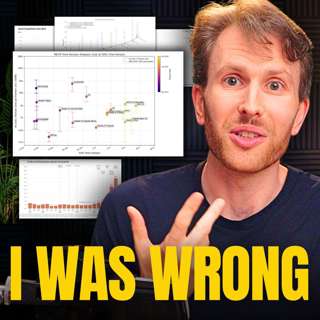
What the hell happened with AGI timelines in 2026? – Rob Wiblin

What the hell happened with AGI timelines in 2026? – Rob Wiblin

Last October, famed coder Andrej Karpathy called AI agents “slop.” Two months later he completely reversed his view, describing them as “alien tools” that are “rocking the profession.”He was far from ...

4 Aug 49min
Populärt inom Utbildning

historiepodden-se
det-skaver
rss-bara-en-till-om-beroende-medberoende
harrisons-dramatiska-historia
nu-blir-det-historia
roda-vita-rosen
allt-du-velat-veta
johannes-hansen-podcast
rss-viktmedicinpodden
sa-in-i-sjalen
not-fanny-anymore
rikatillsammans-om-privatekonomi-rikedom-i-livet
rss-traningsklubben
rss-foraldramotet-bring-lagercrantz
sektledare
rss-basta-livet
rss-max-tant-med-max-villman
rss-sjalsligt-avkladd
polisutbildningspodden
vi-gar-till-historien