Why Nobody Says 'You're Welcome' Anymore. Whose. Chimichanga.

Why Nobody Says 'You're Welcome' Anymore. Whose. Chimichanga.

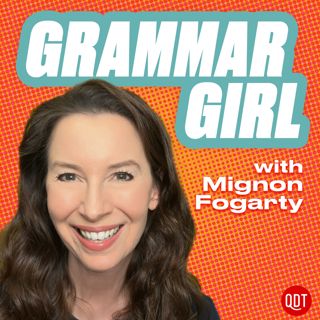
884. People often ask why people say "no worries" or "no problem" instead of "you're welcome," and we actually found an answer! Also, we look at whether it's OK to use "whose" for inanimate objects in a sentence such as "The chair whose legs are broken."

Transcript: https://grammar-girl.simplecast.com/episodes/why-nobody-says-youre-welcome-anymore-whose-chimichanga

| Subscribe to the newsletter for regular updates.

| Watch my LinkedIn Learning writing course.

| Peeve Wars card game.

| Grammar Girl books.

| HOST: Mignon Fogarty

| VOICEMAIL: 833-214-GIRL (833-214-4475)

| Grammar Girl is part of the Quick and Dirty Tips podcast network.

| Theme music by Catherine Rannus at beautifulmusic.co.uk.

| Grammar Girl Social Media Links:

https://www.quickanddirtytips.com/podcasts

https://www.tiktok.com/@therealgrammargirl

http://twitter.com/grammargirl

http://facebook.com/grammargirl

http://instagram.com/thegrammargirl

https://www.linkedin.com/company/grammar-girl

References for the "you're welcome" segment by Valerie Fridland:

Aijmer, Karin. 1996. Conversational routines in English: Convention and creativity. London et al.: Longman.

Dinkin, Aaron. J. 2018. It's no problem to be polite: Apparent‐time change in responses to thanks. Journal of Sociolinguistics 22(2): 190-215.

Jacobsson, M. 2002. Thank you and thanks in Early Modern English. ICAME Journal 26: 63-80.

Rüegg, Larssyn. 2014. Thanks responses in three socio-economic settings: A variational pragmatics approach. Journal of Pragmatics 71. pp. 17–30.

Schneider, Klaus P. 2005. ‘No problem, you’re welcome, anytime’: Responding to thanks in Ireland, England, and the U.S.A. In Anne Barron & Klaus P. Schneider (eds.), The pragmatics of Irish English, Berlin & New York: Mouton de Gruyter. pp. 101–139.

References for the "whose" segment by Bonnie Mills:

American Heritage Guide to Contemporary Usage and Style. 2005. Boston: Houghton Mifflin Company, pp. 505-6.

American Heritage Dictionary of the English Language. Fourth edition. 2006. Boston: Houghton Mifflin Company, p. 1965.

Burchfield, R. W, ed. 1996. The New Fowler’s Modern English Usage. Third edition. New York: Oxford, p. 563.

Hosted on Acast. See acast.com/privacy for more information.

Avsnitt(1012)

Is the Academy Awards singular or plural? Writing about time.

Is the Academy Awards singular or plural? Writing about time.

1166. This week, we look the grammar of the Academy Awards and how to avoid an "illogical plot twist" in your sentences. Then, we look at common time-related redundancies like "period of time," the pr...

10 Mars 17min
Mapping the American Tongue: The Dictionary of American Regional English (DARE), with Joan Houston Hall

Mapping the American Tongue: The Dictionary of American Regional English (DARE), with Joan Houston Hall

1165. Today, we talk with Joan Houston Hall to look at the monumental task of documenting how Americans speak. We look at the Dictionary of American Regional English (DARE), exploring the unique folk ...

5 Mars 38min
The history of the octothorpe. Sir Fragalot and sentence fragments. Dribzle.

The history of the octothorpe. Sir Fragalot and sentence fragments. Dribzle.

1164. This week, we look at the origin of the octothorpe — also known as the pound sign or hashtag — and why it has so many different names. Then, we look at sentence fragments and the secret of "Sir ...

3 Mars 16min
How 'be like' took over the world, with Sali Tagliamonte

How 'be like' took over the world, with Sali Tagliamonte

1163. This week, we look at what it’s like to be a "language detective" with Sali Tagliamonte and how she used her own teenagers as a research lab. We look at a 25-year study on how the phrase "be lik...

26 Feb 26min
Why 'Tonka' sounds big and 'bitty' sounds small. Why you CAN start a sentence with 'because.'

Why 'Tonka' sounds big and 'bitty' sounds small. Why you CAN start a sentence with 'because.'

1162. This week, we look at why some names just "feel right" while others don't and how vowels like "ee" create associations with smallness and sweetness while back vowels like "ah" sound bigger and m...

24 Feb 13min
WHY WE USE ALL CAPS TO SHOUT, with Glenn Fleishman

WHY WE USE ALL CAPS TO SHOUT, with Glenn Fleishman

1161. Today, we look at the history of writing in all-uppercase letters. Tech historian Glenn Fleishman explains how capitals transitioned from a sign of importance to a convention for shouting. Plus,...

19 Feb 27min
Battle of the moguls. 'Awhile' versus 'a while.' Crittador.

Battle of the moguls. 'Awhile' versus 'a while.' Crittador.

1160. This week, we look at why "mogul" means both a ski bump and a powerful person. Then, we tackle when to use "awhile" versus "a while," with a trick to help you remember.🔗 Join the Grammar Girl P...

17 Feb 13min
Writing for ‘civic clarity’ (plus, the power of short sentences), with Roy Peter Clark

Writing for ‘civic clarity’ (plus, the power of short sentences), with Roy Peter Clark

1159. This week, we look at "civic clarity" with writing instructor Roy Peter Clark in a newly edited version of our 2020 conversation. We look at the ethical code of clear communication and why "civi...

12 Feb 23min

Populärt inom Utbildning

historiepodden-se
rss-bara-en-till-om-missbruk-medberoende-2
det-skaver
alska-oss
harrisons-dramatiska-historia
allt-du-velat-veta
nu-blir-det-historia
sektledare
johannes-hansen-podcast
rss-foraldramotet-bring-lagercrantz
rss-viktmedicinpodden
roda-vita-rosen
not-fanny-anymore
i-vantan-pa-katastrofen
rss-sjalsligt-avkladd
sa-in-i-sjalen
rss-max-tant-med-max-villman
rikatillsammans-om-privatekonomi-rikedom-i-livet
rss-beratta-alltid-det-har
rss-npf-podden