
Why Today's 'Thank You' Is Different from an Ancient 'Thank You.' Gerunds.

Why Today's 'Thank You' Is Different from an Ancient 'Thank You.' Gerunds.

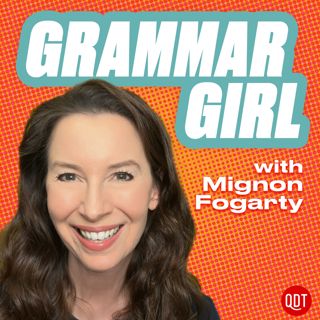
902. Language reflects culture, so it's no surprise that giving thanks hundreds of years ago was different from giving thanks today. We have the fascinating history. Plus, since "Thanksgiving" is a gerund, we looked at all the interesting things you can do with gerunds in general.

| Transcript: https://grammar-girl.simplecast.com/episodes/thank-you-history/transcript

The Thanksgiving history segment was written by Valerie Fridland, a professor of linguistics at the University of Nevada in Reno and the author of the forthcoming book, "Like, Literally Dude," about all the speech habits we love to hate. You can find her at valeriefridland.com or on Twitter at @FridlandValerie.

The gerund segment was written by Neal Whitman, an independent writer and consultant specializing in language and grammar and a member of the Reynoldsburg, Ohio, school board. You can find him on Facebook, on Twitter as @literalminded, and on his blog at literalminded.wordpress.com.

| Subscribe to the newsletter for regular updates.

| Watch my LinkedIn Learning writing courses.

| Peeve Wars card game.

| Grammar Girl books.

| HOST: Mignon Fogarty

| VOICEMAIL: 833-214-GIRL (833-214-4475) or https://sayhi.chat/grammargirl

| Grammar Girl is part of the Quick and Dirty Tips podcast network.

  • Audio engineer: Nathan Semes
  • Editor: Adam Cecil
  • Advertising Operations Specialist: Morgan Christianson
  • Marketing and Publicity Assistant: Davina Tomlin
  • Digital Operations Specialist: Holly Hutchings
  • Intern: Kamryn Lacy

| Theme music by Catherine Rannus.

| Grammar Girl Social Media Links: YouTube. TikTok. Twitter. Facebook. Instagram. LinkedIn. Mastodon.

References for the Thanksgiving history segment:

Culpeper, Jonathan and Demmen, Jane. 2011. Nineteenth-century English politeness: Negative politeness, conventional indirect requests and the rise of the individual self. Journal of Historical Pragmatics, 12 (1/2). pp. 49-81.

Jacobsson, M. 2002. Thank you and thanks in Early Modern English. ICAME Journal 26: 63-80.

Taavitsainen, Irma, Jucker, Andreas H. 2010. Expressive speech acts and politeness in eighteenth century English. In: Hickey, R. (Ed.), Eighteenth Century English: Ideology and Change. Cambridge University Press, Cambridge, pp. 159-181.

"thank, n.". OED Online. September 2022. Oxford University Press.

"welcome, n.1, adj., and int." OED Online. September 2022. Oxford University Press

Hosted on Acast. See acast.com/privacy for more information.

Avsnitt(1016)

Why Brits eat biscuits and Americans eat cookies. Why brands keep nouning everything. Hamster alert.

Why Brits eat biscuits and Americans eat cookies. Why brands keep nouning everything. Hamster alert.

This week, in honor of National Cookie Day, we look at the vocabulary split between British and American English, including the differences between a cookie and a biscuit, and the two meanings of "pud...

2 Dec 202517min

Rob Drummond on languaging and our fluid speaking identities

Rob Drummond on languaging and our fluid speaking identities

In this bonus conversation with Rob Drummond from back in June, he and I get into the fascinating concept of "languaging" — the idea that speaking is an active process we use to constantly shape and p...

27 Nov 202518min

The sinful fork (and other dinner-table surprises)

The sinful fork (and other dinner-table surprises)

1136. This week, we go full Thanksgiving, talking about the origin of butter knives, forks, and more. You'll love all the tidbits you can share with your family or friends during dinner.🔗 Share your ...

25 Nov 202514min
Why print dictionaries still matter, with Peter Sokolowski

Why print dictionaries still matter, with Peter Sokolowski

1135. This week, we talk with Peter Sokolowski, editor at large at Merriam-Webster, about the new print 12th Collegiate Dictionary. We look at why print still matters, how the dictionary used lookup d...

20 Nov 202535min

Personification in language and AI. Dictums, maxims, and proverbs. Expensitive.

Personification in language and AI. Dictums, maxims, and proverbs. Expensitive.

1134. This week, we look at the poetic power of personification (the language quirk that gives human traits to nonhuman things) and why style guides advise against using it for AI. Then, we look at th...

18 Nov 202517min

The secret rules of crossword puzzles, with Natan Last

The secret rules of crossword puzzles, with Natan Last

1133. This week, crossword pro Natan Last talks about his book "Across the Universe." We look at the technical and cultural differences between American and British puzzle styles and the secrets that ...

13 Nov 202529min

How '23 skidoo' & 'at sixes and sevens' are related to '6-7.'

How '23 skidoo' & 'at sixes and sevens' are related to '6-7.'

1132. This week, in honor of Dictionary.com choosing "6-7" as its Word of the Year, we look at the origin of other number phrases: "23 skidoo" and "at sixes and sevens."🔗 Share your familect recordin...

11 Nov 202518min

What a ‘Science' magazine experiment says about the future of AI in journalism, with Abigail Eisenstadt

What a ‘Science' magazine experiment says about the future of AI in journalism, with Abigail Eisenstadt

1131. This week, we talk with ‘Science' magazine senior writer Abigail Eisenstadt about her team's year-long experiment testing ChatGPT's ability to summarize research papers. We look at their methodo...

6 Nov 202523min

Populärt inom Utbildning

rss-bara-en-till-om-missbruk-medberoende-2
historiepodden-se
det-skaver
alska-oss
harrisons-dramatiska-historia
nu-blir-det-historia
roda-vita-rosen
allt-du-velat-veta
johannes-hansen-podcast
rss-foraldramotet-bring-lagercrantz
sektledare
not-fanny-anymore
rss-viktmedicinpodden
i-vantan-pa-katastrofen
sa-in-i-sjalen
rss-basta-livet
rikatillsammans-om-privatekonomi-rikedom-i-livet
rss-sjalsligt-avkladd
rss-om-vi-ska-vara-arliga
rss-psykoterapipodden