Ep 23: USAID and Private Sector Engagement

Ep 23: USAID and Private Sector Engagement

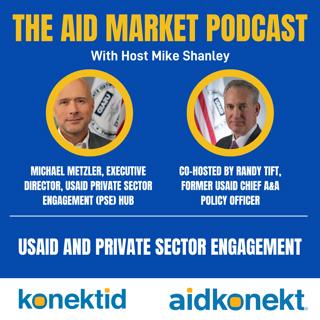
Randy Tift, Former USAID Chief A&A Policy Officer, joins Mike Shanley as co-host, along with guest Michael Metzler, Executive Director of USAID's Private Sector Engagement (PSE) Hub. As the first formalized private sector engagement office, USAID is the longest running donor in the space. USAID's influence continues to evolve, especially as more U.S. foreign assistance professionals are shifting their focus towards the local development of communities and engaging in the private sector space. With this shift comes the need for new policies and strategies necessary to streamline future projects and to support complex relationships between USAID and private sectors. This impactful discussion focuses on USAID's Private Sector Engagement's (PSE) priorities and progress, learning from PSE USAID projects, PSE and localization, and USAID and impact investing.

IN THIS EPISODE:

  • [3:53] Michael Metzler gives a rundown of the history of USAID's Private Sector Engagement.

  • [7:00] What inspired USAID to shift their focus to the commercial interests of their private sector partners and how has this shift benefited USAID and their private partners?

  • [12:44] Michael touches on why USAID is such a great resource for private sectors and local partners trying to establish themselves to tap into.

  • [15:00] Randy introduces PSE Modernize, the overarching term for several initiatives that USAID has launched to track the agency's private sector partnerships, and to bring data to bear for USAID planners, both in the missions and in DC. This has brought more order to managing PSE partners, resulting in a real system for customer relationship management and knowledge management. Michael shares his thoughts on the launch.

  • [23:00] Michael discusses Compass, the Salesforce-based enterprise customer relationship management system that USAID is preparing to launch. He also touches on the staff that will be running and implementing Compass.

  • [28:25] Randy asks Michael how USAID will engage with companies that work through supply chains, that cross borders, or work across sectors and industries? How will USAID incentivize the support for those complex relationships with their workforce?

  • [34:00] Discussion of the A&A Strategy and the Private Sector Engagement Policy, both launched in December of 2018. What has been accomplished and learned throughout the years since these launches?

  • [42:00] Michael touches on the Unlock Aid Organization.

  • [45:43] How has USAID developed and updated their systems to better assist local partners and private sectors?

  • [52:38] Randy inquires about the continuing role of nongovernmental organizations and nonprofits in private sector engagement and relationships with the Development Finance Corporation.

  • [58:30] Michael touches on the Edge Fund and why it was created.

KEY TAKEAWAYS:

  • Many U.S. foreign assistance professionals disagreed on the importance of engaging with multinational corporations, and even local firms, whose primary motive is mere profit. But there's really been a major shift in terms of the development community and engaging the private sector.

  • USAID founded the first formalized private sector engagement office in 2000 with the intention to formalize an approach and its thinking around engaging with the private sector.

  • The Private Sector Engagement Policy and the A&A Strategy, both firsts of their kind, were both released in December of 2018. Michael reflects on that time period and what the resulting awards have accomplished.

  • When the Development Finance Corporation (DFC) was created, there was a significant hole in the agency in terms of its ability to transact. Thus, the Mission Transaction Unit was created to allow for the transaction that USAID brings into the DFC.

QUOTES:

"Focusing on the actual commercial interests of our private sector partners is not only a good thing to do, it's an absolutely necessary thing to do. In fact, we went further than that and said, it's actually a history of how we are going to do development into the future. So out of that recognition came the first ever PSE policy for the agency, and, if you read the policy, you will see that it presents a very bold vision." - Michael Metzler

"USAID has one of the best networks in the business community, as well as a wide team of experts in all technical areas. These are areas that private sectors would like to tap into. USAID has some of the best reputations and the best connections with government officials that can be leveraged. For a company that's coming from the outside that is trying to establish themselves, that is gold." - Michael Metzler

"It's remarkable for partners to know that for any private sector engagement concern, they can find out who those people are. For various reasons, including security, most technical leads for health or food security are not listed, you have to do research to find out who they are. But with PSE, you know who they are, it's public." - Randy Tift

"Localization, I also read as not just localized within the countries themselves, but actually engaging these smaller businesses that do struggle to break into larger contracts." - Michael Metzler

RESOURCES:

Aid Market Podcast

Mike Shanley - LinkedIn

Randy Tift - LinkedIn

BIOGRAPHIES:

Michael Metzler, Executive Director, USAID Private Sector Engagement Hub:

Acting Deputy Assistant Administrator Michael Metzler oversees IPI's Private Sector Engagement Hub, the Center for Economics and Market Development, and manages the Agency's relationship with the U.S. International Development Finance Corporation. Mr. Metzler was previously the Executive Director of IPI's Private Sector Engagement (PSE) Hub.

Previously, Mr. Metzler was the Director of USAID's Development Credit Authority (DCA) in which he successfully led efforts that mobilized over $6 billion of new financing for development projects in over 80 countries. He was also a leading Agency voice on the development of the BUILD Act, which created the U.S. International Development Finance Corporation (DFC) and managed the successful merger of the DCA office and program into the DFC.

Prior to his DCA work, Mr. Metzler served as the Director of USAID's Economic Growth Office in Serbia, where he managed a diverse portfolio of projects focused on regulatory reform, local economic development, agriculture, enterprise competitiveness and economic security.

Mr. Metzler has also served as a special assistant and adviser to several USAID administrators on issues related to financial markets, macroeconomic policy and regulatory reform. Before joining USAID, he was the director of a national house-building program for Habitat for Humanity International and served in the U.S. Peace Corps in Nepal.

Mr. Metzler is a graduate of the Johns Hopkins School for Advanced International Studies, where he studied development finance and economics.

Randy Tift, Former USAID Chief A&A Policy Officer:

J. Randall (Randy) Tift is an advisor / consultant to international development organizations. He led a USAID reform initiative in 2017-21. Previously, he served on US Congressional staff, in field-based operations in global development, and as a policy manager in international affairs focused on relief and development, democracy, human rights, and national security.

At USAID Randy served as Chief Acquisition and Assistance Policy Officer and as Senior Leader Champion for USAID's Effective Partnering and Procurement Reform (EPPR). EPPR established reforms in program cycle, partnering approaches and delivery mechanisms for more than $20 billion in annual USAID funding. Through EPPR and the New Partnerships Initiative, USAID continues to advance locally-led development, adaptive and collaborative programming, and diversification of the USAID partner base.

From 2006-2017, Randy was Senior Adviser and Senior Director for Policy at World Vision. In this role, Randy managed WV policy engagement with US executive branch agencies in crisis response, operational risk, program effectiveness in fragile states, civil society strengthening, human rights, counter-terrorism, and other issues affecting WV brand, mission, and message. He coordinated US donor support for field programs promoting local advocacy and policy change as a critical driver of development outcomes in over 40 countries.

From 1995-2006, Randy managed international development programs in the Balkans. As Chief of Party in Serbia, he managed the $50 million USAID Community Revitalization through Democratic Action (CRDA) program, supporting post-conflict civic participation, economic growth and income generation, stabilization and reconstruction assistance to Serbia. Randy also served as USAID Senior Adviser for Democracy and Governance in Romania, managing a portfolio of a dozen US and local implementing partners building coalitions for reform, promoting programs to remove barriers to free enterprise and economic growth, supporting independent media, and strengthening Romanian democratic institutions. Earlier, Randy served as coordinator of the US Congressional assistance program in the Romanian Parliament.

Det här avsnittet är hämtat från ett öppet RSS-flöde och publiceras inte av Podme. Det kan innehålla reklam.

Avsnitt(84)

Ep 84: Inside SpaceWERX's $500M Venture Model and Space Warfighting Priorities with Arthur Grijalva

Ep 84: Inside SpaceWERX's $500M Venture Model and Space Warfighting Priorities with Arthur Grijalva

Want to know how to break into the U.S. Space Force and scale your technology with over half a billion dollars in annual funding? In this episode, host Mike Shanley sits down with Arthur Grijalva, Dir...

9 Juli 38min
Ep 83: General Mike Minihan (ret.)

Ep 83: General Mike Minihan (ret.)

In this episode, retired four-star General Mike Minihan shares his experiences in military leadership, the importance of industry collaboration, and the strategic role of AI, data, and UAVs in modern ...

3 Juni 54min
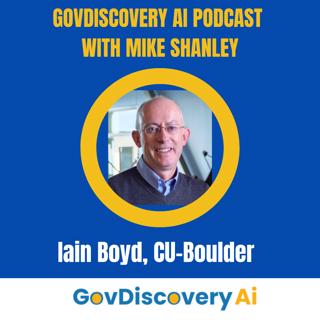
Ep 82: Iain Boyd, Director, Center for National Security Initiatives, University of Colorado-Boulder

Ep 82: Iain Boyd, Director, Center for National Security Initiatives, University of Colorado-Boulder

This interview with Ian Boyd, director at the University of Colorado Boulder, explores the strategic and technological landscape of hypersonics, missile defense, and space domain awareness. It highlig...

3 Juni 31min
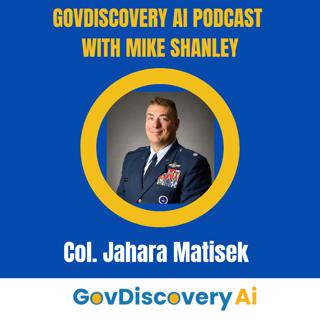
Ep 81: Col. Jahara Matisek - Rethinking Warfare around Space, Civil Society, Arctic Domain, and Critical Minerals

Ep 81: Col. Jahara Matisek - Rethinking Warfare around Space, Civil Society, Arctic Domain, and Critical Minerals

Disclaimer: Views are guest's own and not the official position of the U.S. Air Force, Department of Defense, or any part of the U.S. Government. Visit www.govdiscoveryai.com to learn more about our D...

21 Maj 50min
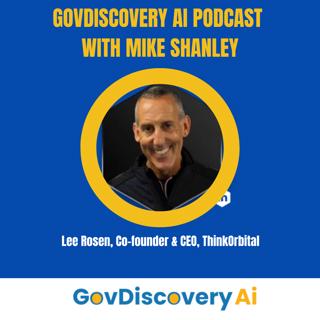
Ep 80: Lee Rosen, CEO, ThinkOrbital - GovDiscovery AI Podcast with Mike Shanley

Ep 80: Lee Rosen, CEO, ThinkOrbital - GovDiscovery AI Podcast with Mike Shanley

How to Build Big Infrastructure in Space: Insights from Lee Rosen LinkedIn: https://www.linkedin.com/company/thinkorbital Website: https://thinkorbital.com/ Email: marketing@thinkorbital.com Building ...

3 Apr 40min
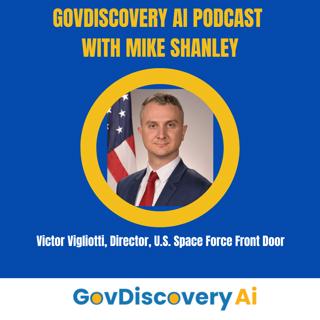
Ep 79 Victor Vigliotti, Director, U.S. Space Force Front Door

Ep 79 Victor Vigliotti, Director, U.S. Space Force Front Door

In this episode, Victor Vigliotti, Director of the Space Force Front Door, discusses how the US Space Force is transforming its knowledge management and vendor engagement processes. He shares insights...

19 Mars 36min
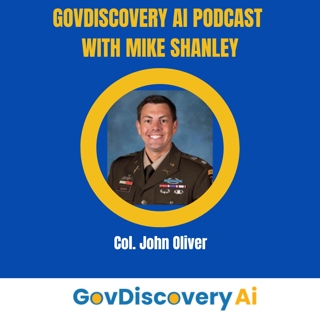
Ep 78 Col. John Oliver - U.S. Army Strategic Capital Initiative

Ep 78 Col. John Oliver - U.S. Army Strategic Capital Initiative

In this episode, Colonel John Oliver discusses the U.S. Army Strategic Capital Initiatives, exploring innovative partnerships with private capital and tech companies to modernize the industrial base a...

11 Mars 23min
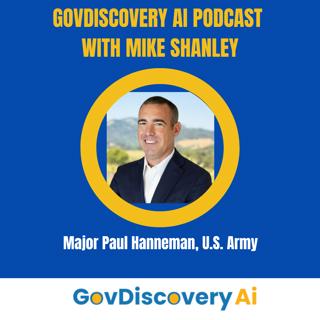
Ep. 77 Maj. Paul Hanneman - Building Software for the Solider

Ep. 77 Maj. Paul Hanneman - Building Software for the Solider

# How to Achieve Agnostic Technology in Defense: Insights from Major Paul Hanneman Learn how to implement agnostic technology in defense. Major Paul Hanneman shares insights on user empathy and collab...

6 Mars 31min

Populärt inom Business & ekonomi

badfluence
framgangspodden
varvet
dynastin
rss-borsens-finest
svd-tech-brief
uppgang-och-fall
avanzapodden
fill-or-kill
rss-inga-dumma-fragor-om-pengar
bathina-en-podcast
tabberaset
rss-dagen-med-di
borslunch-2
rikatillsammans-om-privatekonomi-rikedom-i-livet
market-makers
rss-hos-psykologen
rss-kort-lang-analyspodden-fran-di
lastbilspodden
rss-dominoeffekten