Expert guide to conspiracy theories part 1 – how to spot one

Expert guide to conspiracy theories part 1 – how to spot one

There are a lot of conspiracy theories out there. Some are bizarre – like the idea that Elvis faked his own death. Or that Britain’s royal family are actually shape-shifting alien lizards. A growing number of people believe the world is flat.


A lot of conspiracy theories relate to politics. That 9/11 was orchestrated by the US government so it could start wars in the Middle East. Or that powerful groups like the Illuminati are pulling the strings behind the scenes, plotting to establish a New World Order. Or that the new coronavirus is a bio-weapon engineered by the CIA.


Part one of the series explores what these many different ideas have in common and grapples with what actually makes something a conspiracy theory. We speak to Peter Knight, professor of American studies at the University of Manchester. He says there are three important characteristics to conspiracy theories:


First, that nothing happens by accident. The idea that in history, there are no coincidences, no cock-ups. The second idea is that nothing is as it seems. The suggestion that you need to look beneath the surface to detect the actions and the intentions of the evil conspirators. And the third idea is that everything is connected.


One of the difficulties with defining conspiracy theories is the fact that history is littered with real plots and conspiracies. Jovan Byford, senior lecturer in social psychology at the Open University, tells us how to spot the difference.


We also speak to Clare Birchall, reader in contemporary culture at King’s College London. She challenges us to consider who we label a conspiracy theorist and why. We find out how many conspiracy theories that sound outlandish make a lot more sense when you scratch beneath the surface of why people believe in them.


Andrew McKenzie-McHarg, senior research fellow at the Australian Catholic University, explains how the term conspiracy theory evolved from simply being a neutral theory about a conspiracy to a more loaded term. And Quassim Cassam, philosophy professor at the University of Warwick, argues that conspiracy theories are always a form of political propaganda. He says we must be aware of what ideology they are pushing and we must differentiate between the producers of conspiracy theories and those that believe in them.


The Anthill is produced by Annabel Bligh and Gemma Ware. Sound design is by Eloise Stevens, with original music from Neeta Sarl and audio from Epidemic Sound. A big thanks to City, University of London, for letting us use their studios.


Det här avsnittet är hämtat från ett öppet RSS-flöde och publiceras inte av Podme. Det kan innehålla reklam.

Avsnitt(107)

6 | The Making of One Nation: seize the moment?

6 | The Making of One Nation: seize the moment?

One Nation didn't emerge in a vacuum, then or now.The global surge in right-wing populism has propelled the party and thirty years on, it’s arguably stronger than ever.But is its popularity a protest ...

16 Juni 24min

5 | The Making of One Nation: master the media

5 | The Making of One Nation: master the media

The media made Pauline Hanson and One Nation, but now the party holds all the power.It’s a perfect storm for democracy: a shrinking and cowering traditional media, the toxic algorithms of the unmodera...

9 Juni 25min

4 | The Making of One Nation: move the centre

4 | The Making of One Nation: move the centre

It’s never held government, or even opposition, yet One Nation’s managed to exert an outsized influence on the public policy agenda.From borders to migration, multiculturalism to Indigenous affairs, t...

2 Juni 19min

3 | The Making of One Nation: survive a scandal

3 | The Making of One Nation: survive a scandal

We’d all like deeply considered policy and informed debate to be at the heart of politics, but unfortunately controversies and scandals tend to steal the show.For most parties, scandals are disastrous...

26 Maj 19min

2 | The Making of One Nation: define the enemy

2 | The Making of One Nation: define the enemy

You might remember this line in Pauline Hanson's maiden speech: "I'm afraid we're in danger of being swamped by Asians."It wasn't the first racist comment she'd made in public and it certainly wasn't ...

19 Maj 20min

1 | The Making of One Nation: enter the outsider

1 | The Making of One Nation: enter the outsider

Listen to the full series by searching and following 'The Making of One Nation'(click here for Spotify or Apple.)Nearly thirty years on, Hanson's infamous maiden speech — warning that Australia was "b...

1 Apr 25min
The Making of One Nation: coming soon

The Making of One Nation: coming soon

Search for "The Making of One Nation" and follow now.From a fish and chip shop in regional Queensland to the heart of Australian politics: this is the unlikely story of the country’s most controversia...

27 Mars 2min
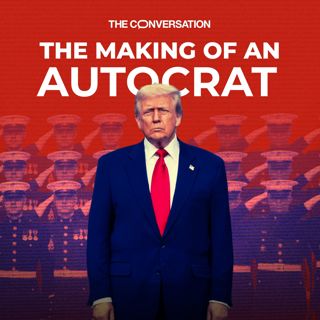
The Making of an Autocrat: co-opt the military

The Making of an Autocrat: co-opt the military

In November, six Democratic lawmakers recorded a video directed at members of the US military and intelligence agencies. In it, they issued a blunt reminder:"The laws are clear: […] You must refuse il...

4 Jan 18min
Populärt inom Politik & nyheter

p3-krim
aftonbladet-daily
svenska-fall
rss-krimstad
aftonbladet-krim
flashback-forever
tv4-nyheterna-story
rss-krimreportrarna
rss-sanning-konsekvens
motiv
mannen-utan-spar
de-fyras-gang
svd-ledarredaktionen
politiken
rss-flodet
rss-vad-fan-hande
spar
rss-aftonbladet-krim
rss-frandfors-horna
krimmagasinet