
Want to Understand Neural Networks? Think Elastic Origami! - Prof. Randall Balestriero

Want to Understand Neural Networks? Think Elastic Origami! - Prof. Randall Balestriero

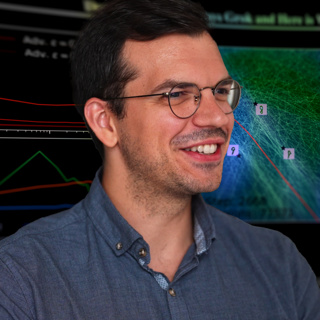
Professor Randall Balestriero joins us to discuss neural network geometry, spline theory, and emerging phenomena in deep learning, based on research presented at ICML. Topics include the delayed emergence of adversarial robustness in neural networks ("grokking"), geometric interpretations of neural networks via spline theory, and challenges in reconstruction learning. We also cover geometric analysis of Large Language Models (LLMs) for toxicity detection and the relationship between intrinsic dimensionality and model control in RLHF.


SPONSOR MESSAGES:

***

CentML offers competitive pricing for GenAI model deployment, with flexible options to suit a wide range of models, from small to large-scale deployments.

https://centml.ai/pricing/


Tufa AI Labs is a brand new research lab in Zurich started by Benjamin Crouzier focussed on o-series style reasoning and AGI. Are you interested in working on reasoning, or getting involved in their events?


Goto https://tufalabs.ai/

***


Randall Balestriero

https://x.com/randall_balestr

https://randallbalestriero.github.io/


Show notes and transcript: https://www.dropbox.com/scl/fi/3lufge4upq5gy0ug75j4a/RANDALLSHOW.pdf?rlkey=nbemgpa0jhawt1e86rx7372e4&dl=0


TOC:

- Introduction

- 00:00:00: Introduction

- Neural Network Geometry and Spline Theory

- 00:01:41: Neural Network Geometry and Spline Theory

- 00:07:41: Deep Networks Always Grok

- 00:11:39: Grokking and Adversarial Robustness

- 00:16:09: Double Descent and Catastrophic Forgetting

- Reconstruction Learning

- 00:18:49: Reconstruction Learning

- 00:24:15: Frequency Bias in Neural Networks

- Geometric Analysis of Neural Networks

- 00:29:02: Geometric Analysis of Neural Networks

- 00:34:41: Adversarial Examples and Region Concentration

- LLM Safety and Geometric Analysis

- 00:40:05: LLM Safety and Geometric Analysis

- 00:46:11: Toxicity Detection in LLMs

- 00:52:24: Intrinsic Dimensionality and Model Control

- 00:58:07: RLHF and High-Dimensional Spaces

- Conclusion

- 01:02:13: Neural Tangent Kernel

- 01:08:07: Conclusion


REFS:

[00:01:35] Humayun – Deep network geometry & input space partitioning

https://arxiv.org/html/2408.04809v1


[00:03:55] Balestriero & Paris – Linking deep networks to adaptive spline operators

https://proceedings.mlr.press/v80/balestriero18b/balestriero18b.pdf


[00:13:55] Song et al. – Gradient-based white-box adversarial attacks

https://arxiv.org/abs/2012.14965


[00:16:05] Humayun, Balestriero & Baraniuk – Grokking phenomenon & emergent robustness

https://arxiv.org/abs/2402.15555


[00:18:25] Humayun – Training dynamics & double descent via linear region evolution

https://arxiv.org/abs/2310.12977


[00:20:15] Balestriero – Power diagram partitions in DNN decision boundaries

https://arxiv.org/abs/1905.08443


[00:23:00] Frankle & Carbin – Lottery Ticket Hypothesis for network pruning

https://arxiv.org/abs/1803.03635


[00:24:00] Belkin et al. – Double descent phenomenon in modern ML

https://arxiv.org/abs/1812.11118


[00:25:55] Balestriero et al. – Batch normalization’s regularization effects

https://arxiv.org/pdf/2209.14778


[00:29:35] EU – EU AI Act 2024 with compute restrictions

https://www.lw.com/admin/upload/SiteAttachments/EU-AI-Act-Navigating-a-Brave-New-World.pdf


[00:39:30] Humayun, Balestriero & Baraniuk – SplineCam: Visualizing deep network geometry

https://openaccess.thecvf.com/content/CVPR2023/papers/Humayun_SplineCam_Exact_Visualization_and_Characterization_of_Deep_Network_Geometry_and_CVPR_2023_paper.pdf


[00:40:40] Carlini – Trade-offs between adversarial robustness and accuracy

https://arxiv.org/pdf/2407.20099


[00:44:55] Balestriero & LeCun – Limitations of reconstruction-based learning methods

https://openreview.net/forum?id=ez7w0Ss4g9

(truncated, see shownotes PDF)


Det här avsnittet är hämtat från ett öppet RSS-flöde och publiceras inte av Podme. Det kan innehålla reklam.

Avsnitt(271)

What Most People Get Wrong About Evolution | Akarsh Kumar

What Most People Get Wrong About Evolution | Akarsh Kumar

A lot of people in AI treat evolution as a dumb fallback, basically random search for when you can't take a gradient. Akarsh Kumar thinks that is wrong. Selection hangs on to partial solutions, so mut...

10 Okt 47min

How a Voice Agent Learns the Rhythm of Conversation — Shawn Wen

How a Voice Agent Learns the Rhythm of Conversation — Shawn Wen

Tsung-Hsien (Shawn) Wen, CTO of PolyAI, tells Tim Scarfe why voice agents are harder than text agents. Voice adds time, and a good conversation depends on adapting to the person on the line, not just ...

1 Okt 1h 10min

Who Checks a Proof No Human Can Read? — Leo de Moura

Who Checks a Proof No Human Can Read? — Leo de Moura

Leonardo de Moura created Lean and co-created Z3. ---This episode is sponsored by Parallel.Parallel, where agents find answers: web search, extraction and deep research APIs built for AI agents.Start ...

30 Sep 1h 14min

When AI Research Starts Moving Faster Than Human Research - Zhengyao Jiang

When AI Research Starts Moving Faster Than Human Research - Zhengyao Jiang

Weco let an AI coding agent rewrite the harness around another agent for eight days: its code, prompts and tools, while the underlying language model stayed fixed. Tim Scarfe asks Weco co-founder Zhen...

26 Sep 43min

How Deep Learning Finally Cracked Messy Tables - Frank Hutter

How Deep Learning Finally Cracked Messy Tables - Frank Hutter

Frank Hutter, co-founder of Prior Labs, talks about TabPFN, a tabular foundation model that makes predictions in a single forward pass, and the research behind it.TabPFN is pre-trained on synthetic da...

23 Sep 1h 53min

Why Scaling Prediction Cannot Create Intelligence - Alexander Mattick

Why Scaling Prediction Cannot Create Intelligence - Alexander Mattick

Alexander Mattick is a researcher at Fraunhofer IIS and a PhD researcher at the University of Technology Nuremberg (UTN), and a regular on Yannic Kilcher's Discord. He first came on MLST in 2022, afte...

21 Sep 2h 14min

How Physical AI Learns Across Language, Video and Action — Ming-Yu Liu

How Physical AI Learns Across Language, Video and Action — Ming-Yu Liu

The car making a left turn at the start of this episode was never filmed. Cosmos 3 generated it. Ming-Yu Liu, who leads the Cosmos research at NVIDIA, explains how one model can describe a video, gene...

15 Sep 25min

Speech Recognition Is Not a Solved Problem — Pavan Kumar Reddy

Speech Recognition Is Not a Solved Problem — Pavan Kumar Reddy

Pavan Kumar Reddy leads audio research at Mistral AI. He joins Tim Scarfe for a deep technical tour of Voxtral — and explains why the frontier of deployed voice is still a cascade of specialised model...

14 Sep 1h 42min

Populärt inom Teknik

uppgang-och-fall
rss-ai-med-jonas-benjamin
bilar-med-sladd
elbilsveckan
natets-morka-sida
skogsforum-podcast
rss-technokratin
market-makers
rss-elektrikerpodden
rss-snacka-om-ai
rss-uppgang-och-fall
rss-laddstationen-med-elbilen-i-sverige
rss-upplyst-entreprenordirektor
rss-veckans-ai
bli-saker-podden
gubbar-som-tjotar-om-bilar
rss-fabriken-2
vi-bilagares-podcast
rss-en-ai-till-kaffet
rss-it-sakerhetspodden