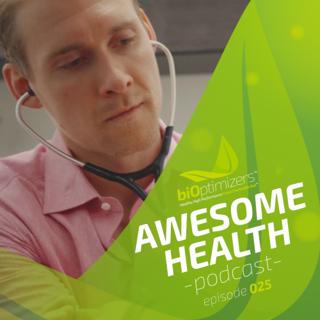
025: The Five Health Tests You Need with Dr. Paul Maximus

025: The Five Health Tests You Need with Dr. Paul Maximus

The one way to be sure you nip health problems in the bud is through testing. And here to tell us exactly which five health tests we need and why is my good friend, Dr. Paul Maximus.

Dr. Paul is a naturopathic physician, coach, speaker, and former natural heavyweight bodybuilding champion. With a focus on high-performance medicine, his therapeutic approach prioritizes a strong foundation of nutrition, exercise, and psychology. He runs Maximus Concierge Medicine (MxCM) in Vancouver, B.C., a house-call service that offers in-depth, extended medical consults and health coaching.

Join us as he brings his bright light and wealth of information to today's Awesome Health podcast.

More About Awesome Health with Dr. Paul Maximus

To start the show we dig into his background. Dr. Paul went to university and didn't have a lot of tools to deal with the stress that came along with college life. He took up running as a way to cope and went all in on it. He admits to having a "black and white" type of personality which he has adjusted over the years. But back then that all or nothing mentality led him to becoming an anorexic marathon runner. Eventually, his knee and leg gave out so he couldn't run any more. He became so depressed he had to leave school.

Many of his family members are medical doctors so they provided him with help, which was fantastic at the time. But he found every time he went on an anti-depressant he would feel temporarily better, but would ultimately crash down.He was so sick he couldn't function - he couldn't hold down a job or stay in school.

This went on for a year, and he became sick of the cycle. To find out what was really going on he took it upon himself to dive into the literature on anti-depressants: he wanted to know what was wrong with his brain and why the medications weren't working for him.

Doing so showed him it wasn't healthy to run a half-marathon every week and restrict your food intake. It also isn't healthy to avoid fats, eat high amounts of carbs and avoid protein.

He also learned the facts behind pharmaceutical trails, the low efficacy rates of anti-depressants (efficacy meaning their ability to produced the desired effects and results), and the importance of sleep, omega 3s, and stress reduction.

Everything changed when he found books like Dr. Allen Logan's Your Brain Diet and Wayne Dyer's Erroneous Zones. He went from a 134 pound anorexic, college dropout marathon runner to a 200-pound bodybuilder getting 90s in his Psychology classes. He was on fire and everything was different for him. He came off the anti-depressants with his doctor's approval, and he has never gone back on them.

His next step into the health world was when he worked online for Dr. Jon Berardi; he coached 300 guys through the Scrawny to Brawny program. That only gave him the itch to do more: he wanted to dive into labs, blood work and to generally understand physiology in a deeper way.

He considered medical school before going to naturopath school. Four years and 4700 hours of training later he came out the other side, and now runs a high performance men's medical program. He's based in Vancouver and does house calls within the area, and works with his out of area patients virtually.

From there we dig into the meat of this show. Dr. Paul posted something on social media that relates to this directly, and I asked him to talk about that particular post and how it relates to the way men think about and approach their health.

Dr. Paul says he was walking home one day from a client visit and he saw a $2.4 million Pagani roadster. People were crowded around it and taking photos, everyone was in awe of it!

But a lot of those people around the car didn't look fit or very healthy, they revered the car as if it was far more valuable than the body they were using to experience the car. If you are born you already have something far more valuable than a $2.4 million car.

You can replace parts of the car, but how are you going to replace your heart, your kidneys, your brain, your lungs, etc.? They are priceless.

The average person can't and the average person doesn't bother to look under their own hood to find out what their inflammatory markers are, their body composition, their hormones, their micronutrients, etc. They don't look into the well-being of their body until something goes wrong.

Dr. Paul equates that to having a Pagani roadster and not taking care of it in any way.

The Five Health Tests You Need

Twelve years ago when he started this journey, he saw hundreds of thousands of products online and in health food stores, but he knew nothing of oils. Until one day he ran into a guy pressing oils at a raw food market in Venice, CA. The guy was so excited that it caught his attention. And while everyone gets excited about their products, Ian was intrigued by this man's oils.

So what kind of labs do you need to do for your very own Pagani (aka your body)? That's our next topic - these are the 5 tests he has all his concierge clients run.
1. General screening.
These are what are typically done every time you see a general practitioner: things like your fasting glucose, cholesterol, your liver function tests, your kidney function tests, your CBC, etc. For the most part these are usually normal.

He recommends having your fasted insulin done as well, most docs don't usually run it. Dr. Paul explains why not and in what scenarios this number could be different than your fasting glucose.

He also recommends doing a GGT (gamma-glutamyl transferase): it's a great marker for your health. In fact, he just read a paper that suggests it may be the single greatest indicator or marker of your health over anything else. It relates to atherosclerosis, oxidative stress, toxic load, and dysglycemia strongly. It should be below 20 when you test it.

2. Body composition.
While this isn't medically necessary, he recommends it for guys. He likes using the Dexa scan for this test. It shows you a picture of your muscle, your bones and your fat, while not exposing you to extra radiation like an X-ray would. With the Dexa scan, you get to see how much fat you have in your left arm versus your right arm versus your torso versus your hips, etc.

3. The spectra cell micronutrient test.
We talk in detail about how this test works, but in essence it checks your dietary status over a 3-6 month range. It's very comprehensive; they split your blood into 30 different sample tubes that are then tested for things like Vitamin C, calcium, magnesium, chromium, etc. This test provides a functional assessment of your white blood cells, Dr. Paul explains more on this episode.

4. The PULS test.
PULS stands for protein unstable lesion signature. This is a great test for assessing heart attack risk. We tend to think high levels of fats equals a higher risk of heart attack.

Dr. Paul says that's like saying being a hoarder causes your house to start on fire. While hoarding may increase your risk of a fire, but you still need something to spark and start that fire.

And research backs this up: people who were hospitalized for a heart attack were studied. 50% of those people had normal cholesterol levels prior to their heart attack.

So high levels of fats is not the full story, there is more going on. And that more that is going on is inflammation. That spark in the majority of heart attacks is an inflammatory response, some kind of oxidative stress. Now that oxidative stress could be because of free radicals from a poor diet or from high blood sugar, or other reasons. There are lots of reasons for the oxidative stress becoming the spark that ignites the heart attack.

That is where the PULS test comes in: it looks at your HDL (good cholesterol) along with a set of inflammatory markers that are specific to the vasculature in the arteries and the heart.

As a result, it gives a much better risk assessment for what your likelihood of a heart attack is in the next five years. This is a test he recommends, especially for anyone who has a history of heart attacks and/or strokes in their family. With the PULS test, you'll find out which markers are high and which are low so your therapies and treatments can be specifically targeted.

5. The DUTCH test.
This is a hormone test. He puts this one last because you should do the other tests first. The other tests may help you fix the underlying cause of a hormonal issue so he recommends doing this one after you've done the other four tests.

For example, if you think your testosterone is low but you do the spectra cell micronutrient test you could find out your zinc is off (zinc is a necessary co-factor to make testosterone). Once you address the zinc issue your testosterone levels increase and those low testosterone symptoms disappear because you addressed the underlying issue.

After discussing the 5 health tests we need, Dr. Paul tells us why health is more than just a simple equation: for example, depression stems from more than just low serotonin levels. Our bodies are far more complex; our biology is incredibly sophisticated.

On this episode, we get into that sophistication including how often to do these 5 labs, what symptoms tell you that you need these tests, as well as the 5 types of Alzheimer's.

Join us for those topics plus a chat about epigenetic testing and his concierge service on today's Awesome Health podcast with Dr. Paul Maximus.

Episode Resources

Avsnitt(304)

304: Burnout, Fertility and Recovering Smarter - with Charlene Gisele

304: Burnout, Fertility and Recovering Smarter - with Charlene Gisele

In today's competitive professional landscape, the ninety-hour work week is often celebrated as a badge of honor. This mindset pushes high achievers into a cycle of toxic endurance that prioritizes th...

19 Mars 2h 2min

303: Master Your Health Operating System - with Ben Brown

303: Master Your Health Operating System - with Ben Brown

Achieving optimal health isn't about white-knuckling a restrictive diet or chasing the latest quick-fix trend. Benjamin Brown, founder of Body Systems, advocates for a personalized "Operating System" ...

19 Feb 52min

302: Superhuman to Survivor - with Roger Snipes / Awesome Health Podcast

302: Superhuman to Survivor - with Roger Snipes / Awesome Health Podcast

For decades, Roger Snipes was a titan in the natural bodybuilding world, winning prestigious titles like Mr. UK and Mr. Britannia. His brand was built on high performance with a physique that pushed t...

5 Feb 1h 24min

301: The Menopause Gut Connection - with Cynthia Thurlow

301: The Menopause Gut Connection - with Cynthia Thurlow

The conversation around menopause is evolving toward a more holistic understanding of this transition. One crucial, yet often overlooked, aspect is the profound connection between menopause and gut he...

22 Jan 57min

300: Roadmap to Tinnitus Relief - with Ben Thompson

300: Roadmap to Tinnitus Relief - with Ben Thompson

While many perceive tinnitus as a problem solely with the ears, it is actually a neurological condition occurring in the auditory brain. The Auditory Brain Connection Because the brain possesses neur...

15 Jan 38min

299: Fertility Beyond Biological Clock - with Gabriela Rosa

299: Fertility Beyond Biological Clock - with Gabriela Rosa

For decades, the conversation around starting a family has been dominated by a single, ticking sound: the biological clock. We're told that age is the ultimate arbiter of reproductive success. But acc...

8 Jan 1h 6min

298: Organic to Regenerative Agriculture - with Jeffrey Burke

298: Organic to Regenerative Agriculture - with Jeffrey Burke

Dr. Burke started working in health food stores while in college at the University of Michigan. In the late 70s and early 80s, he worked with industry pioneer Dr. Earl Mandel, eventually managing a ch...

1 Jan 55min

297: Insurance Rigged Against You - with Chris Hamilton

297: Insurance Rigged Against You - with Chris Hamilton

Health insurance in America is expensive on purpose, not by accident. Chris Hamilton argues that confusion and hidden incentives are the real products big carriers sell… and employers and employees pa...

25 Dec 20251h 9min

Populärt inom Hälsa

somna-med-henrik
rss-jossan-nina
inga-beiga-morsor
rss-bara-en-till-om-missbruk-medberoende-2
alska-oss
johannes-hansen-podcast
rss-vuxna-pa-latsas
not-fanny-anymore
rss-viktmedicinpodden
angestpodden
sexnoveller-deluxe
sova-med-dan-horning
sa-in-i-sjalen
brottarbroder
giggles-med-wiggles
rss-aldrig-lagom
rss-sjalsligt-avkladd
rss-psykoterapipodden
rss-basta-livet
smartare-fitness-podden