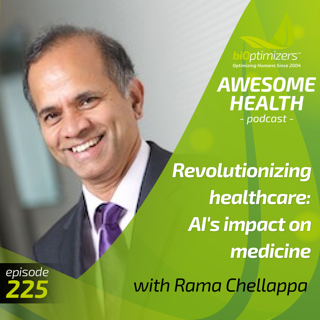
225: Revolutionizing healthcare: AI's impact on medicine - with Rama Chellappa

225: Revolutionizing healthcare: AI's impact on medicine - with Rama Chellappa

Artificial Intelligence (AI) has become an integral part of modern medicine, with its potential for helping diagnose and treat diseases and improve patient outcomes.

AI can be used in a variety of ways to improve medical care, from providing personalized medical advice to detecting medical errors.

Rama Chellappa, a computer vision researcher and professor at the University of Maryland, has been studying AI for nearly 40 years. He believes that AI can be used to provide better healthcare, with its ability to analyze vast amounts of data and make more accurate diagnoses.

AI can also be used to monitor and detect changes in patient health and alert doctors when changes occur.

For example, it can be used to monitor a patient's vital signs, such as pulse and blood pressure, and alert medical personnel if changes are detected.

It can also be used to analyze medical imaging, such as MRI and CT scans, for potential health issues.

In general, AI can be used to:

  • Detect tumors or other abnormalities in imaging.
  • Help with drug development and clinical trials, by monitoring patients and providing feedback to researchers.
  • Prevent and treat diseases, by providing personalized advice and recommendations to patients.
  • Track a patient's diet, exercise, and medication, and provide suggestions on how to improve their health.
  • Provide virtual counseling and therapy to patients, as well as provide support and resources to those in need.

AI can also be used to reduce medical errors, by providing more accurate diagnoses and monitoring patient health more closely.

In summary, AI is becoming increasingly important in the medical field, and its potential is only beginning to be realized.

As it continues to improve, it can provide medical professionals with more accurate diagnoses and provide patients with better care.

Can AI prevent pandemics in the future?

In today's world, the unpredictability of pandemics has become a major concern for many. AI has emerged as a potential solution to this problem, with many believing that it can be used to predict and prevent pandemics.

According to Rama Chellappa, when faced with a pandemic, it is difficult to expect that all decisions will be purely rational and perfect.

This is especially true in the case of the recent Covid-19 pandemic, where the full story and consequences were unclear.

Chellappa suggests that post-pandemic analysis is important in order to be better prepared for future pandemics. AI can be used to help with this analysis, by providing data-driven insights into the causes of pandemics and their effects.

AI can also be used to analyze data from social media sources, helping to identify potential pandemic-related trends and outbreaks.

AI can also be used to help with ethical considerations during pandemics. AI can be used to help ensure that decisions made by governments and private entities are fair and unbiased.

Additionally, AI can be used to monitor medical data and ensure that it is kept private and secure.

Finally, AI can also be used to help with the prevention of pandemics. AI can be used to analyze data on potential pandemic-causing agents, helping to identify and eliminate risks before they become a problem. AI can also be used to monitor health conditions and alert authorities to potential pandemic threats.

How AI can create harmony between Doctors and Patients

According to Chellappa, AI technology can help doctors provide more personalized care by continuously monitoring patient health data and providing reminders to take medications or exercise.

It can also help doctors remember important details about a patient's health by storing electronic health records, diagnostic images, and conversations between doctors and patients.

Chellappa believes that AI can help bridge the gap between patient and doctor by providing the doctor with quantitative data that can help inform decisions.

For example, AI can be used to analyze motion-related disorders or to determine how many calories are in a meal.

Chellappa also believes that AI can help foster trust between a doctor and patient by providing an impartial source of information.

On this podcast, you will learn about:

  • How can AI be used in medicine?
  • What is the difference between specific and general AI?
  • How can AI help doctors provide better care for their patients?
  • How can AI be used to create harmony?
    And so much more

EPISODE RESOURCES:

https://engineering.jhu.edu

https://www.press.jhu.edu

https://www.linkedin.com

https://scholar.google.com

Avsnitt(304)

304: Burnout, Fertility and Recovering Smarter - with Charlene Gisele

304: Burnout, Fertility and Recovering Smarter - with Charlene Gisele

In today's competitive professional landscape, the ninety-hour work week is often celebrated as a badge of honor. This mindset pushes high achievers into a cycle of toxic endurance that prioritizes th...

19 Mars 2h 2min

303: Master Your Health Operating System - with Ben Brown

303: Master Your Health Operating System - with Ben Brown

Achieving optimal health isn't about white-knuckling a restrictive diet or chasing the latest quick-fix trend. Benjamin Brown, founder of Body Systems, advocates for a personalized "Operating System" ...

19 Feb 52min

302: Superhuman to Survivor - with Roger Snipes / Awesome Health Podcast

302: Superhuman to Survivor - with Roger Snipes / Awesome Health Podcast

For decades, Roger Snipes was a titan in the natural bodybuilding world, winning prestigious titles like Mr. UK and Mr. Britannia. His brand was built on high performance with a physique that pushed t...

5 Feb 1h 24min

301: The Menopause Gut Connection - with Cynthia Thurlow

301: The Menopause Gut Connection - with Cynthia Thurlow

The conversation around menopause is evolving toward a more holistic understanding of this transition. One crucial, yet often overlooked, aspect is the profound connection between menopause and gut he...

22 Jan 57min

300: Roadmap to Tinnitus Relief - with Ben Thompson

300: Roadmap to Tinnitus Relief - with Ben Thompson

While many perceive tinnitus as a problem solely with the ears, it is actually a neurological condition occurring in the auditory brain. The Auditory Brain Connection Because the brain possesses neur...

15 Jan 38min

299: Fertility Beyond Biological Clock - with Gabriela Rosa

299: Fertility Beyond Biological Clock - with Gabriela Rosa

For decades, the conversation around starting a family has been dominated by a single, ticking sound: the biological clock. We're told that age is the ultimate arbiter of reproductive success. But acc...

8 Jan 1h 6min

298: Organic to Regenerative Agriculture - with Jeffrey Burke

298: Organic to Regenerative Agriculture - with Jeffrey Burke

Dr. Burke started working in health food stores while in college at the University of Michigan. In the late 70s and early 80s, he worked with industry pioneer Dr. Earl Mandel, eventually managing a ch...

1 Jan 55min

297: Insurance Rigged Against You - with Chris Hamilton

297: Insurance Rigged Against You - with Chris Hamilton

Health insurance in America is expensive on purpose, not by accident. Chris Hamilton argues that confusion and hidden incentives are the real products big carriers sell… and employers and employees pa...

25 Dec 20251h 9min

Populärt inom Hälsa

somna-med-henrik
rss-bara-en-till-om-missbruk-medberoende-2
rss-jossan-nina
inga-beiga-morsor
johannes-hansen-podcast
not-fanny-anymore
alska-oss
angestpodden
sexnoveller-deluxe
rss-viktmedicinpodden
rss-vuxna-pa-latsas
sa-in-i-sjalen
sova-med-dan-horning
giggles-med-wiggles
rss-psykoterapipodden
brottarbroder
rss-aldrig-lagom
rss-sjalsligt-avkladd
rss-basta-livet
smartare-fitness-podden