Phrenology & Crime in 19th Century America
Unsung History30 Aug 2021

Phrenology & Crime in 19th Century America

In Nineteenth Century America there was a strong reformist push to know and improve the self. One key tactic Americans used to learn more about themselves was phrenological readings. They would pay practical phrenologists, like Orson Squire Fowler and his younger brother, Lorenzo Niles Fowler for readings of their skulls or their children’s skulls.


In Lorenzo Fowler’s reading of Emily Sawyer, he concluded a thirteen-page analysis by saying: “Cultivate as much as you can the organs marked smallest in your Chart + properly guide and exercise the stronger ones + thus produce a harmony of mental and physical action.” By using the phrenological readings of themselves or their children, Nineteenth Century Americans could apply the advice to become the best version of themselves.


Practical phrenologists weren’t interested only in reform of the self, but in larger societal reform as well. For practical phrenologists, prisons were the site of both research and reform; they argued for the elimination of capital punishment and the reform of prisons to include re-education instead of punishment.


Despite the reform impulse of phrenologists, phrenology was also used as a scientific reason to justify racism and gender stereotyping. American phrenologists were sympathetic to liberal causes including the antislavery movement, even while claiming the superiority of the European brain.


By the early 20th century phrenology had been largely discredited in the public, but some of the concepts of phrenology, including propensities and physical localization in the brain of different characteristics have persisted.


In this episode, Kelly briefly tells the story of phrenology in 19th Century America and interviews Courtney Thompson, Assistant Professor of History at Mississippi State University, and author of the February 2021 book, An Organ of Murder: Crime, Violence, and Phrenology in Nineteenth-Century America.


Our theme song is Frogs Legs Rag, composed by James Scott and performed by Kevin MacLeod, licensed under Creative Commons. Episode image: “A head marked with images representing the phrenological faculties, with a key below. Coloured wood engraving, ca. 1845, after H. Bushea and O.S. Fowler.” Wellcome Collection. Public Domain.


Sources:


Advertising Inquiries: https://redcircle.com/brands

Det här avsnittet är hämtat från ett öppet RSS-flöde och publiceras inte av Podme. Det kan innehålla reklam.

Avsnitt(230)

Jane Addams, Hull House, and Chicago's Nineteenth Ward

Jane Addams, Hull House, and Chicago's Nineteenth Ward

In the fall of 1889, Jane Addams and Ellen Gates Starr opened Hull House on Chicago’s Near West Side, full of good intentions to help the poor people of the neighborhood. They were a force for good, p...

10 Aug 46min
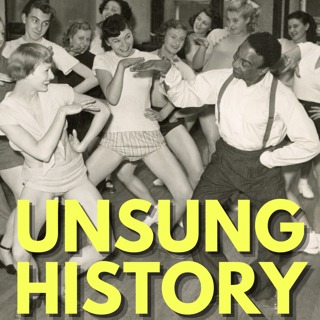
Buddy Bradley

Buddy Bradley

Buddy Bradley, born in the Jim Crow South in 1905, made his way to Harlem at age 16 where he learned to tap dance and became a chorus boy. He was sought out on Broadway as both teacher and choreograph...

27 Juli 50min
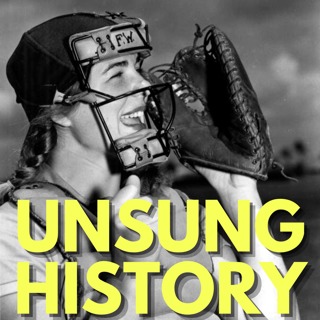
The All-American Girls Professional Baseball League

The All-American Girls Professional Baseball League

During World War II, afraid that major league baseball would need to pause while men were overseas fighting, Philip K. Wrigley, chewing gum mogul and owner of the Chicago Cubs, spearheaded a new profe...

13 Juli 54min
The Declaration of Independence

The Declaration of Independence

The Continental Congress voted to break from Great Britain on July 2, 1776, and approved the text of the Declaration of Independence on July 4, but it took weeks for the news to spread throughout the ...

29 Juni 48min
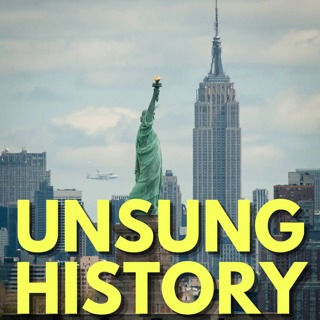
The Statue of Liberty and the Empire State Building

The Statue of Liberty and the Empire State Building

The Statue of Liberty and the Empire State Building loom large in the American imagination, symbolizing the conflicting ideas of liberty and empire; their meanings and characters have shifted over tim...

15 Juni 38min
An American History of Purses

An American History of Purses

Today the US handbag market is estimated to be nearly $12 billion, with most of the purchasing done by women, but into the early 20th Century purses hadn’t yet become the nearly-exclusive domain of wo...

1 Juni 40min
The Lady Bird Special

The Lady Bird Special

On the morning of Tuesday, October 6, 1964, the Lady Bird Special, a 19-car train carrying First Lady Claudia “Lady Bird” Johnson, her supporters, members of the press, and a security detail, departed...

18 Maj 41min
Policing Slavery & Black Rebellion in the American South

Policing Slavery & Black Rebellion in the American South

Enslaved Africans were forcibly shipped to Virginia starting in 1619 in response to a severe labor shortage. From the beginning, enslaved laborers resisted by fleeing and through violence, and white e...

4 Maj 50min
Populärt inom Utbildning

det-skaver
historiepodden-se
rss-bara-en-till-om-missbruk-medberoende-2
allt-du-velat-veta
nu-blir-det-historia
harrisons-dramatiska-historia
johannes-hansen-podcast
roda-vita-rosen
rss-viktmedicinpodden
i-vantan-pa-katastrofen
not-fanny-anymore
sektledare
rss-max-tant-med-max-villman
sa-in-i-sjalen
rikatillsammans-om-privatekonomi-rikedom-i-livet
vi-gar-till-historien
rss-traningsklubben
rss-basta-livet
rss-autismandan
sektpodden