
The Compendium - Connor Leahy and Gabriel Alfour

The Compendium - Connor Leahy and Gabriel Alfour

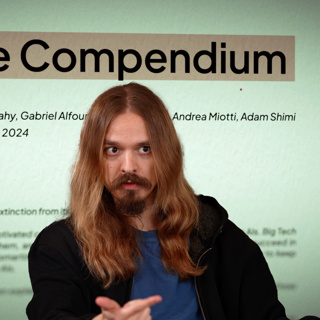
Connor Leahy and Gabriel Alfour, AI researchers from Conjecture and authors of "The Compendium," joinus for a critical discussion centered on Artificial Superintelligence (ASI) safety and governance. Drawing from their comprehensive analysis in "The Compendium," they articulate a stark warning about the existential risks inherent in uncontrolled AI development, framing it through the lens of "intelligence domination"—where a sufficiently advanced AI could subordinate humanity, much like humans dominate less intelligent species.


SPONSOR MESSAGES:

***

Tufa AI Labs is a brand new research lab in Zurich started by Benjamin Crouzier focussed on o-series style reasoning and AGI. They are hiring a Chief Engineer and ML engineers. Events in Zurich.


Goto https://tufalabs.ai/

***


TRANSCRIPT + REFS + NOTES:

https://www.dropbox.com/scl/fi/p86l75y4o2ii40df5t7no/Compendium.pdf?rlkey=tukczgf3flw133sr9rgss0pnj&dl=0


https://www.thecompendium.ai/

https://en.wikipedia.org/wiki/Connor_Leahy

https://www.conjecture.dev/about

https://substack.com/@gabecc​


TOC:

1. AI Intelligence and Safety Fundamentals

[00:00:00] 1.1 Understanding Intelligence and AI Capabilities

[00:06:20] 1.2 Emergence of Intelligence and Regulatory Challenges

[00:10:18] 1.3 Human vs Animal Intelligence Debate

[00:18:00] 1.4 AI Regulation and Risk Assessment Approaches

[00:26:14] 1.5 Competing AI Development Ideologies


2. Economic and Social Impact

[00:29:10] 2.1 Labor Market Disruption and Post-Scarcity Scenarios

[00:32:40] 2.2 Institutional Frameworks and Tech Power Dynamics

[00:37:40] 2.3 Ethical Frameworks and AI Governance Debates

[00:40:52] 2.4 AI Alignment Evolution and Technical Challenges


3. Technical Governance Framework

[00:55:07] 3.1 Three Levels of AI Safety: Alignment, Corrigibility, and Boundedness

[00:55:30] 3.2 Challenges of AI System Corrigibility and Constitutional Models

[00:57:35] 3.3 Limitations of Current Boundedness Approaches

[00:59:11] 3.4 Abstract Governance Concepts and Policy Solutions


4. Democratic Implementation and Coordination

[00:59:20] 4.1 Governance Design and Measurement Challenges

[01:00:10] 4.2 Democratic Institutions and Experimental Governance

[01:14:10] 4.3 Political Engagement and AI Safety Advocacy

[01:25:30] 4.4 Practical AI Safety Measures and International Coordination


CORE REFS:

[00:01:45] The Compendium (2023), Leahy et al.

https://pdf.thecompendium.ai/the_compendium.pdf


[00:06:50] Geoffrey Hinton Leaves Google, BBC News

https://www.bbc.com/news/world-us-canada-65452940


[00:10:00] ARC-AGI, Chollet

https://arcprize.org/arc-agi


[00:13:25] A Brief History of Intelligence, Bennett

https://www.amazon.com/Brief-History-Intelligence-Humans-Breakthroughs/dp/0063286343


[00:25:35] Statement on AI Risk, Center for AI Safety

https://www.safe.ai/work/statement-on-ai-risk


[00:26:15] Machines of Love and Grace, Amodei

https://darioamodei.com/machines-of-loving-grace


[00:26:35] The Techno-Optimist Manifesto, Andreessen

https://a16z.com/the-techno-optimist-manifesto/


[00:31:55] Techno-Feudalism, Varoufakis

https://www.amazon.co.uk/Technofeudalism-Killed-Capitalism-Yanis-Varoufakis/dp/1847927270


[00:42:40] Introducing Superalignment, OpenAI

https://openai.com/index/introducing-superalignment/


[00:47:20] Three Laws of Robotics, Asimov

https://www.britannica.com/topic/Three-Laws-of-Robotics


[00:50:00] Symbolic AI (GOFAI), Haugeland

https://en.wikipedia.org/wiki/Symbolic_artificial_intelligence


[00:52:30] Intent Alignment, Christiano

https://www.alignmentforum.org/posts/HEZgGBZTpT4Bov7nH/mapping-the-conceptual-territory-in-ai-existential-safety


[00:55:10] Large Language Model Alignment: A Survey, Jiang et al.

http://arxiv.org/pdf/2309.15025


[00:55:40] Constitutional Checks and Balances, Bok

https://plato.stanford.edu/entries/montesquieu/

<trunc, see PDF>

Det här avsnittet är hämtat från ett öppet RSS-flöde och publiceras inte av Podme. Det kan innehålla reklam.

Avsnitt(271)

What Most People Get Wrong About Evolution | Akarsh Kumar

What Most People Get Wrong About Evolution | Akarsh Kumar

A lot of people in AI treat evolution as a dumb fallback, basically random search for when you can't take a gradient. Akarsh Kumar thinks that is wrong. Selection hangs on to partial solutions, so mut...

10 Okt 47min

How a Voice Agent Learns the Rhythm of Conversation — Shawn Wen

How a Voice Agent Learns the Rhythm of Conversation — Shawn Wen

Tsung-Hsien (Shawn) Wen, CTO of PolyAI, tells Tim Scarfe why voice agents are harder than text agents. Voice adds time, and a good conversation depends on adapting to the person on the line, not just ...

1 Okt 1h 10min

Who Checks a Proof No Human Can Read? — Leo de Moura

Who Checks a Proof No Human Can Read? — Leo de Moura

Leonardo de Moura created Lean and co-created Z3. ---This episode is sponsored by Parallel.Parallel, where agents find answers: web search, extraction and deep research APIs built for AI agents.Start ...

30 Sep 1h 14min

When AI Research Starts Moving Faster Than Human Research - Zhengyao Jiang

When AI Research Starts Moving Faster Than Human Research - Zhengyao Jiang

Weco let an AI coding agent rewrite the harness around another agent for eight days: its code, prompts and tools, while the underlying language model stayed fixed. Tim Scarfe asks Weco co-founder Zhen...

26 Sep 43min

How Deep Learning Finally Cracked Messy Tables - Frank Hutter

How Deep Learning Finally Cracked Messy Tables - Frank Hutter

Frank Hutter, co-founder of Prior Labs, talks about TabPFN, a tabular foundation model that makes predictions in a single forward pass, and the research behind it.TabPFN is pre-trained on synthetic da...

23 Sep 1h 53min

Why Scaling Prediction Cannot Create Intelligence - Alexander Mattick

Why Scaling Prediction Cannot Create Intelligence - Alexander Mattick

Alexander Mattick is a researcher at Fraunhofer IIS and a PhD researcher at the University of Technology Nuremberg (UTN), and a regular on Yannic Kilcher's Discord. He first came on MLST in 2022, afte...

21 Sep 2h 14min

How Physical AI Learns Across Language, Video and Action — Ming-Yu Liu

How Physical AI Learns Across Language, Video and Action — Ming-Yu Liu

The car making a left turn at the start of this episode was never filmed. Cosmos 3 generated it. Ming-Yu Liu, who leads the Cosmos research at NVIDIA, explains how one model can describe a video, gene...

15 Sep 25min

Speech Recognition Is Not a Solved Problem — Pavan Kumar Reddy

Speech Recognition Is Not a Solved Problem — Pavan Kumar Reddy

Pavan Kumar Reddy leads audio research at Mistral AI. He joins Tim Scarfe for a deep technical tour of Voxtral — and explains why the frontier of deployed voice is still a cascade of specialised model...

14 Sep 1h 42min

Populärt inom Teknik

uppgang-och-fall
rss-ai-med-jonas-benjamin
market-makers
elbilsveckan
rss-technokratin
natets-morka-sida
bilar-med-sladd
rss-laddstationen-med-elbilen-i-sverige
skogsforum-podcast
rss-snacka-om-ai
rss-elektrikerpodden
gubbar-som-tjotar-om-bilar
rss-upplyst-entreprenordirektor
bli-saker-podden
vi-bilagares-podcast
rss-veckans-ai
rss-uppgang-och-fall
rss-en-ai-till-kaffet
rss-fabriken-2
hej-bruksbil