President of xSEL Labs, Clark McKown on "SEL Assessments Made Simple"

President of xSEL Labs, Clark McKown on "SEL Assessments Made Simple"

Welcome back to the “Neuroscience Meets SEL Podcast” this is Andrea Samadi. This interview will be broadcast on YouTube as well as on the regular podcast channel, so be sure to look for the YouTube link in the show notes if you would like to view the video.

Today we have Clark McKown, the Founder and President of xSEL Labs, an award-winning social scientist and a leading expert on SEL assessments. His work with SEL assessments began back in 2007 at Rush University and in 2016 he founded xSELLabs and their assessment called SELweb. In 2017 more than 50,000 children completed SELweb during the 2017-2018 school year and they continue to grow.

Welcome Clark. I have some questions that tie into the language of SEL and assessment for others to gain some clarity with these terms. There’s a lot to navigate with all the terminology that often has different meaning for different people, so let’s dive right in.

Q1: When I was referred to your work from Greg Wolcott, an Assistant Superintendent from Chicago, he mentioned you were the #1 person to look at with regards to SEL assessment in the US. We know from the feedback from the Edweek 2019 Social and Emotional Learning in Schools Summit that educators are “interested in social and emotional learning but aren’t always sure where to start” [i] and they are looking for “clear starting points in developing their own SEL strategies and programs.” I wanted to have you on today to share your research and knowledge in the growing field of SEL as many school districts begin to implement their programs[ii] but there’s a lot that I can see that could use some clarification for this field. Can you give an overview of where you see SEL now since you started xSELLabs, and where you see SEL going in the country to bring some clarity to this emerging field? Clark mentions the work Casel is doing with their Collaborating States Initiative[iii] as well as the Assessment Work Group[iv] that he is a steering committee member of.

Q2: What first steps would you recommend a District consider when looking to go from intention to action with implementing an SEL program? You mention in your blog “Social and Emotional Learning Programs and Practices”[v] that there are 2 broad approaches—one being to adopt a widely used SEL program and the other being the kernel approach. Can you explain these approaches with the pros and cons of each? Clark mentions to begin with Casel.org and Casel’s District Resource Center[vi] for your first implementation steps.

Q3: When Districts are choosing an SEL program, a program that is evidence-based, like those found in Casel’s program guides[vii], and data-informed SEL programs both matter.

Q4: “One of the main reasons for the historic lack of engagement with social and emotional skill development in schools relates to issues of measurement. It was only a few years ago that a superintendent emailed me an article that asked the question of “how are we going to measure SEL competencies.” He was looking for my thoughts on this and I didn’t know the answer. The latest developments in social and emotional skills measurement allow these skills to be measured meaningfully.”[viii] Can you explain the difference between some measurement tools that are survey-based vs what you have created with SELweb and how SELweb measures SEL competence key performance indicators? How do they differ and why are they both important?[ix] Clark offers his recent book Assessing Students’ Social and Emotional Learning: A Guide to Meaningful Measurement[x] as a resource.

Q5: To wrap this up Clark, what are the important ingredients that you think an SEL program should include? (Teacher Well-Being, Teacher Practices, SEL Competencies). Thank you, Clark, for the time you took today to explain how SEL assessments work with SELweb. If anyone wants to reach you to learn more, they can contact you through your website www.xsel-labs.com or on Twitter @xSEL_Labs

REFERENCES:

[i] Social and Emotional Learning Ed Week Summit March 20, 2019 https://www.edweek.org/ew/events/social-emotional-learning-in-schools-an-education.html

[ii] Social and Emotional Learning Ed Week Summit March 20, 2019 https://www.edweek.org/ew/events/social-emotional-learning-in-schools-an-education.html

[iii] https://casel.org/collaborative-state-initiative/

[iv] https://casel.org/assessment-work-group/

[v] https://www.linkedin.com/pulse/social-emotional-learning-sel-programs-practices-clark-mckown/

[vi] https://drc.casel.org/

[vii] https://casel.org/guide/

[viii] http://measuringsel.casel.org/beyond-past-paradigms-building-a-global-ecosystem-for-the-future-of-learning/

[ix] https://www.linkedin.com/pulse/evidence-based-sel-data-informed-same-both-important-clark-mckown/

[x] https://www.amazon.com/Assessing-Students-Social-Emotional-Learning/dp/0393713350

Det här avsnittet är hämtat från ett öppet RSS-flöde och publiceras inte av Podme. Det kan innehålla reklam.

Avsnitt(414)

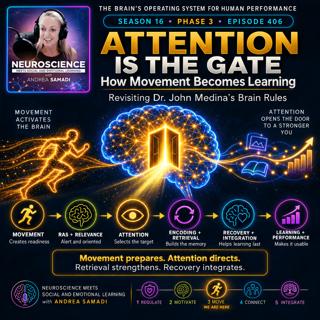
Attention Is the Gate—How Movement Becomes Lasting Learning with Dr. John Medina

Attention Is the Gate—How Movement Becomes Lasting Learning with Dr. John Medina

Episode 406 explains how movement prepares the brain but does not guarantee learning. It traces the full sequence—movement, RAS-driven readiness, salience and relevance, focused attention, encoding, r...

6 Sep 46min
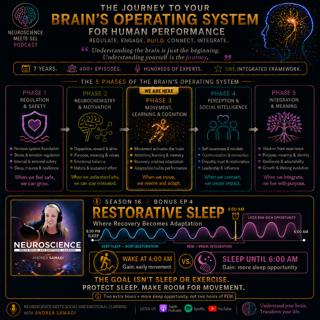
The 4:00 AM Tradeoff: Movement, REM and Recovery (Bonus Episode)

The 4:00 AM Tradeoff: Movement, REM and Recovery (Bonus Episode)

In this episode Andrea Samadi explores how movement and sleep work together in a "brain operating system" for human performance, focusing on restorative sleep (deep + REM), personal WHOOP data, and th...

30 Aug 29min
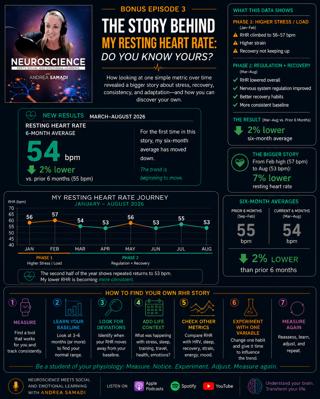
The Hidden Story Behind Your Resting Heart Rate: What Your RHR Can Reveal About Stress, Recovery & Adaptation

The Hidden Story Behind Your Resting Heart Rate: What Your RHR Can Reveal About Stress, Recovery & Adaptation

Andrea Samadi shares her personal resting heart rate data to show why measuring over time matters more than fixating on a single score. She explains how trends reveal stress, recovery, and adaptation,...

23 Aug 30min
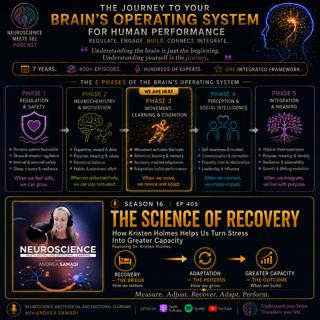
The Science of Recovery—How Dr. Kristen Holmes Helps Us Turn Stress Into Greater Capacity

The Science of Recovery—How Dr. Kristen Holmes Helps Us Turn Stress Into Greater Capacity

In this episode Andrea Samadi explores Phase 3 of the Brain's Operating System—movement, learning, and cognition—focusing on the recovery and adaptation side of the "movement loop." She revisits Dr. K...

16 Aug 45min
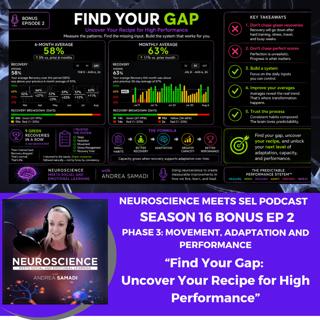
Find Your Gap: How Recovery Unlocks Predictable Performance (Bonus Episode)

Find Your Gap: How Recovery Unlocks Predictable Performance (Bonus Episode)

In this bonus episode Andrea Samadi introduces the Predictable Performance System, a practical roadmap from her Brain’s Operating System. She shows how measuring patterns—not chasing daily scores—plus...

9 Aug 30min
Dr. John Ratey and The Movement Loop: How Movement Becomes Human Performance

Dr. John Ratey and The Movement Loop: How Movement Becomes Human Performance

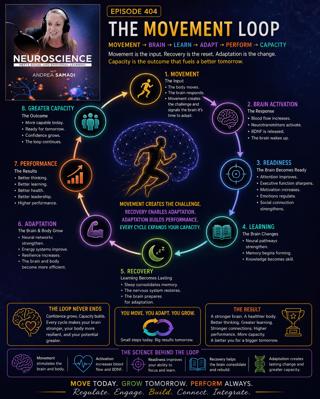
In this episode Andrea Samadi explores Phase Three of the Brain’s Operating System — how movement acts as the essential input that activates the brain, sharpens attention, boosts learning, and improve...

2 Aug 21min
Five Years, 1,905 Recoveries: How Daily Movement Rewires Your Brain (Bonus Episode)

Five Years, 1,905 Recoveries: How Daily Movement Rewires Your Brain (Bonus Episode)

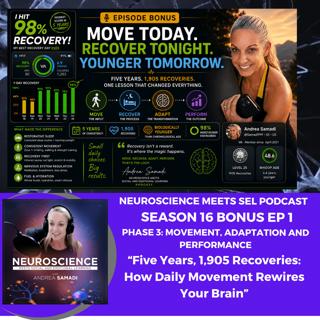
Andrea Samadi shares a five-year self-experiment using a WHOOP wearable to track sleep, recovery, movement, and biological age. She reveals how daily low-intensity movement and consistent recovery—not...

25 Juli 16min
The Movement Loop: How Movement Activates the Brain for Learning, Adaptation & Performance

The Movement Loop: How Movement Activates the Brain for Learning, Adaptation & Performance

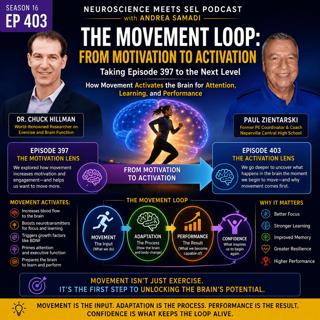
Welcome back to Season 16 of the Neuroscience Meets Social and Emotional Learning Podcast. I'm Andrea Samadi, and this is where we bridge neuroscience, social and emotional learning, and human perform...

19 Juli 34min

Populärt inom Utbildning

historiepodden-se
det-skaver
rss-bara-en-till-om-beroende-medberoende
nu-blir-det-historia
harrisons-dramatiska-historia
allt-du-velat-veta
not-fanny-anymore
rss-viktmedicinpodden
johannes-hansen-podcast
i-vantan-pa-katastrofen
rikatillsammans-om-privatekonomi-rikedom-i-livet
sa-in-i-sjalen
roda-vita-rosen
rss-basta-livet
rss-ar-det-rimligt
sektledare
rss-foraldramotet-bring-lagercrantz
rss-max-tant-med-max-villman
rss-autismandan
rss-traningsklubben