Dr. John Dunlosky on "Improving Student Success: Some Principles from Cognitive Science"

Dr. John Dunlosky on "Improving Student Success: Some Principles from Cognitive Science"

This is episode #37 with Dr. John Dunlosky, a Professor of Psychology at Kent State University, who has contributed empirical and theoretical work on memory and metacognition, including theories of self-regulated learning and metacomprehension. You can watch this interview on Youtube for the visuals.

Welcome to the Neuroscience Meets Social and Emotional Learning podcast, my name is Andrea Samadi, I’m a former educator whose been fascinated with understanding the science behind high performance strategies in schools, sports and the workplace for the past 20 years. Each week we bring you an expert who has risen to the top in their industry with specific strategies that you can implement immediately to take your results to the next level.

I’m so excited to introduce you to Dr. John Dunlosky. John’s research has focused on understanding three inter-related components of self-regulated learning: (1) the monitoring of learning, (2) control of study time, and (3) the application of strategies during learning. These three components of learning fall under the rubric of metacognition, which is about people's cognition (the mental processes like thinking, knowing, remembering, judging and problem-solving, all involved in gaining knowledge and comprehension).[i] By studying metacognition in students across the life span, a major goal of his research involves developing techniques to improve student learning and achievement.

Welcome John! Thank you so much for taking the time away from your important work to be here to share your research and thoughts for improving student learning.

Question 1: I first heard you back in 2016 on an Edweek Webinar, speaking about “deliberate practice” being one of the most effective learning strategies, vs cramming, and I wrote that down and that concept has ended up in all my presentations for the K-12 school market ever since. I recently watched your presentation from the McMaster Symposium on Cognition, Learning and Education[ii] where you dive deep into your research. Can you give an overview of what launched your research with learning strategies and do you think that we can learn ANYTHING with enough deliberate practice over time?

Question 2: When you were doing your research to find which learning strategies work the best, what surprised you the most, and what feedback did you hear about your discoveries?

Question 3: Knowing what strategies scored the highest in your research (distributed practice—spacing study sessions out over time vs cramming) and retrieval practice or practice test taking using multiple choice, fill in the blanks, or essay type recall) do you see that these methods are used more frequently now by students? What have you seen with the application of your research?

Question 4: What happens next? Once a student uses distributed practice and retrieval practice, what is successive relearning?

Question 5: It caught my attention that a major aim of your research is to develop techniques to improve the effectiveness of people’s self-regulated learning because self-regulation is the most requested topic I see when working with schools, especially with older students (middle school and high school) and it seems to be the skill that challenges most adults (thinking where we are at the start of the year setting new goals for ourselves and many goal-setter fall off their plan before January is complete). Why did you choose self-regulation opposed to let’s say growth mindset or something, and what are your current goals with your Metacognition and Education Lab?[iii] Note- Self-Regulation is one of the six social and emotional competencies that we dive deep into here on the podcast (episode 14).[iv]

Question 6: I was reading your book on the weekend, the first textbook to be written on metacognition, can you share what metacognition is, and why it’s so important for the learning process?

Question 7: Is there anything else that’s important that you have uncovered to help improve student learning and achievement that I might have missed?

Thank you very much John, for taking the time to be here today to share your knowledge and wisdom on these evidence-based learning strategies. If someone wants to learn more about your work is the best place through Kent State’s website? [v] I’ve also included your full study from Sage Journals[vi] in the show-notes. Thanks John.

REFERENCES:

[i] The Basics of Cognition and Mental Processes by Kendra Cherry June 16, 2019 https://www.verywellmind.com/what-is-cognition-2794982

[ii] Dr. John Dunlosky McMaster Symposium on Cognition, Learning and Education (YouTube Published Dec. 12, 2013). https://www.youtube.com/watch?v=7KsC9CktCno&t=2102s

[iii] https://www.kent.edu/psychology/metacognition-education-lab

[iv]Neuroscience Meets Social and Emotional Learning Podcast EPISODE #14 “Self-Regulation: The foundational Learning Skill for Future Success” https://podcasts.apple.com/us/podcast/self-regulation-foundational-learning-skill-for-future/id1469683141?i=1000447299318

[v] https://www.kent.edu/psychology/profile/john-dunlosky

[vi] https://journals.sagepub.com/stoken/rbtfl/Z10jaVH/60XQM/full

Det här avsnittet är hämtat från ett öppet RSS-flöde och publiceras inte av Podme. Det kan innehålla reklam.

Avsnitt(414)

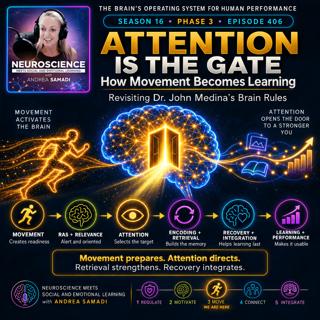
Attention Is the Gate—How Movement Becomes Lasting Learning with Dr. John Medina

Attention Is the Gate—How Movement Becomes Lasting Learning with Dr. John Medina

Episode 406 explains how movement prepares the brain but does not guarantee learning. It traces the full sequence—movement, RAS-driven readiness, salience and relevance, focused attention, encoding, r...

6 Sep 46min
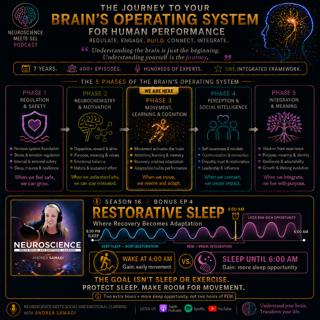
The 4:00 AM Tradeoff: Movement, REM and Recovery (Bonus Episode)

The 4:00 AM Tradeoff: Movement, REM and Recovery (Bonus Episode)

In this episode Andrea Samadi explores how movement and sleep work together in a "brain operating system" for human performance, focusing on restorative sleep (deep + REM), personal WHOOP data, and th...

30 Aug 29min
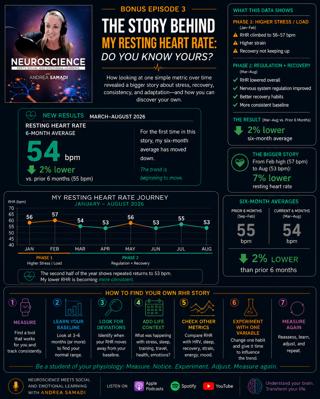
The Hidden Story Behind Your Resting Heart Rate: What Your RHR Can Reveal About Stress, Recovery & Adaptation

The Hidden Story Behind Your Resting Heart Rate: What Your RHR Can Reveal About Stress, Recovery & Adaptation

Andrea Samadi shares her personal resting heart rate data to show why measuring over time matters more than fixating on a single score. She explains how trends reveal stress, recovery, and adaptation,...

23 Aug 30min
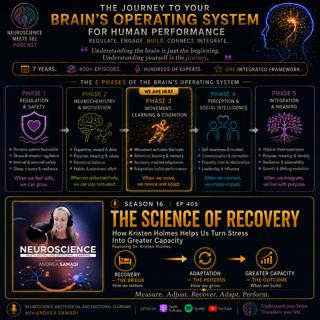
The Science of Recovery—How Dr. Kristen Holmes Helps Us Turn Stress Into Greater Capacity

The Science of Recovery—How Dr. Kristen Holmes Helps Us Turn Stress Into Greater Capacity

In this episode Andrea Samadi explores Phase 3 of the Brain's Operating System—movement, learning, and cognition—focusing on the recovery and adaptation side of the "movement loop." She revisits Dr. K...

16 Aug 45min
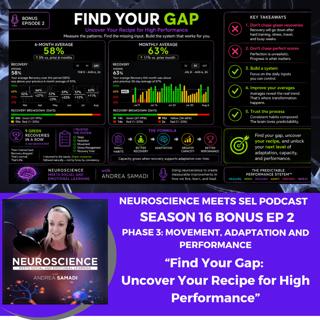
Find Your Gap: How Recovery Unlocks Predictable Performance (Bonus Episode)

Find Your Gap: How Recovery Unlocks Predictable Performance (Bonus Episode)

In this bonus episode Andrea Samadi introduces the Predictable Performance System, a practical roadmap from her Brain’s Operating System. She shows how measuring patterns—not chasing daily scores—plus...

9 Aug 30min
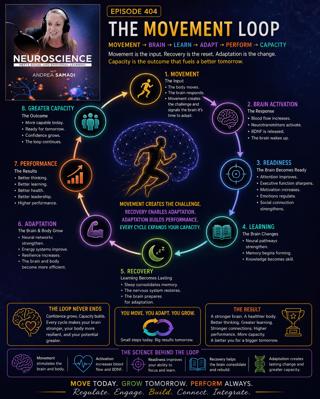
Dr. John Ratey and The Movement Loop: How Movement Becomes Human Performance

Dr. John Ratey and The Movement Loop: How Movement Becomes Human Performance

In this episode Andrea Samadi explores Phase Three of the Brain’s Operating System — how movement acts as the essential input that activates the brain, sharpens attention, boosts learning, and improve...

2 Aug 21min
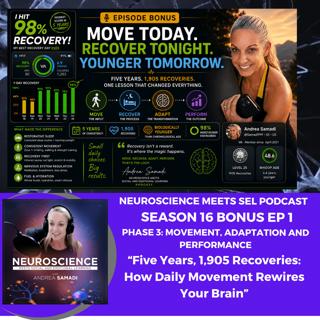
Five Years, 1,905 Recoveries: How Daily Movement Rewires Your Brain (Bonus Episode)

Five Years, 1,905 Recoveries: How Daily Movement Rewires Your Brain (Bonus Episode)

Andrea Samadi shares a five-year self-experiment using a WHOOP wearable to track sleep, recovery, movement, and biological age. She reveals how daily low-intensity movement and consistent recovery—not...

25 Juli 16min
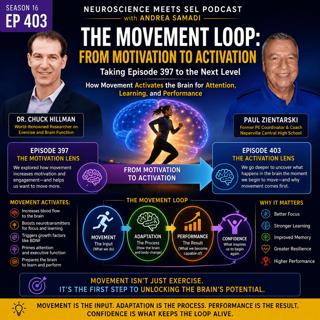
The Movement Loop: How Movement Activates the Brain for Learning, Adaptation & Performance

The Movement Loop: How Movement Activates the Brain for Learning, Adaptation & Performance

Welcome back to Season 16 of the Neuroscience Meets Social and Emotional Learning Podcast. I'm Andrea Samadi, and this is where we bridge neuroscience, social and emotional learning, and human perform...

19 Juli 34min
Populärt inom Utbildning

historiepodden-se
rss-bara-en-till-om-beroende-medberoende
det-skaver
allt-du-velat-veta
harrisons-dramatiska-historia
nu-blir-det-historia
rikatillsammans-om-privatekonomi-rikedom-i-livet
rss-viktmedicinpodden
not-fanny-anymore
i-vantan-pa-katastrofen
johannes-hansen-podcast
roda-vita-rosen
sa-in-i-sjalen
rss-max-tant-med-max-villman
rss-basta-livet
rss-ar-det-rimligt
sektledare
rss-sjalsligt-avkladd
rss-foraldramotet-bring-lagercrantz
rss-traningsklubben