Neuroscience Researcher Stefanie Faye on "Using Neuroscience to Improve our Mindset, Self Regulation and Self-Awareness"

Neuroscience Researcher Stefanie Faye on "Using Neuroscience to Improve our Mindset, Self Regulation and Self-Awareness"

This is episode #39 with neuroscience researcher and clinician Stefanie Faye, whose research is focused on brainwaves, heart rhythms and micro-movements[i] that influence our ability to self-regulate and build healthy relationships. Listen to the interview here or watch the YouTube for the visuals.

Welcome to the Neuroscience Meets Social and Emotional Learning podcast, my name is Andrea Samadi, I’m a former educator whose been fascinated with understanding the science behind high performance strategies in schools, sports and the workplace for the past 20 years. Each week we bring you an expert who has risen to the top of their industry with specific strategies that you can implement immediately, whether you are a teacher or student in the classroom, or working in the corporate world, to take your results to the next level.

I’ve got to give you a bit more background on Stefanie Faye Frank, whose graduate research at New York University and fieldwork at the NYU Phelps lab for neuroscience research, the NYU Institute for Prevention Science and Yeshiva University's Albert Einstein College of Medicine focused on the cross-section of self-directed neuroplasticity, empathy and social justice. For the past decade, she’s been teaching and consulting in countries all over the world by combining scientific insights and her training in monasteries with meditation masters from India, Africa and Vietnam. She has delivered a series of workshops for Google's Analytics Academy in London, Chicago, Tel Aviv, Munich and Singapore focused on the Science of Learning.

Stephanie, I am so grateful to have you here today, to share some of your fascinating research with our listeners. I found your work through YouTube[ii], one night, when I was looking to take my understanding of Growth Mindset just a bit deeper for the programs that I offer in the school market. Then I came across one of your videos, that led me to your Mindset Neuroscience Podcast[iii], and then your interview with Maria Xenidou on How to Develop a Growth Mindset[iv] and from here I was blown away with your work, how simple you made everything seem, and I was hooked and wanted to learn everything. I love the FREE online courses you have on your website http://stefaniefaye.com/ and the fact that you are also Canadian (from Calgary) and I grew up in Toronto. Welcome Stefanie!

Question 1: Stefanie, I watched your “Mindset Neuroscience” video course, and thoroughly enjoyed the way you connected neuroscience to building a growth mindset. We have covered Growth Mindset on this podcast with episode 20[v] with “Strategies for Overcoming Obstacles and Cognitive Biases.” I’ve mentioned an Ed Week survey that found that “the vast majority of educators believe that a growth-oriented mindset can help improve students’ motivation, commitment and engagement in learning. But the study found that applying those ideas to practice, and helping students shift their mindset around learning, remains an elusive challenge.”[vi] So applying growth mindset has proven to be something that has not been simple or easy to do—whether in the classroom, workplace, or even in the field of athletics. With your experience why is applying growth mindset proving to be so difficult? What’s happening or not happening at the brain level that we can learn from, to improve the application of these strategies?

Question 2: You talk about some keys to building a Growth Mindset in your video course and one of the keys is to understand neuroplasticity (the ability for the brain to continually change over our lifespan) or how the brain creates high priority pathways with skills that we are practicing and then eliminates low priority pathways with skills we ignore. Can you explain how the brain re-wires itself using myelin and why patterned repetition is so important at the brain level for those skills we want to improve, develop and keep?

Question 3: This is definitely the era where we are coming around more to the fact that we must celebrate mistakes and to fail quickly and often. Can you explain why this is so important to understand from a neuroscientific point of view? What happens to the brain when we fail, make mistakes or do something that we find challenging?

Question 4: One of the most popular episodes, with the highest downloads to date on this podcast was on self-awareness[vii], showing me, this is an important topic to people all over the world. Listening to your podcast, Mindset Neuroscience, I learned about the term Interseption, or becoming aware of the sensations we have in our body and listening and learning to what we are feeling. I have heard before from Dr. Daniel Siegel (episode 28) where he mentions that we have a second brain. Can you explain what this is, is it like intuition? How it can help us with our self-awareness? How can we develop interception to help us be more confident with ourselves?

Question 5: What do you think is the best way to teach self-regulation to students in the classroom, or even adults in the boardroom? No one seems to be immune from learning new skills to keep us on task. When someone is doing something that is working, how can they learn to replicate this experience so they can repeat this strategy in the future? On the other hand, when something is not working, instead of allowing frustrations to come and giving up, losing hope or momentum, how does someone know when and what to do or try next? Do we all need coaches to help guide us/offer feedback or is this a skill we can learn ourselves?

Question 6: As we come to a close, and bring this all in together, is there anything that you think is important to emphasize about how the brain impacts our mindset, self-awareness and self-regulation?

Stefanie, thank you so much for taking the time out of your weekend to speak with me here. I know this is a topic of high interest and appreciate you diving deep with me to help others gain more understanding. If someone wanted to learn more about you, is the best place where I found your online courses www.stefaniefaye.com? Be sure to see Stefanie’s TEDx Talk “Humans: the Most Experience-Dependent Species on the Planet.”[viii] Thank you!

RESOURCES:

[i] https://medium.com/delasign/muscle-mimicry-how-our-thoughts-generate-micro-movements-invisible-to-the-naked-eye-98f2a60f9830

[ii] Stefanie Faye YouTube “Why Growth Mindset Won’t Work” Published March 3, 2017 https://www.youtube.com/watch?v=brfWMFKcsfI

[iii] https://podcasts.apple.com/us/podcast/mindset-neuroscience-podcast/id1366359821

[iv] http://stefaniefayefrank.com/podcast/how-to-develop-a-growth-mindset-my-interview-with-maria-xenidou-part-2/

[v] https://andreasamadi.podbean.com/e/coaching-a-growth-mindset-strategies-for-overcoming-obstacles-and-cognitive-biases/

[vi] “Why Growth Mindset Still Has some Growing to Do” by Rupa Chandra Gupta Nov.12, 2018 https://www.edsurge.com/amp/news/2018-11-12-why-the-growth-mindset-still-needs-to-grow-up

[vii] https://andreasamadi.podbean.com/e/self-awareness-know-thyself/

[viii] http://stefaniefayefrank.com/articles/my-tedx-talk-humans-the-most-experience-dependent-species-on-the-planet/

Det här avsnittet är hämtat från ett öppet RSS-flöde och publiceras inte av Podme. Det kan innehålla reklam.

Avsnitt(414)

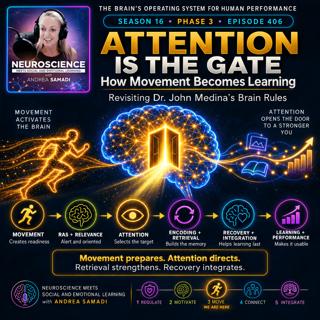
Attention Is the Gate—How Movement Becomes Lasting Learning with Dr. John Medina

Attention Is the Gate—How Movement Becomes Lasting Learning with Dr. John Medina

Episode 406 explains how movement prepares the brain but does not guarantee learning. It traces the full sequence—movement, RAS-driven readiness, salience and relevance, focused attention, encoding, r...

6 Sep 46min
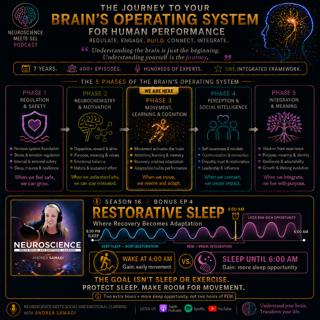
The 4:00 AM Tradeoff: Movement, REM and Recovery (Bonus Episode)

The 4:00 AM Tradeoff: Movement, REM and Recovery (Bonus Episode)

In this episode Andrea Samadi explores how movement and sleep work together in a "brain operating system" for human performance, focusing on restorative sleep (deep + REM), personal WHOOP data, and th...

30 Aug 29min
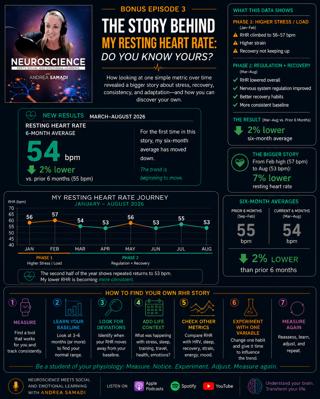
The Hidden Story Behind Your Resting Heart Rate: What Your RHR Can Reveal About Stress, Recovery & Adaptation

The Hidden Story Behind Your Resting Heart Rate: What Your RHR Can Reveal About Stress, Recovery & Adaptation

Andrea Samadi shares her personal resting heart rate data to show why measuring over time matters more than fixating on a single score. She explains how trends reveal stress, recovery, and adaptation,...

23 Aug 30min
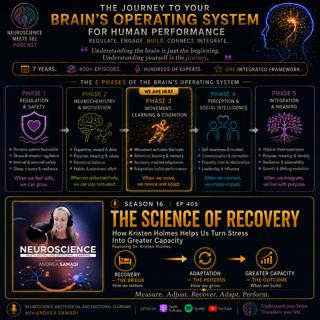
The Science of Recovery—How Dr. Kristen Holmes Helps Us Turn Stress Into Greater Capacity

The Science of Recovery—How Dr. Kristen Holmes Helps Us Turn Stress Into Greater Capacity

In this episode Andrea Samadi explores Phase 3 of the Brain's Operating System—movement, learning, and cognition—focusing on the recovery and adaptation side of the "movement loop." She revisits Dr. K...

16 Aug 45min
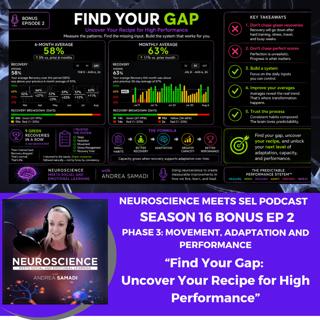
Find Your Gap: How Recovery Unlocks Predictable Performance (Bonus Episode)

Find Your Gap: How Recovery Unlocks Predictable Performance (Bonus Episode)

In this bonus episode Andrea Samadi introduces the Predictable Performance System, a practical roadmap from her Brain’s Operating System. She shows how measuring patterns—not chasing daily scores—plus...

9 Aug 30min
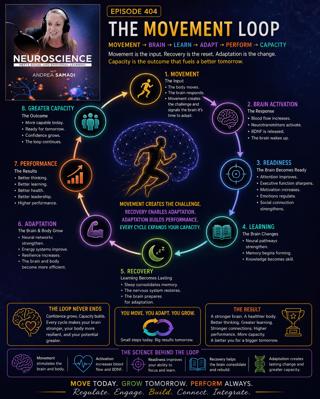
Dr. John Ratey and The Movement Loop: How Movement Becomes Human Performance

Dr. John Ratey and The Movement Loop: How Movement Becomes Human Performance

In this episode Andrea Samadi explores Phase Three of the Brain’s Operating System — how movement acts as the essential input that activates the brain, sharpens attention, boosts learning, and improve...

2 Aug 21min
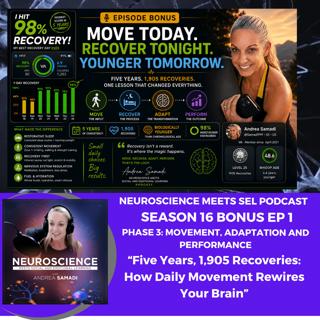
Five Years, 1,905 Recoveries: How Daily Movement Rewires Your Brain (Bonus Episode)

Five Years, 1,905 Recoveries: How Daily Movement Rewires Your Brain (Bonus Episode)

Andrea Samadi shares a five-year self-experiment using a WHOOP wearable to track sleep, recovery, movement, and biological age. She reveals how daily low-intensity movement and consistent recovery—not...

25 Juli 16min
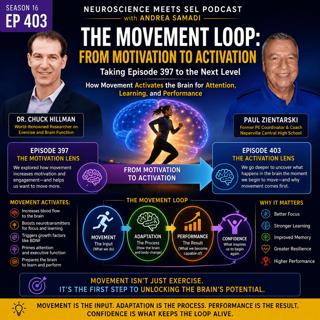
The Movement Loop: How Movement Activates the Brain for Learning, Adaptation & Performance

The Movement Loop: How Movement Activates the Brain for Learning, Adaptation & Performance

Welcome back to Season 16 of the Neuroscience Meets Social and Emotional Learning Podcast. I'm Andrea Samadi, and this is where we bridge neuroscience, social and emotional learning, and human perform...

19 Juli 34min

Populärt inom Utbildning

historiepodden-se
det-skaver
rss-bara-en-till-om-beroende-medberoende
nu-blir-det-historia
harrisons-dramatiska-historia
allt-du-velat-veta
not-fanny-anymore
rss-viktmedicinpodden
johannes-hansen-podcast
i-vantan-pa-katastrofen
rikatillsammans-om-privatekonomi-rikedom-i-livet
sa-in-i-sjalen
roda-vita-rosen
rss-basta-livet
rss-ar-det-rimligt
sektledare
rss-foraldramotet-bring-lagercrantz
rss-max-tant-med-max-villman
rss-autismandan
rss-traningsklubben