CEO and President of Casel, Karen Niemi on "Tools and Strategies to Enhance and Expand SEL in our Schools and Communities"

CEO and President of Casel, Karen Niemi on "Tools and Strategies to Enhance and Expand SEL in our Schools and Communities"

This is episode #62: with the President and CEO of CASEL (Collaborative for Academic, Social, and Emotional Learning, which is the trusted source for knowledge about high-quality, evidence-based social and emotional learning) Karen Niemi. You can watch the interview on YouTube here.

Welcome back to the Neuroscience Meets Social and Emotional Learning podcast, my name is Andrea Samadi, I’m a former educator who created this podcast to bring the most current neuroscience research, along with high performing experts who have risen to the top of their field with specific strategies or ideas that you can implement immediately, whether you are a teacher in the classroom, a parent trying to figure out homeschooling and working from home,  or someone working in the corporate world, to take your results to the next level. 

Today our podcast comes full circle, as anyone who follows our work, will know that we launched this idea almost a year ago, when I saw a huge need for a platform for social and emotional learning when Casel’s first SEL Exchange in 2019,[i] drew an interest from over 850 speakers around the country to present their ideas to help improve our schools, homes and communities with SEL and this inaugural SEL conference drew over 1,500 attendees from 48 states and 30 countries.

I am thrilled to have the Karen Niemi, the President and CEO of CASEL here today. Karen oversees and directs all of CASEL’s activities to enhance and expand evidence-based social and emotional learning, including practice, research, communications, policy, and development. This is no small feat, but as an accomplished business leader with a long track record of success in the education sector she blends a deep understanding of school systems and pedagogy with solid business practice and has successfully led educational companies through all stages of growth. She has also helped schools advance their educational mission by making research and best practices accessible and actionable by teachers and administrators and has brought learning tools and strategies to school systems and students nationwide.

Welcome Karen, it’s such an honor to have you here today. I must give David Adams from episode #54[ii] a shout out and thanks for introducing us and let you know that we have had a few leaders from Casel, like Clark McKown, the President and Founder of xSEL labs[iii] who is on the advisory board for Casel’s Measuring SEL Initiative[iv] as well as Yale’s Center for Emotional Intelligence Founder Marc Brackett with his important book “Permission to Feel.”[v] Thank you for coming on today to share your thoughts, experiences tools and resources for SEL at such an important time for parents, educators and everyone for that matter.

Question 1: I was speaking with the President of a large publishing company to potentially develop an SEL program, and many people in this company, were still unclear of the years of research and data behind implementing SEL in our schools. So, even though there’s this huge interest in SEL, not everyone has caught up yet to the benefits behind implementing an SEL program (in our schools) or even an Emotional Intelligence Training program in our workplaces for those who are in the workforce and are missing these important skills. I pointed them to your research page https://casel.org/research/ and explained about the 11 percentile point academic gain. How can we spread the word of all of the resources that Casel offers, that’s really been the Hallmark of your work since its founding? Can you give an overview of all of the resources that Casel offers?

Question 2: There’s a lot of people who work at Casel with your board, staff, consultants, funders and collaborators. I know Linda Dusenbury from following her Collaborating States Initiative[vi] since 2016 as I watched with amazement when SEL standards slowly but surely started being implemented in schools across the country, and I know of some of the people in your research department, but can you give an overview of “Who Works” with Casel in addition to some of the new initiatives that have been formed like your Assessment Work Group[vii]?

Question 3: With the research in mind, why should every student be exposed to SEL? What gains do they see? For schools listening, what would you say would be the main reason behind why should schools invest in SEL, the importance of parents implementing these skills at home and corporations continuing to reinforce these skills in the workplace? (How is Casel currently conducting research?[viii])

Question 4: What are the social and emotional competencies, and out of all of them, what ones do you think have been missing in our schools? Why do you think this is the case? What’s different now, from 20 years ago?

Question 5: As more and more schools are looking for SEL programs, highlighting evidence-based programs and how to access them would be helpful. On CASEL’s Recommended Program Guides: What are they, how can people access them?[ix]

Question 6: As a vendor of an SEL program I created and launched with a partnership with AZ schools and AZ Dept of Education in 2014 a few years before this buzz for SEL began, I’m speaking on behalf of all the great programs out there that have not a) even thought of what they must to do to show efficacy and to appear in your program guide b) are not even sure of where to begin this process.

Back in 2014 there just wasn’t all the valuable resources available as there are now. Panorama Education was just emerging with their SEL measurement tools and I didn’t have the understanding of how to properly measure students who I was working with (that I know better now from Clark McKown) and I know that many other vendors are not clear on how to properly measure students before, during and after program results. After a few years of measuring and submitting data to earn the “evidence-based” criteria and being unsuccessful, I just gave up.

Would there ever be a step by step training program on the requirements to have a program reviewed to be considered evidence-based so it would be clear on exactly how a program qualifies to appear in your program guides, especially for the middle and high school ages where there could be more options for schools? How would NEW vendors be able to qualify for the program guide review process? Do you recommend partnering with your local University for this?

Question 7: Where do you envision SEL going in the next 5 years? Do you think it will ever be as important as the core subjects?

Karen, I want to thank you very much for the time you have taken to meet with me today, and share a deeper dive into everything that you offer at Casel. For people who want to learn more about Casel, they can go to casel.org and I have included everything we are speaking about in the show notes. Can you explain your CASEL CARES[x] Initiative, and your Weekly Webinar Series[xi], and anything else that I might have missed that you think would be important for people to know about?

REFERENCES:

[i] 2019 CASEL Exchange Conference https://www.collaborativeclassroom.org/casel-sel-exchange-2019-conference-chicago-il/

[ii] Neuroscience Meets SEL Podcast Episode #54 David Adams on “ A New Vision for Education: Living Up to the Values We Want for Our Next Generation” https://www.achieveit360.com/director-of-sel-david-adams-on-a-new-vision-of-education-living-up-to-the-values-we-want-for-our-next-generation/

[iii] xSEL Labs: Helping Educators Understand Children’s Social and Emotional Strengths and Needs https://xsel-labs.com/about/about-us/

[iv] Measuring SEL Initiative https://measuringsel.casel.org/our-initiative/

[v] Neuroscience Meets SEL Podcast Episode #22 with Yale’s Center for Emotional Intelligence Founder, Marc Brackett with his book, “Permission to Feel.” https://www.achieveit360.com/founding-director-of-the-yale-center-for-emotional-intelligence-on-his-new-book-permission-to-feel/

[vi] https://casel.org/collaborative-state-initiative/

[vii] https://casel.org/assessment-work-group/

[viii] https://casel.org/from-casel/

[ix] https://casel.org/guide/

[x] https://casel.org/resources-covid/

[xi] https://casel.org/weekly-webinars/

Det här avsnittet är hämtat från ett öppet RSS-flöde och publiceras inte av Podme. Det kan innehålla reklam.

Avsnitt(414)

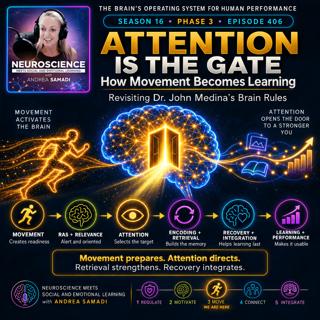
Attention Is the Gate—How Movement Becomes Lasting Learning with Dr. John Medina

Attention Is the Gate—How Movement Becomes Lasting Learning with Dr. John Medina

Episode 406 explains how movement prepares the brain but does not guarantee learning. It traces the full sequence—movement, RAS-driven readiness, salience and relevance, focused attention, encoding, r...

6 Sep 46min
The 4:00 AM Tradeoff: Movement, REM and Recovery (Bonus Episode)

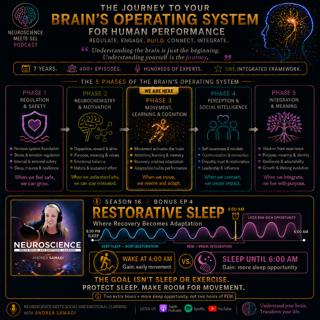
The 4:00 AM Tradeoff: Movement, REM and Recovery (Bonus Episode)

In this episode Andrea Samadi explores how movement and sleep work together in a "brain operating system" for human performance, focusing on restorative sleep (deep + REM), personal WHOOP data, and th...

30 Aug 29min
The Hidden Story Behind Your Resting Heart Rate: What Your RHR Can Reveal About Stress, Recovery & Adaptation (Bonus Episode)

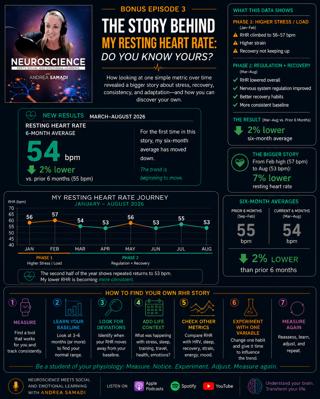
The Hidden Story Behind Your Resting Heart Rate: What Your RHR Can Reveal About Stress, Recovery & Adaptation (Bonus Episode)

Andrea Samadi shares her personal resting heart rate data to show why measuring over time matters more than fixating on a single score. She explains how trends reveal stress, recovery, and adaptation,...

23 Aug 30min
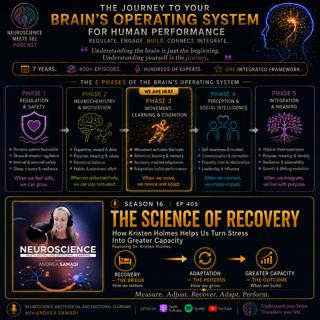
The Science of Recovery—How Dr. Kristen Holmes Helps Us Turn Stress Into Greater Capacity

The Science of Recovery—How Dr. Kristen Holmes Helps Us Turn Stress Into Greater Capacity

In this episode Andrea Samadi explores Phase 3 of the Brain's Operating System—movement, learning, and cognition—focusing on the recovery and adaptation side of the "movement loop." She revisits Dr. K...

16 Aug 45min
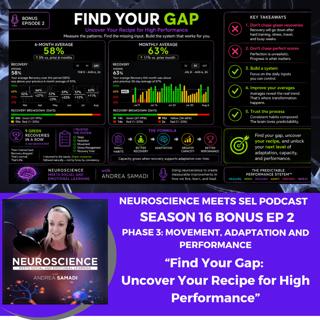
Find Your Gap: How Recovery Unlocks Predictable Performance (Bonus Episode)

Find Your Gap: How Recovery Unlocks Predictable Performance (Bonus Episode)

In this bonus episode Andrea Samadi introduces the Predictable Performance System, a practical roadmap from her Brain’s Operating System. She shows how measuring patterns—not chasing daily scores—plus...

9 Aug 30min
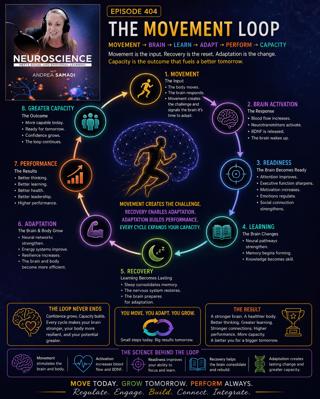
Dr. John Ratey and The Movement Loop: How Movement Becomes Human Performance

Dr. John Ratey and The Movement Loop: How Movement Becomes Human Performance

In this episode Andrea Samadi explores Phase Three of the Brain’s Operating System — how movement acts as the essential input that activates the brain, sharpens attention, boosts learning, and improve...

2 Aug 21min
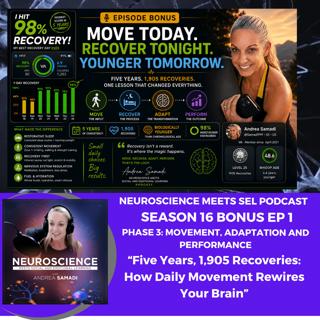
Five Years, 1,905 Recoveries: How Daily Movement Rewires Your Brain (Bonus Episode)

Five Years, 1,905 Recoveries: How Daily Movement Rewires Your Brain (Bonus Episode)

Andrea Samadi shares a five-year self-experiment using a WHOOP wearable to track sleep, recovery, movement, and biological age. She reveals how daily low-intensity movement and consistent recovery—not...

25 Juli 16min
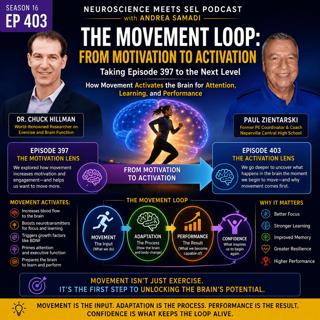
The Movement Loop: How Movement Activates the Brain for Learning, Adaptation & Performance

The Movement Loop: How Movement Activates the Brain for Learning, Adaptation & Performance

Welcome back to Season 16 of the Neuroscience Meets Social and Emotional Learning Podcast. I'm Andrea Samadi, and this is where we bridge neuroscience, social and emotional learning, and human perform...

19 Juli 34min
Populärt inom Utbildning

historiepodden-se
rss-bara-en-till-om-beroende-medberoende
det-skaver
nu-blir-det-historia
harrisons-dramatiska-historia
not-fanny-anymore
allt-du-velat-veta
rss-viktmedicinpodden
johannes-hansen-podcast
sa-in-i-sjalen
i-vantan-pa-katastrofen
rss-max-tant-med-max-villman
rikatillsammans-om-privatekonomi-rikedom-i-livet
roda-vita-rosen
rss-basta-livet
rss-autismandan
rss-ar-det-rimligt
rss-foraldramotet-bring-lagercrantz
rss-okrystat
rss-traningsklubben