Certified Neurocoach Ben Ampil on "Using Your Brain to Manage Your Behavior and Results"

Certified Neurocoach Ben Ampil on "Using Your Brain to Manage Your Behavior and Results"

Welcome back to the Neuroscience Meets Social and Emotional Learning podcast, episode #69 with Ben Ampil, a US-Certified Neuroscience Coach and Neuro-Linguistic Programming (NLP) Trainer who I have watched all over the news this weekend, even though he is located in the Philippines, his positive message about using your brain to manage your behavior is having a global impact and following. Watch the interview with visuals here on YouTube.

My name is Andrea Samadi, and if you are new here, I’m a former educator who created this podcast to bring the most current neuroscience research, along with high performing experts who have risen to the top of their field with specific strategies or ideas that you can implement immediately, to take your results to the next level.  

I’m beyond excited to speak with Ben Ampil today and we’ve been chatting about our topic the past week or so, adding new thoughts and ideas to his message as things in the world are changing on a daily basis, but Ben’s message remains consistent. He has had extensive corporate experience in the various cross-functional disciplines of General Management, in a variety of Industries and has also been a Keynote Speaker in Conferences in Neuroscience in London and in Bangkok. His background and speaking history is top notch, and I know that he will share some insights to make us all think differently after this interview about the best ways for us to manage our behavior with our brain in mind.

Welcome Ben! All the way from Manila, Philippines! This was fun setting up this interview and making sure we had the time zone correct. You are so right, nothing is going to stop us from finding the right time to speak together and from now on, I will be mindful about what it means for me to say “see you tomorrow” because my tomorrow and your tomorrow are 15 hours apart.

Q1: Since connecting with you on LinkedIn, I noticed many similarities with how much we are both passionate about the topic of neuroscience. It’s an area I lose track of time when I’m learning and studying and spend all of my spare time with. What got you interested and passionate about the field of Neuroscience?

Q2: I’ll never forget the first person who introduced me to this topic. He was a school administrator and he urged me to take my work in this direction. He handed me a bunch of books off his bookshelf, one of them was a series from David Souza on How the Brain Learns[i] (to Read, the Special Needs Brain, the Gifted Brain, the ELL Brain etc) and at first glance of this book series, without any knowledge of how the brain works, it can be an intimidating topic. You’ve created some acronyms to help demystify an otherwise intimidating topic like “Neuroscience”

Can we break this down a bit?

2 A) CHANGE OUR PARADIGMS vs BEHAVIOR: The past few podcasts I’ve taken a deep look at the fact that in order to make significant change in our life, we need to change our paradigms vs our behavior….Can you explain how our brains work with your acronym BATMAN and keep in mind that we don’t want to just change our behavior, but change some of our old ways of thinking or beliefs that might be keeping us stuck?

2 B) WHAT ARE SOME STRATEGIES FOR OVERCOMING THE FEAR WE MIGHT BE FEELING IN THE WORLD TODAY? (Real fears like you’ve lost your job, or someone you know is really struggling with something or even a perceived or imagined fear?) SCORE

2 C) Over the weekend, I created a graphic based on Dr. Bruce Perry’s concept of the Power Differential that describes the fact that there is this power differential that puts one person at a cognitive disadvantage and can cause significant issues with leadership and communication (it describes what happens to a young child’s brain when dealing with an adult, or when anyone gets pulled over by a policeman for speeding etc. What are triggers the fear we feel coming from the amygdala and what are some solutions we can keep in mind to offset this instinctive fear? SCARF as a solution

Q3: I know that we all know that when our brain works right, everything else works right. What other strategies do you suggest to better manage our brain/minds and behavior during these times, so that we can continue to move forward and make progress in our lives?

Q4: From all of the work you have been doing all over the world with Neuro-Linguistic Programming (NLP) and Neuro-Coaching with Business Executives, what do you see as some of the most common reasons that people become stuck with their results? What do you think we should all know and practice daily to improve our personal and professional results, with the brain in mind?

Q5: What strategies that you teach about, have you found to be the most useful for you, in your own personal and professional life?

Q6: To sum this all up, what’s a simple way for us to all remember these strategies to Manage our Minds and Behavior? BATMAN/SCORE /SCARFand SELFISH?

Thank you for this interview, Ben, for the insightful conversations we’ve had as weve been preparing for this interview and for doing this after hours in Manila. If people want to learn more about you, they can go to www.benampil.com and follow you @Ben Ampil on LinkedIn, Twitter and Facebook. You’re definitely all over the media, so it’s not difficult to find you! Thank you for everything you are doing to help the world to take some deep breaths, and continue to move forward.

REFERENCES:

[i] David A Sousa, How the Brain Learns https://www.amazon.com/How-Brain-Learns-David-Sousa/dp/1412997976

Det här avsnittet är hämtat från ett öppet RSS-flöde och publiceras inte av Podme. Det kan innehålla reklam.

Avsnitt(414)

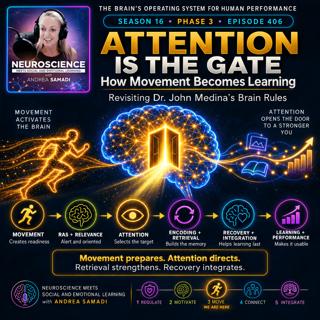
Attention Is the Gate—How Movement Becomes Lasting Learning with Dr. John Medina

Attention Is the Gate—How Movement Becomes Lasting Learning with Dr. John Medina

Episode 406 explains how movement prepares the brain but does not guarantee learning. It traces the full sequence—movement, RAS-driven readiness, salience and relevance, focused attention, encoding, r...

6 Sep 46min
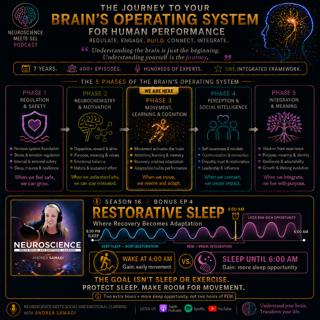
The 4:00 AM Tradeoff: Movement, REM and Recovery (Bonus Episode)

The 4:00 AM Tradeoff: Movement, REM and Recovery (Bonus Episode)

In this episode Andrea Samadi explores how movement and sleep work together in a "brain operating system" for human performance, focusing on restorative sleep (deep + REM), personal WHOOP data, and th...

30 Aug 29min
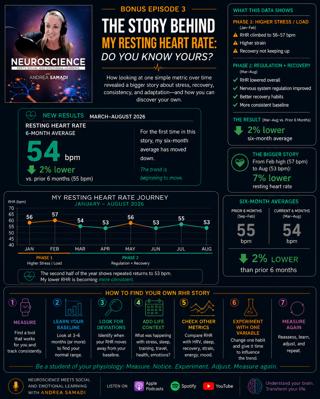
The Hidden Story Behind Your Resting Heart Rate: What Your RHR Can Reveal About Stress, Recovery & Adaptation (Bonus Episode)

The Hidden Story Behind Your Resting Heart Rate: What Your RHR Can Reveal About Stress, Recovery & Adaptation (Bonus Episode)

Andrea Samadi shares her personal resting heart rate data to show why measuring over time matters more than fixating on a single score. She explains how trends reveal stress, recovery, and adaptation,...

23 Aug 30min
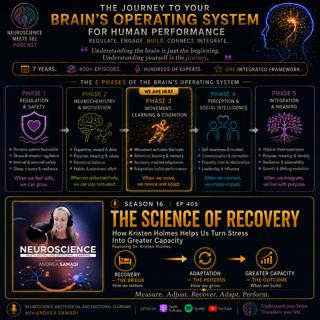
The Science of Recovery—How Dr. Kristen Holmes Helps Us Turn Stress Into Greater Capacity

The Science of Recovery—How Dr. Kristen Holmes Helps Us Turn Stress Into Greater Capacity

In this episode Andrea Samadi explores Phase 3 of the Brain's Operating System—movement, learning, and cognition—focusing on the recovery and adaptation side of the "movement loop." She revisits Dr. K...

16 Aug 45min
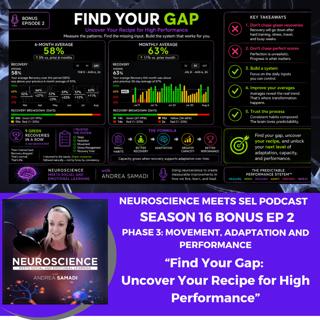
Find Your Gap: How Recovery Unlocks Predictable Performance (Bonus Episode)

Find Your Gap: How Recovery Unlocks Predictable Performance (Bonus Episode)

In this bonus episode Andrea Samadi introduces the Predictable Performance System, a practical roadmap from her Brain’s Operating System. She shows how measuring patterns—not chasing daily scores—plus...

9 Aug 30min
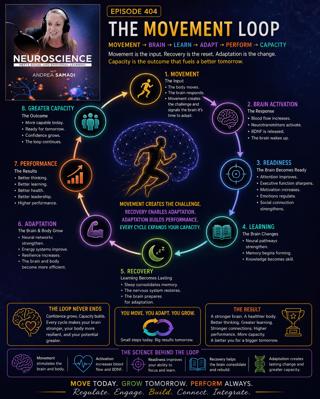
Dr. John Ratey and The Movement Loop: How Movement Becomes Human Performance

Dr. John Ratey and The Movement Loop: How Movement Becomes Human Performance

In this episode Andrea Samadi explores Phase Three of the Brain’s Operating System — how movement acts as the essential input that activates the brain, sharpens attention, boosts learning, and improve...

2 Aug 21min
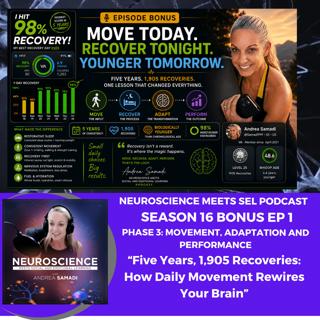
Five Years, 1,905 Recoveries: How Daily Movement Rewires Your Brain (Bonus Episode)

Five Years, 1,905 Recoveries: How Daily Movement Rewires Your Brain (Bonus Episode)

Andrea Samadi shares a five-year self-experiment using a WHOOP wearable to track sleep, recovery, movement, and biological age. She reveals how daily low-intensity movement and consistent recovery—not...

25 Juli 16min
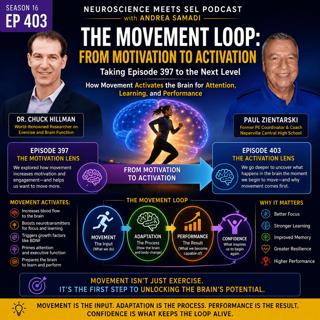
The Movement Loop: How Movement Activates the Brain for Learning, Adaptation & Performance

The Movement Loop: How Movement Activates the Brain for Learning, Adaptation & Performance

Welcome back to Season 16 of the Neuroscience Meets Social and Emotional Learning Podcast. I'm Andrea Samadi, and this is where we bridge neuroscience, social and emotional learning, and human perform...

19 Juli 34min
Populärt inom Utbildning

historiepodden-se
rss-bara-en-till-om-beroende-medberoende
det-skaver
nu-blir-det-historia
harrisons-dramatiska-historia
not-fanny-anymore
allt-du-velat-veta
rss-viktmedicinpodden
johannes-hansen-podcast
sa-in-i-sjalen
i-vantan-pa-katastrofen
rss-max-tant-med-max-villman
rikatillsammans-om-privatekonomi-rikedom-i-livet
roda-vita-rosen
rss-basta-livet
rss-autismandan
rss-ar-det-rimligt
rss-foraldramotet-bring-lagercrantz
rss-okrystat
rss-traningsklubben