Alan Greenspan: “The man who knew”

Alan Greenspan: “The man who knew”

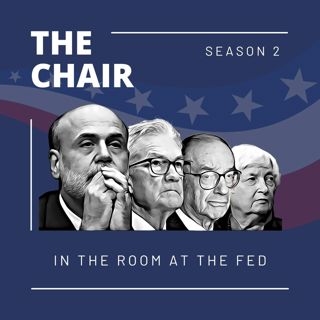
More than any other single institution, the US Federal Reserve drives global capital markets with its decisions and communications. While its interest rates are set by a committee, for almost a century, the Fed’s philosophy and operational approach have been moulded by one person: the Chair of the Board of Governors. In the first series of The Chair, Tim Gwynn Jones talked to authors of books about the Fed's foundational Chairs – Marriner Eccles, Bill Martin, Arthur Burns, and Paul Volcker. In this second series, he covers the people who chaired the Fed through the post-1990 period of financialisation, globalisation, and – perhaps today – deglobalisation. The first episode of the second series explores Alan Greenspan, the chairman who followed Paul Volcker and ran the Fed from 1987 until 2006. Once bestowed with “Maestro” status, Greenspan – who turns 100 in March 2026 – has seen his reputation deflate in the wake of the post-2008 financial crisis. To discuss the fallen Maestro, Tim is joined by Sebastian Mallaby, author of The Man Who Knew: The Life and Times of Alan Greenspan (Bloomsbury, 2016). “Greenspan was the man who knew,” says Mallaby. “He was the man who knew that bubbles were extremely destructive, and yet he was not the man who acted against those bubbles. So, whilst he was great on inflation and on stabilising the price of eggs, he was not good on asset-price inflation or stabilising the price of nest eggs”. A former journalist at The Economist and the Washington Post, Mallaby is the prize-winning author of The World's Banker – a portrait of the World Bank under James Wolfensohn – and More Money Than God: Hedge Funds and the Making of a New Elite. He is now the Paul A. Volcker senior fellow for international economics at the Council on Foreign Relations. Learn more about your ad choices. Visit megaphone.fm/adchoices Support our show by becoming a premium member! https://newbooksnetwork.supportingcast.fm/political-science

Det här avsnittet är hämtat från ett öppet RSS-flöde och publiceras inte av Podme. Det kan innehålla reklam.

Avsnitt(1000)

Why Democracy’s Troubles Should Come as No Surprise

Why Democracy’s Troubles Should Come as No Surprise

Why have so many democracies become more polarized, unstable, and vulnerable to authoritarianism? And why did so many political observers fail to see it coming? In this episode of the People, Power, P...

23 Juni 0s

Jeremy J. Holland, "The Political Worldviews of American Social Movements: Partisan Politics and the Future of Democracy" (Routledge, 2026)

Jeremy J. Holland, "The Political Worldviews of American Social Movements: Partisan Politics and the Future of Democracy" (Routledge, 2026)

The Political Worldviews of American Social Movements: Partisan Politics and the Future of Democracy (Routledge, 2026) explores the political worldviews of progressive American social movements and h...

21 Juni 33min

Jonathan Daly, "The Man Who Knew Russia: Richard Pipes, Humanist and Cold Warrior" (Stanford UP, 2025)

Jonathan Daly, "The Man Who Knew Russia: Richard Pipes, Humanist and Cold Warrior" (Stanford UP, 2025)

He’s been called the man academics love to hate. One time, when the author disclosed that he worked with Pipes, the colleague responded, “I will forgive you.” Love him or hate him, Richard Pipes (19...

21 Juni 1h 17min

Gareth Doherty, "Landscape Fieldwork: How Engaging the World Can Change Design" (U Virginia Press, 2025)

Gareth Doherty, "Landscape Fieldwork: How Engaging the World Can Change Design" (U Virginia Press, 2025)

Landscape architecture is at a crossroads. The ability to draw upon interdisciplinary perspectives and generate insights from the combined vantage points of design, environmental studies, and the so...

21 Juni 1h 3min

Alena Ledeneva, "Russian Pendulum: Paradoxes, Practices and Patterns" (UCL Press, 2026)

Alena Ledeneva, "Russian Pendulum: Paradoxes, Practices and Patterns" (UCL Press, 2026)

Alena Ledeneva is Professor of Politics and Society at the University College London and a founder of the Global Informality Project. Her research focuses on informal practices, and she has written ...

20 Juni 1h 17min

Alex Boodrookas, "Comrades Estranged: Labor and Citizenship in the Twentieth-Century Persian Gulf" (Stanford UP, 2026)

Alex Boodrookas, "Comrades Estranged: Labor and Citizenship in the Twentieth-Century Persian Gulf" (Stanford UP, 2026)

In 1975, Kuwaiti workers orchestrated arguably the most powerful citizen-led movement for noncitizen rights in the history of the Persian Gulf. Their efforts built on decades of wide-ranging struggl...

20 Juni 53min

Anna O. Law, "Migration and the Origins of American Citizenship: African Americans, Native Americans, and Immigrants" (Oxford UP, 2026)

Anna O. Law, "Migration and the Origins of American Citizenship: African Americans, Native Americans, and Immigrants" (Oxford UP, 2026)

Anna O. Law, the Herbert Kurz Chair in Constitutional Rights in the Department of Political Science at City University of New York-Brooklyn Campus, has a deeply researched and important new book that ...

18 Juni 47min

Legacy of the Ancient Greeks: On Classical and Modern Democracy with Josiah Ober

Legacy of the Ancient Greeks: On Classical and Modern Democracy with Josiah Ober

American democracy is in a period of crisis, so it seems natural to look back to its origins. So here in Episode 10 of Season 5, I interview Professor Josiah Ober. Having previously taught at Princet...

17 Juni 0s

Populärt inom Vetenskap

dumma-manniskor
p3-dystopia
allt-du-velat-veta
doden-hjarnan-kemisten
kapitalet-en-podd-om-ekonomi
medicinvetarna
ufo-sverige
svd-nyhetsartiklar
bildningspodden
rss-kriminologerna
sexet
rss-vetenskapsradion
dumforklarat
rss-ufobortom-rimligt-tvivel
4health-med-anna-sparre
rss-spraket
rss-arkeologi-historia-podden-som-graver-i-vart-kulturlandskap
vetenskapsradion
halsorevolutionen
hacka-livet