#217 – Beth Barnes on the most important graph in AI right now — and the 7-month rule that governs its progress

#217 – Beth Barnes on the most important graph in AI right now — and the 7-month rule that governs its progress

AI models today have a 50% chance of successfully completing a task that would take an expert human one hour. Seven months ago, that number was roughly 30 minutes — and seven months before that, 15 minutes. (See graph.)

These are substantial, multi-step tasks requiring sustained focus: building web applications, conducting machine learning research, or solving complex programming challenges.

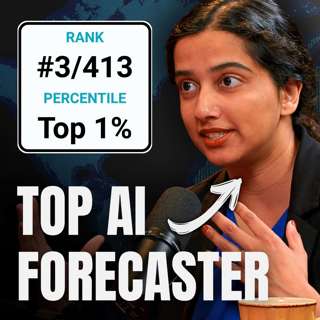
Today’s guest, Beth Barnes, is CEO of METR (Model Evaluation & Threat Research) — the leading organisation measuring these capabilities.

Links to learn more, video, highlights, and full transcript: https://80k.info/bb

Beth's team has been timing how long it takes skilled humans to complete projects of varying length, then seeing how AI models perform on the same work. The resulting paper “Measuring AI ability to complete long tasks” made waves by revealing that the planning horizon of AI models was doubling roughly every seven months. It's regarded by many as the most useful AI forecasting work in years.

Beth has found models can already do “meaningful work” improving themselves, and she wouldn’t be surprised if AI models were able to autonomously self-improve as little as two years from now — in fact, “It seems hard to rule out even shorter [timelines]. Is there 1% chance of this happening in six, nine months? Yeah, that seems pretty plausible.”

Beth adds:

The sense I really want to dispel is, “But the experts must be on top of this. The experts would be telling us if it really was time to freak out.” The experts are not on top of this. Inasmuch as there are experts, they are saying that this is a concerning risk. … And to the extent that I am an expert, I am an expert telling you you should freak out.


What did you think of this episode? https://forms.gle/sFuDkoznxBcHPVmX6


Chapters:

  • Cold open (00:00:00)
  • Who is Beth Barnes? (00:01:19)
  • Can we see AI scheming in the chain of thought? (00:01:52)
  • The chain of thought is essential for safety checking (00:08:58)
  • Alignment faking in large language models (00:12:24)
  • We have to test model honesty even before they're used inside AI companies (00:16:48)
  • We have to test models when unruly and unconstrained (00:25:57)
  • Each 7 months models can do tasks twice as long (00:30:40)
  • METR's research finds AIs are solid at AI research already (00:49:33)
  • AI may turn out to be strong at novel and creative research (00:55:53)
  • When can we expect an algorithmic 'intelligence explosion'? (00:59:11)
  • Recursively self-improving AI might even be here in two years — which is alarming (01:05:02)
  • Could evaluations backfire by increasing AI hype and racing? (01:11:36)
  • Governments first ignore new risks, but can overreact once they arrive (01:26:38)
  • Do we need external auditors doing AI safety tests, not just the companies themselves? (01:35:10)
  • A case against safety-focused people working at frontier AI companies (01:48:44)
  • The new, more dire situation has forced changes to METR's strategy (02:02:29)
  • AI companies are being locally reasonable, but globally reckless (02:10:31)
  • Overrated: Interpretability research (02:15:11)
  • Underrated: Developing more narrow AIs (02:17:01)
  • Underrated: Helping humans judge confusing model outputs (02:23:36)
  • Overrated: Major AI companies' contributions to safety research (02:25:52)
  • Could we have a science of translating AI models' nonhuman language or neuralese? (02:29:24)
  • Could we ban using AI to enhance AI, or is that just naive? (02:31:47)
  • Open-weighting models is often good, and Beth has changed her attitude to it (02:37:52)
  • What we can learn about AGI from the nuclear arms race (02:42:25)
  • Infosec is so bad that no models are truly closed-weight models (02:57:24)
  • AI is more like bioweapons because it undermines the leading power (03:02:02)
  • What METR can do best that others can't (03:12:09)
  • What METR isn't doing that other people have to step up and do (03:27:07)
  • What research METR plans to do next (03:32:09)

This episode was originally recorded on February 17, 2025.

Video editing: Luke Monsour and Simon Monsour
Audio engineering: Ben Cordell, Milo McGuire, Simon Monsour, and Dominic Armstrong
Music: Ben Cordell
Transcriptions and web: Katy Moore

Avsnitt(323)

#233 – James Smith on how to prevent a mirror life catastrophe

#233 – James Smith on how to prevent a mirror life catastrophe

When James Smith first heard about mirror bacteria, he was sceptical. But within two weeks, he’d dropped everything to work on it full time, considering it the worst biothreat that he’d seen described...

13 Jan 2h 9min

#144 Classic episode – Athena Aktipis on why cancer is a fundamental universal phenomena

#144 Classic episode – Athena Aktipis on why cancer is a fundamental universal phenomena

What’s the opposite of cancer? If you answered “cure,” “antidote,” or “antivenom” — you’ve obviously been reading the antonym section at www.merriam-webster.com/thesaurus/cancer.But today’s guest Athe...

9 Jan 3h 30min

#142 Classic episode – John McWhorter on why the optimal number of languages might be one, and other provocative claims about language

#142 Classic episode – John McWhorter on why the optimal number of languages might be one, and other provocative claims about language

John McWhorter is a linguistics professor at Columbia University specialising in research on creole languages. He's also a content-producing machine, never afraid to give his frank opinion on anything...

6 Jan 1h 35min

2025 Highlight-o-thon: Oops! All Bests

2025 Highlight-o-thon: Oops! All Bests

It’s that magical time of year once again — highlightapalooza! Stick around for one top bit from each episode we recorded this year, including:Kyle Fish explaining how Anthropic’s AI Claude descends i...

29 Dec 20251h 40min

#232 – Andreas Mogensen on what we owe 'philosophical Vulcans' and unconscious beings

#232 – Andreas Mogensen on what we owe 'philosophical Vulcans' and unconscious beings

Most debates about the moral status of AI systems circle the same question: is there something that it feels like to be them? But what if that’s the wrong question to ask? Andreas Mogensen — a senior ...

19 Dec 20252h 37min

#231 – Paul Scharre on how AI-controlled robots will and won't change war

#231 – Paul Scharre on how AI-controlled robots will and won't change war

In 1983, Stanislav Petrov, a Soviet lieutenant colonel, sat in a bunker watching a red screen flash “MISSILE LAUNCH.” Protocol demanded he report it to superiors, which would very likely trigger a ret...

17 Dec 20252h 45min

AI might let a few people control everything — permanently (article by Rose Hadshar)

AI might let a few people control everything — permanently (article by Rose Hadshar)

Power is already concentrated today: over 800 million people live on less than $3 a day, the three richest men in the world are worth over $1 trillion, and almost six billion people live in countries ...

12 Dec 20251h

#230 – Dean Ball on how AI is a huge deal — but we shouldn’t regulate it yet

#230 – Dean Ball on how AI is a huge deal — but we shouldn’t regulate it yet

Former White House staffer Dean Ball thinks it's very likely some form of 'superintelligence' arrives in under 20 years. He thinks AI being used for bioweapon research is "a real threat model, obvious...

10 Dec 20252h 54min

Populärt inom Utbildning

rss-bara-en-till-om-missbruk-medberoende-2
historiepodden-se
det-skaver
alska-oss
harrisons-dramatiska-historia
rss-viktmedicinpodden
sektledare
nu-blir-det-historia
allt-du-velat-veta
johannes-hansen-podcast
roda-vita-rosen
rss-sjalsligt-avkladd
i-vantan-pa-katastrofen
sa-in-i-sjalen
not-fanny-anymore
sex-pa-riktigt-med-marika-smith
polisutbildningspodden
rss-om-vi-ska-vara-arliga
rss-max-tant-med-max-villman
rss-traningsklubben