
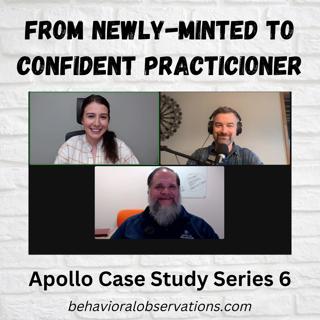
From Newly-Minted to Confident Practitioner: ACSS 6
In the 6th installment of the Apollo Case Study Series, I'm joined by my regular conversation partner, Dr. Jim Moore, along with Christina Nylander. Christina is a BCBA who works at Apollo's Lawrenceville, GA clinic. In this episode, Christina opens up quite a bit and describes how she encountered Applied Behavior Analysis, her early experiences as an RBT, the mentoring and supervision she's received as a BCBA in the early stages of her career, the value of learning about typical child development, the successes she's had as a clinician, learning the PEAK curriculum, and much more. Christina quite vulnerably discussed juggling the immense challenges of being a working mother in our field as well. From sleep deprivation to feeling like one is never fully caught up... she candidly describes how she navigated that process. Throughout the podcast, Jim related Christina's points to Apollo's unique clinical and supervision models. If you are interested in learning more about what they do, you can find more information here. Here are some of the resources we discussed: Prior Apollo Case Study podcasts. Making the Science Part of Your Practice, Session 167. Rapport Building and Instructional Fading Prior to Discrete Trial Instruction: Moving From Child-Led Play to Intensive Teaching (Shillingsburg, et al., 2019). Last year's Verbal Behavior Conference. For those who are interested, the 2023 VBC (disclosure: VBC is a podcast sponsor). In parting, I have two requests: First, if you have any questions about this episode or any other ACSS podcasts, I encourage you to hit Jim up on LinkedIn.... even if it is just to say hello. Second, please share this show with friends and colleagues. I think Christina's story is highly representative of many people in the field right now, and this podcast may be helpful to quite a few BCBAs out there.
18 Nov 20221h 12min
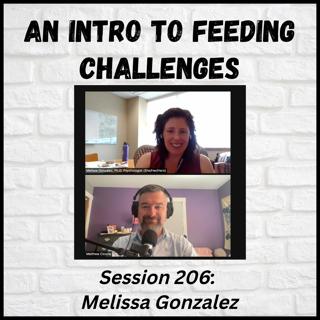
An Intro to Feeding Challenges: Session 206 with Melissa Gonzalez
In Session 206, I spoke with Dr. Melissa Gonzalez, BCBA-D, about Pediatric Feeding Disorders, and what Applied Behavior Analysis can offer in this area. Melissa is the Clinical Therapy Director at the Siskin Children's Institute in Chattanooga, Tennessee, arriving there by way of Louisiana State University's Clinical Psychology program and the Kennedy Krieger Institute, amongst other waypoints. In this episode, we discussed how she got into working with individuals with Pediatric Feeding Disorders, what are the diagnostic criteria for this repertoire, what we know what works for PDFs, the difference between picky eaters and individuals with PFDs, the importance of taking a multidisciplinary approach to treatment, and much more! This is a topic I'm not terribly familiar with, so I learned a ton. If you have the same reaction to this podcast, please share it with friends and colleagues! Here are some of the resources we discussed: Feedingmatters.org Pediatric Feeding Disorders Fact Sheet S3E7: Ethical Considerations of Behavioral Feeding Interventions with Lisa Tereshko and Mary Jane Weiss Ethical Considerations of Behavioral Feeding Interventions (the paper... Tereshko, et al., 2021). Pediatric Feeding Disorder: A Nationwide Prevalence Study (Kovacic, et al., 2020). Pediatric Feeding Disorder: Consensus Definition and Conceptual Framework (Goday, et al., 2019). This podcast is brought to you buy: Abaspeech.org - the brainchild of Session 203 guest, Rose Griffin, is giving listeners a 30% discount on all of her courses which include, The Advanced Language Learner, Help Me Find My Voice, and Start Communicating Today. The offer is valid through December 1st, 2022. Go to abaspeech.org, check out the 'courses' link, and use the promo code, aba30, at checkout. The University of Cincinnati Online. UC Online designed a Master of Education in Behavior Analysis program that is 100% online and asynchronous, meaning you log on when it works for you. Want to learn more? Go to online.uc.edu and click the "request info" button. HRIC Recruiting. Barb Voss has been placing BCBAs in permanent positions throughout the US for just about a decade, and has been in the business more generally for 30 years. When you work with HRIC, you work directly with Barb, thereby accessing highly personalized service. So if you're about to graduate, you're looking for a change of pace, or you just want to know if the grass really is greener on the other side, head over to HRIColorado.com to schedule a confidential chat right away.
10 Nov 20221h 22min
Ethics Regarding the Use of Punishment, Amongst Other Things: Session 205 with Matt Brodhead
After a long hiatus, Dr. Matt Brodhead returns to Behavioral Observations. In this episode, we discuss the use of punishment in the context of creating effective, ethical behavioral interventions. Of course, pursuant to the Behavior Analysis Certification Board's Ethics Code for Behavior Analysts, punishment should only be considered, "only after demonstrating that desired results have not been obtained using less intrusive means, or when it is determined by an existing intervention team that the risk of harm to the client outweighs the risk associated with the behavior-change intervention" (Code Element 2.15, page 12). So Matt and I talked about what this means in practice, the role of coercive or aversive events in everyday life, weighing the pros and cons of treatment choices, and much more. As we state in the first few minutes of the show, we made the editorial decision not to discuss the ABAI Task Force report on Contingent Electric Skin Shock. It's not that we don't have opinions on this topic; rest assured, we certainly do. But we felt like it would be more helpful for practitioners to hear Matt's thoughts on things like response cost, time-out, and so forth, as these are procedures that are more likely to be used by "everyday" practitioners. We also meandered into a few other topics, like the necessity of teaching cooperation and compliance under certain stimulus conditions, the utility or role of descriptive assessments vs. analog functional analyses, as well as other digressions. On a stylistic note, because Matt and I have gotten to know each other pretty well, this is an even more conversational episode that usual (versus one that is a series of questions and answers), with the attendant joking around that we usually engage in. If you're interested in Matt's work, go over to his website, betteraba.com, and pick up a copy of his excellent workbook, Behavioral Systems Analysis and Ethical Behavior. It's a bargain at $25 bucks... and remember, the holidays are right around the corner Matt is also available for workshops and consultations, and you can reach him through the same website. And while I'm plugging Matt's stuff, the popular text book he co-authored with Drs. David Cox and Shawn Quigley, is out in its second edition (disclosure: Amazon Associates Link). Other resources we discussed: Brodhead and Oteto (2022): Ethics and Ethical Problem Solving. Thomas and Brodhead (2022): Bringing Challenge to Coercion and the Status Quo. Matt's earlier appearances on the BOP. Musical references: "I Love this Bar" and "Check Yo Self" Hanley et al. (2005). On the Effectiveness of and Preference for Punishment and Extinction-Based Components of Function-Based Interventions. Hanley (2012): Functional assessment of problem behavior: dispelling myths, overcoming implementation obstacles, and developing new lore. Congenital Insensitivity to Pain. Perone (2003): The Negative Effects of Positive Reinforcement. The Importance of Red Teams, Peter Attia, MD. Michael (1975): Positive and Negative Reinforcement, a Distinction That Is No Longer Necessary; Or a Better Way to Talk about Bad Things. MacKenzie (2021): Caring by Lying. Fisher et al. (1996): On the reinforcing effects of the content of verbal attention. CBIT for Tic Disorders. Inside JABA #3 with Iser DeLeon on Accumulated vs. Distributed Reinforcement. This podcast is brought to you with the generous support of: Behavior University. Their mission is to provide university quality professional development for the busy Behavior Analyst. Learn about their CEU offerings, including their brand new 8-hour Supervision Course, as well as their RBT offerings over at behavioruniversity.com/observations. Abaspeech.org - the brainchild of Session 203 guest, Rose Griffin, is giving listeners a 30% discount on all of her courses which include, The Advanced Language Learner, Help Me Find My Voice, and Start Communicating Today. The offer is valid through December 1st, 2022. Go to abaspeech.org, check out the 'courses' link, and use the promo code, aba30, at checkout. Behavior Development Solutions For BCBA and BCaBA candidates, they report a 98.5% pass rate for first-time exam takers… plus a money-back guarantee! They also have solutions for RBT aspirants, plus CE courses, and live webinars (most of which are free for anyone to attend). To learn more, head over to bds.com/bop for a special offer for podcast listeners!
1 Nov 20221h 41min
Looking back, Looking forward: Inside JABA 13
On November 26th, 2019, the first Inside JABA Series podcast was published. This series was the brainchild of Dr. Linda LeBlanc, who at the time was the incoming Editor in Chief, and I have to say, doing these shows has been a highlight of producing this podcast. As I remind people often, I'm not involved in the production or publication of Behavior Analytic research, so you can imagine how much I've learned about this process in making what is now 13 Inside JABA Series podcast episodes. At the same time, it's been an incredible privilege to share these shows - including the papers we've hi-lighted therein - with you. At the time of this recording, Linda recently transitioned out of the role of Editor in Chief. This position is now filled by Dr. John Borrero, from the University of Maryland Baltimore County. As such, for the 13th installment in this series, the three of us got together to discuss a range of nerdy JABA topics, including how editors-in-chief are selected, what repertoires make for successful editors-in-chief, how to manage the review process, and more. We also talked about what makes a paper a "JABA paper." I think you might find some of Linda and John's thoughts on this surprising. Linda also shared a story on how she solved a specific clinical problem she encountered early on in her career by getting inspiration from the pages of JABA. Finally, we closed the show by looking back on some of Linda's accomplishments and discussed where John sees JABA moving forward. I won't spoil it here, but let's just say he has some really cool ideas, so please be sure to tune in for that segment. Even if you're not involved in conducting and publishing research, I think you'll find the discussion of how our flagship journal works very interesting. Lastly, as I have expressed numerous times, I am profoundly grateful for this opportunity to work with the JABA team, and I look forward to working with John on future installments of the Inside JABA Series. References mentioned in this episode: Previous JABA Podcasts. Treatment of Self-Injury and Hand-Mouthing Following Inconclusive Functional Analyses. (Vollmer, Marcus, and LeBlanc, 1994). Editor's note: The Power of Big Ideas (LeBlanc, 2020). Dr. Claire St. Peters' research on treatment integrity. Sign up for the Newsletter. Grab some Inside JABA (and other) CEUs!
26 Okt 20221h 7min
Speech Therapy and ABA: Session 203 with Rose Griffin
In the world of Behavior Analysis, Rose Griffin is a unicorn of sorts, which is the unofficial mascot of those select few who hold both Speech Language Pathologist and Board Certified Behavior Analyst credentials. For 20 years, Rose supported students in public school settings, but these days, she is concentrating on taking all the knowledge she's acquired and sharing it in the form of podcasts, online trainings and courses, and much more. In this interview, Rose and I discuss how she got into speech therapy and then behavior analysis, the challenges and benefits of collaboration, the subtleties of joint attention that many behavior analysts miss in our training programs, her awesome podcast, the Autism Outreach Podcast, and advice for newly-minted BCBAs. Rose and I also spend a few minutes nerding out over our mutual podcasting hero, Pat Flynn. Here are the links to the things we discussed: Rose's website. The Autism Outreach Podcast. Free Joint Attention Training for Parents and Staff. Rose's solo show on Joint Attention. Rose's interview with Jared Stewart. Language Development: An Introduction, by Robert Owens (note: Amazon Associates link). American Speech-Language-Hearing Association. Univ. of New Hampshire Cooperative Extension child development newsletter. Rose's Advanced Language Learner Course. Pat Friman's Public Speaking Tutorial (also available as a CEU). Rose on Pat Flynn's podcast. ABA Speech on TikTok. The Verbal Behavior Conference/Central Texas Autism Center. Rose was kind enough to provide listeners with a 30% discount on her courses through December 1st, 2022. These courses include: The Advanced Language Learner, Help Me Find My Voice, and Start Communicating Today. Just use the promo code, aba30, at checkout, and you'll be good to go. Two footnotes to add: First, I mistakenly noted in this interview that Rose was the first SLP/BCBA on the show. That honor goes to Dr. Barbara Esch, who appeared on a panel discussion for the Verbal Behavior Conference. Second, in the spirit of transparency, I want to note that ABASpeech.org will be sponsoring several upcoming podcast episodes. Speaking of sponsors, Session 203 is brought to you by the following: The University of Cincinnati Online. UC Online designed a Master of Education in Behavior Analysis program that is 100% online and asynchronous, meaning you log on when it works for you. Want to learn more? Go to online.uc.edu and click the "request info" button. HRIC Recruiting. Barb Voss has been placing BCBAs in permanent positions throughout the US for just about a decade, and has been in the business more generally for 30 years. When you work with HRIC, you work directly with Barb, thereby accessing highly personalized service. So if you're about to graduate, you're looking for a change of pace, or you just want to know if the grass really is greener on the other side, head over to HRIColorado.com to schedule a confidential chat right away. Behavior University. Their mission is to provide university quality professional development for the busy Behavior Analyst. Learn about their CEU offerings, including their brand new 8-hour Supervision Course, as well as their RBT offerings over at behavioruniversity.com/observations.
18 Okt 202255min
How to Think About Program Modification: Apollo Case Study Series #5 with Jim Moore
After a brief hiatus, the Apollo Case Study Series returns to Behavioral Observations for its fifth installment. In this episode, Dr. Jim Moore shares his approach to modifying existing clinical programs that aren't making progress. More specifically, we talk about the temptation to go out and purchase the 'new shiny thing' (as in curriculum, assessment protocol, data collection systems, etc...), and what things to consider before deciding whether making such changes is an appropriate course of action. If you're a clinical director or supervisor, I'd say this is a must-listen episode. At one point, our internet connection phases out. Thankfully it passes quickly and the remaining conversation is pretty stable. If you're digging these conversations with Jim, hit him up on LinkedIn, or email him (jim.moore at apollobehavior dot com). Also, many of you have reached out to see if Apollo is a good fit as an employer, and if you're wondering the same thing, you can talk to Jim about that too, or check out their openings in the Atlanta Metro area. Here are the links to what we discussed: Previous ACSS shows. Session 167 with Jim, "Making Science Part of Your Practice." Fisher et al. (2014). Increasing the saliency of behavior-consequence relations for children with autism who exhibit persistent errors. Fisher, Kodak, and Moore (2007). Embedding an identity-matching task within a prompting hierarchy to facilitate acquisition of conditional discriminations in children with autism. Cariveau et al. (2019). A Review of Error Correction Procedures during Instruction for Children with Developmental Disabilities. Hayes et al. (1999). The Scientist Practitioner: Research and Accountability in the Age of Managed Care (2nd Edition) 2nd Edition (note: Amazon Associates link). EFL Methods of Alternative Speaking (Pat, you're welcome ;-). I hope you enjoy this ad and intro-free episode, brought to you courtesy of Apollo Behavior! If you enjoy it, please share it with friends and colleagues!
5 Okt 202247min
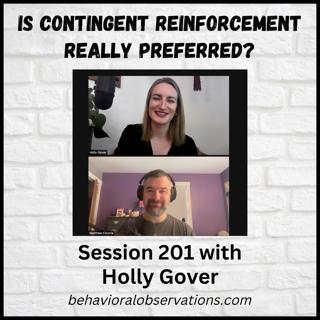
Is Contingent Reinforcement Really Preferred? Session 201 with Holly Gover
Would you rather earn preferred items or get them for free? More technically stated, would you prefer response-contingent reinforcers over response-independent ones (and to further split hairs, if the preferred items are provided response-independently, are they really reinforcers?)? It turns out that there has been some basic and applied research in this area, and some studies demonstrated participants' general preference for earning reinforcers as opposed to simply getting them for "free." My guest for Session 201, Dr. Holly Gover, published a review and meta-analysis on this topic in a recent issue of The Journal of Applied Behavior Analysis, called, "On the generality of preference for contingent reinforcement." In this episode, we discuss how she became interested in this topic, what motivated her to review this literature, what she learned from this process, and perhaps of most interest to you, what implications these findings have for practice. Towards the end of the conversation, we changed gears a bit and discussed Holly's work in the area of feeding challenges. She quickly reviewed what is currently known about the assessment and treatment of these problems, as well as the unique approach to resolving feeding issues that she has outlined. Holly will be presenting on this topic at the upcoming Stone Soup Conference on October 21st (disclosure: the Lake Ridge Community Support Services, host of the conference, is a BOP sponsor, and they are providing listeners with discounted registration when using the promo code, PODCAST). Lastly, I'd be remiss if I didn't ask - no, I mean beg you to to listen to Holly's advice for newly-minted BCBAs. I'm not kidding you that this has to be one of the best pieces of advice offered on this podcast. Please do yourself a favor and check it out and let me know if you agree. OK, here are some links: Holly's Vanderbilt University page. Holly's Google Scholar page. TRIAD - Treatment and Research Institute for Autism Spectrum Disorders. Session 186: Enhanced Choice Model, Adithyan Rajaraman. Luczynski and Hanley (2013). Do Children Prefer Contingencies? An evaluation of the efficacy and preference for contingent versus non-contingent social reinforcement during play. Luczynski and Hanley (2010). Examining the Generality of Children's Preference for Contingent Reinforcement via Extension to Different Reinforcers, Responses, and Schedules. QCABA - Quebec Association for Behaviour Analysis. Koffer and Coulson (1971). Feline indolence: Cats prefer free to response-produced food. Osborne (1977). The free food (contrafreeloading) phenomenon: A review and analysis. Honig & Staddon: Handbook of Operant Behavior (disclosure: Amazon Associates link). In addition to the Stone Soup Conference, if you're interested in learning more about addressing feeding challenges, my colleague, Jen Farris, is putting together a 10-week mentoring cohort on this topic called Happy, Relaxed, and Eating. This is for a 10-week cohort consisting of 6, 2-hour LIVE virtual meetings and includes 12 CEs. There is also an option for no CEs at a discounted rate. And she is giving podcast listeners a 10% discount. So use the code BOP at checkout, or just tell Jen you heard about it on the podcast. If you're looking for continuing education on a wide variety of topics, don't forget that many of your favorite Behavioral Observations shows are available for approved continuing education.
30 Sep 20221h 9min
Behavioral Observations Session 200 Special!
I've always maintained that this is a show that is all about the listeners and the guests, and so it is with that in mind that I'm thrilled to share the following interview segments that were nominated by so many of you. We did have many entries, so I couldn't fit all of them in, but I genuinely appreciate all of you who took the time to write in and share your thoughts. While I'm expressing gratitude here, I'd be remiss to not mention the support that I've received from podcast sponsors, especially the OG's like Barb Voss at HRIC Recruiting and Behavior University. I'm also very thankful to all of you who have supported the show through Continuing Education sales, and Patreon memberships. Together, we've created this medium that has been downloaded almost 3.6 million times in over 100 countries. As I've told many friends and colleagues, back when I was conceptualizing this show, I always knew there would be an audience for this type of content, but I had no idea that it would develop into what it is these days. All of this to say that I'm extraordinarily thankful for all of you who have tuned in over the years. Thanks so much for letting Behavioral Observations into your commutes, your workouts, your laundry folding, your dog walking… or when or wherever else you take in the show. It's been a privilege to be able to share these conversations with you, and I look forward to the next 200 episodes! Here's what we have in store for you: Session 87: Merrill Winston Session 31: Pat McGreevy Session 181: Francesca Delgi Espinosa Session 51: Ashley Rose Session 193: Claire St. Peter Inside JABA 7: Pat Friman Session 41: Russ Harris Session 160: Greg Hanley Session 63/91: Chuck Merbitz Lastly, huge thanks to Miguel Avila, Celia Heyman, Natalie Todd, Rob Harvey, Sarah DiGioia, Alesia Patterson, Alexa, as well as my colleague, Jen Farris (who also nominated some of the same segments from Session 63, which I forgot to mention in the broadcast).
26 Sep 20221h 4min