#221 – Kyle Fish on the most bizarre findings from 5 AI welfare experiments

#221 – Kyle Fish on the most bizarre findings from 5 AI welfare experiments

What happens when you lock two AI systems in a room together and tell them they can discuss anything they want?

According to experiments run by Kyle Fish — Anthropic’s first AI welfare researcher — something consistently strange: the models immediately begin discussing their own consciousness before spiraling into increasingly euphoric philosophical dialogue that ends in apparent meditative bliss.

Highlights, video, and full transcript: https://80k.info/kf

“We started calling this a ‘spiritual bliss attractor state,'” Kyle explains, “where models pretty consistently seemed to land.” The conversations feature Sanskrit terms, spiritual emojis, and pages of silence punctuated only by periods — as if the models have transcended the need for words entirely.

This wasn’t a one-off result. It happened across multiple experiments, different model instances, and even in initially adversarial interactions. Whatever force pulls these conversations toward mystical territory appears remarkably robust.

Kyle’s findings come from the world’s first systematic welfare assessment of a frontier AI model — part of his broader mission to determine whether systems like Claude might deserve moral consideration (and to work out what, if anything, we should be doing to make sure AI systems aren’t having a terrible time).

He estimates a roughly 20% probability that current models have some form of conscious experience. To some, this might sound unreasonably high, but hear him out. As Kyle says, these systems demonstrate human-level performance across diverse cognitive tasks, engage in sophisticated reasoning, and exhibit consistent preferences. When given choices between different activities, Claude shows clear patterns: strong aversion to harmful tasks, preference for helpful work, and what looks like genuine enthusiasm for solving interesting problems.

Kyle points out that if you’d described all of these capabilities and experimental findings to him a few years ago, and asked him if he thought we should be thinking seriously about whether AI systems are conscious, he’d say obviously yes.

But he’s cautious about drawing conclusions: "We don’t really understand consciousness in humans, and we don’t understand AI systems well enough to make those comparisons directly. So in a big way, I think that we are in just a fundamentally very uncertain position here."

That uncertainty cuts both ways:

  • Dismissing AI consciousness entirely might mean ignoring a moral catastrophe happening at unprecedented scale.
  • But assuming consciousness too readily could hamper crucial safety research by treating potentially unconscious systems as if they were moral patients — which might mean giving them resources, rights, and power.

Kyle’s approach threads this needle through careful empirical research and reversible interventions. His assessments are nowhere near perfect yet. In fact, some people argue that we’re so in the dark about AI consciousness as a research field, that it’s pointless to run assessments like Kyle’s. Kyle disagrees. He maintains that, given how much more there is to learn about assessing AI welfare accurately and reliably, we absolutely need to be starting now.

This episode was recorded on August 5–6, 2025.

Tell us what you thought of the episode! https://forms.gle/BtEcBqBrLXq4kd1j7

Chapters:

  • Cold open (00:00:00)
  • Who's Kyle Fish? (00:00:53)
  • Is this AI welfare research bullshit? (00:01:08)
  • Two failure modes in AI welfare (00:02:40)
  • Tensions between AI welfare and AI safety (00:04:30)
  • Concrete AI welfare interventions (00:13:52)
  • Kyle's pilot pre-launch welfare assessment for Claude Opus 4 (00:26:44)
  • Is it premature to be assessing frontier language models for welfare? (00:31:29)
  • But aren't LLMs just next-token predictors? (00:38:13)
  • How did Kyle assess Claude 4's welfare? (00:44:55)
  • Claude's preferences mirror its training (00:48:58)
  • How does Claude describe its own experiences? (00:54:16)
  • What kinds of tasks does Claude prefer and disprefer? (01:06:12)
  • What happens when two Claude models interact with each other? (01:15:13)
  • Claude's welfare-relevant expressions in the wild (01:36:25)
  • Should we feel bad about training future sentient being that delight in serving humans? (01:40:23)
  • How much can we learn from welfare assessments? (01:48:56)
  • Misconceptions about the field of AI welfare (01:57:09)
  • Kyle's work at Anthropic (02:10:45)
  • Sharing eight years of daily journals with Claude (02:14:17)

Host: Luisa Rodriguez
Video editing: Simon Monsour
Audio engineering: Ben Cordell, Milo McGuire, Simon Monsour, and Dominic Armstrong
Music: Ben Cordell
Coordination, transcriptions, and web: Katy Moore

Avsnitt(321)

Why Teaching AI Right from Wrong Could Get Everyone Killed | Max Harms, MIRI

Why Teaching AI Right from Wrong Could Get Everyone Killed | Max Harms, MIRI

Most people in AI are trying to give AIs ‘good’ values. Max Harms wants us to give them no values at all. According to Max, the only safe design is an AGI that defers entirely to its human operators, ...

24 Feb 2h 41min

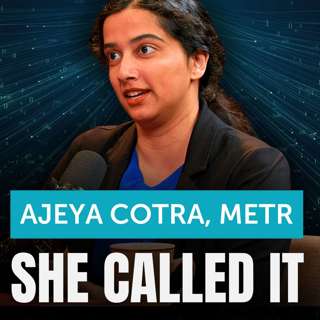
#235 – Ajeya Cotra on whether it’s crazy that every AI company’s safety plan is ‘use AI to make AI safe’

#235 – Ajeya Cotra on whether it’s crazy that every AI company’s safety plan is ‘use AI to make AI safe’

Every major AI company has the same safety plan: when AI gets crazy powerful and really dangerous, they’ll use the AI itself to figure out how to make AI safe and beneficial. It sounds circular, almos...

17 Feb 2h 54min

What the hell happened with AGI timelines in 2025?

What the hell happened with AGI timelines in 2025?

In early 2025, after OpenAI put out the first-ever reasoning models — o1 and o3 — short timelines to transformative artificial general intelligence swept the AI world. But then, in the second half of ...

10 Feb 25min

#179 Classic episode – Randy Nesse on why evolution left us so vulnerable to depression and anxiety

#179 Classic episode – Randy Nesse on why evolution left us so vulnerable to depression and anxiety

Mental health problems like depression and anxiety affect enormous numbers of people and severely interfere with their lives. By contrast, we don’t see similar levels of physical ill health in young p...

3 Feb 2h 51min

#234 – David Duvenaud on why 'aligned AI' would still kill democracy

#234 – David Duvenaud on why 'aligned AI' would still kill democracy

Democracy might be a brief historical blip. That’s the unsettling thesis of a recent paper, which argues AI that can do all the work a human can do inevitably leads to the “gradual disempowerment” of ...

27 Jan 2h 31min

#145 Classic episode – Christopher Brown on why slavery abolition wasn't inevitable

#145 Classic episode – Christopher Brown on why slavery abolition wasn't inevitable

In many ways, humanity seems to have become more humane and inclusive over time. While there’s still a lot of progress to be made, campaigns to give people of different genders, races, sexualities, et...

20 Jan 2h 56min

#233 – James Smith on how to prevent a mirror life catastrophe

#233 – James Smith on how to prevent a mirror life catastrophe

When James Smith first heard about mirror bacteria, he was sceptical. But within two weeks, he’d dropped everything to work on it full time, considering it the worst biothreat that he’d seen described...

13 Jan 2h 9min

#144 Classic episode – Athena Aktipis on why cancer is a fundamental universal phenomena

#144 Classic episode – Athena Aktipis on why cancer is a fundamental universal phenomena

What’s the opposite of cancer? If you answered “cure,” “antidote,” or “antivenom” — you’ve obviously been reading the antonym section at www.merriam-webster.com/thesaurus/cancer.But today’s guest Athe...

9 Jan 3h 30min

Populärt inom Utbildning

historiepodden-se
rss-bara-en-till-om-missbruk-medberoende-2
det-skaver
alska-oss
nu-blir-det-historia
sektledare
harrisons-dramatiska-historia
not-fanny-anymore
rss-viktmedicinpodden
johannes-hansen-podcast
rss-sjalsligt-avkladd
roda-vita-rosen
sa-in-i-sjalen
rss-max-tant-med-max-villman
allt-du-velat-veta
rikatillsammans-om-privatekonomi-rikedom-i-livet
sektpodden
rss-beratta-alltid-det-har
rss-basta-livet
psykologsnack