Gobi Bear Is Almost Gone

Gobi Bear Is Almost Gone

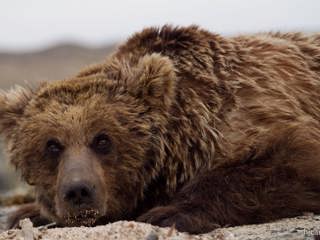
The Gobi bear (Ursus arctos gobiensis) is the rarest bear in the world, with fewer than 40 individuals surviving in the wild. Found only in Mongolia’s Great Gobi Strictly Protected Area, these desert specialists endure brutal summers and freezing winters on one of Earth’s harshest landscapes. In this episode, Chris and Angie explore the Gobi bear’s adaptations, ecology, and precarious future. We discuss their differences from other brown bears, why their numbers have plummeted, and how human pressures like mining and climate change put them on the edge of extinction. Inspired by the Apple TV+ series The Wild Ones and an interview with Aldo Kane, we also highlight the conservation heroes working tirelessly to protect this species and what listeners can do to help. Podcast Timeline 00:00 Introduction and The Wild Ones inspiration 03:00 Meet the Gobi Bear: The World’s Rarest Bear 07:30 Comparison to Other Brown Bears 10:30 Historical Range and Current Habitat in the Gobi Desert 15:30 Ecological Importance: Role in Food Webs and Oases 20:30 Population Decline: Why Fewer Than 40 Remain 27:30 Mining and Rare Earth Minerals 31:00 Climate Change and Desertification Challenges 40:00 Evolutionary Background of Brown Bear Subspecies 47:00 Physiological Adaptations of the Gobi Bear 53:00 Hibernation and Winter Survival Strategies 58:00 Super Sense of Smell and Desert Diet 01:10:00 Reproduction and Cub Survival in Harsh Conditions 01:17:00 Conservation Efforts: The Gobi Bear Project and UNESCO Involvement 01:20:00 Global Action Steps: What Listeners Can Do to Help 01:25:00 Closing Reflections and Hope for the Future =========================================================== Another thank you to all our Patreon supporters. You too can join for one cup of "good" coffee a month. With your pledge you can support your favorite podcast on Patreon and give back to conservation. With the funds we receive each month, we are have been sending money to conservation organizations monthly. We now send a check to every organization we cover, as we feel they all are deserving of our support. Thank you so much for your support and for supporting animal conservation. Please considering supporting us at Patreon HERE. We also want to thank you to all our listeners. We are giving back to every conservation organization we cover and you make that possible. We are committed to donating large portions of our revenue (at minimum 25%) to every organization we cover each week. Thank you for helping us to grow, and for helping to conserve our wildlife. Please contact us at advertising@airwavemedia.com if you would like to advertise on our podcast You can also visit our website HERE. Learn more about your ad choices. Visit megaphone.fm/adchoices Learn more about your ad choices. Visit megaphone.fm/adchoices

Avsnitt(594)

Episode 45: Kiwi Conservation w/Dr. Helen Taylor

Episode 45: Kiwi Conservation w/Dr. Helen Taylor

Dr. Helen Taylor is a research fellow at the University of Otago in Dunedin, New Zealand. Her work specializes on studying the affects of inbreeding on native species, especially threatened birds. The...

19 Juli 201859min

Episode 44: A New Zealand Treasure, The Kiwi

Episode 44: A New Zealand Treasure, The Kiwi

This week we cover a New Zealand icon, the Kiwi. While this is a long episode it is one not to miss. New Zealand has such a unique biome and is overcoming many incredible challeneges for their native ...

17 Juli 20181h 27min

This Week in Conservation for July 13, 2018

This Week in Conservation for July 13, 2018

This week we are joined with Jesse Golden. We open up with discussing Iceland's continued whale hunt and the killing of a a critically-endangered blue whale. We then discuss alternatives to thinking o...

13 Juli 201846min

Episode 43: Angels of the Deep, The Manta Ray

Episode 43: Angels of the Deep, The Manta Ray

There are two species of Manta Ray. The Giant Manta Ray (Manta birostris) is the larger of the two. The Reef Manta Ray (Manta alfredi) is the other.  The large ocean-going creatures are found all arou...

10 Juli 20181h 17min

This Week in Conservation for July 6, 2018

This Week in Conservation for July 6, 2018

This week we again are joined with Jim Weinpress. We first discuss how a honey badger went up and attacked a large South African Oryx. Apparently even after being butted and tossed, the honey badger k...

6 Juli 201849min

Episode 42: Snake and Sea Turtle Conservation with Dr. David A. Steen

Episode 42: Snake and Sea Turtle Conservation with Dr. David A. Steen

Dr. David A. Steen is a wildlife ecologist and renowned scientist studying snakes and now sea turtles. He is currently a research scientist with the Georgia Sea Turtle Center on Jekyll Island, Georgia...

5 Juli 201851min

Episode 41: Rattling with Rattlesnakes

Episode 41: Rattling with Rattlesnakes

The Eastern Diamondback Rattlesnake (Crotalus adamanteus) is just 1 of 3,600 species of snake. They belong to the family of Viperidae, which is a family of venomous snakes found throughout the world e...

3 Juli 20181h 18min

This Week in Conservation for June 29, 2018

This Week in Conservation for June 29, 2018

This week we discuss Iceland resuming whaling of the endangered fin whale. Despite international outcry, Iceland this week slaughtered its first fin whale, which is tragic for a protected species. How...

29 Juni 201845min

Populärt inom Vetenskap

dumma-manniskor
p3-dystopia
allt-du-velat-veta
svd-nyhetsartiklar
rss-vetenskapsradion
det-morka-psyket
kapitalet-en-podd-om-ekonomi
rss-ufo-bortom-rimligt-tvivel-2
rss-vetenskapsradion-2
medicinvetarna
dumforklarat
sexet
hacka-livet
paranormalt-med-caroline-giertz
barnpsykologerna
vetenskap-och-halsa
rss-tidslinjen-podcast
vetenskapsradion
doden-hjarnan-kemisten
bildningspodden