Nestcraft
Many Minds27 Nov 2024

Nestcraft

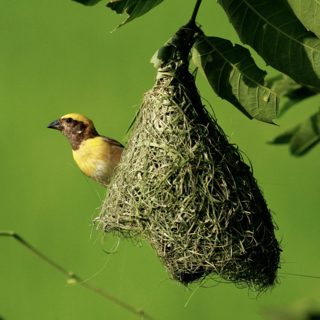
How do birds build their nests? By instinct, of course—at least that's what the conventional wisdom tells us. A swallow builds a swallow's nest; a robin builds a robin's nest. Every bird just follows the rigid template set down in its genes. But over the course of the last couple of decades, scientists have begun to take a closer look at nests—they've weighed and measured them, they've filmed the building process. And the conventional wisdom just doesn't hold up. These structures vary in all kinds of ways, even within a species. They're shaped by experience, by learning, by cultural tradition. When we look at a bird's nest, we're looking at the product of a flexible mind.

My guest today is Dr. Susan Healy. Sue is a Professor in the School of Biology at the University of St Andrews and an expert in birds—their behavior, their cognition, and their evolution. For more than a decade now, Sue has been pioneering a new chapter in the study of birds' nests.

Here, Sue and I talk about some of the most impressive nests (as well as some of the least impressive). We do a bit of Birds' Nests 101—the different forms they take, the functions they serve, which sex does the building, how these structures evolved, and more. We dig into the mounting evidence that birds are in fact quite flexible in their building practices, that they learn from others and from their own experience. We discuss recent evidence from Sue's team that cultural traditions shape the weaver nests of the Kalahari. And we talk about what nests might have in common with songs and tools. Along the way, we touch on: pigeon nests and hummingbird nests, dinosaur nests and chimpanzee nests; Alfred Russel Wallace; commonalities in the techniques of human weavers and weaver birds; whether bird personality might be reflected in nest style; the brain basis of nest-building; and a whole lot else.

Hope you enjoy this one, friends. On to my conversation with Dr. Sue Healy.

A transcript of this episode is availalble here.

Notes and links

2:30 – An example of a post on the (seemingly inadequate) nests of pigeons.

7:30 – An article featuring a variety of weaverbird nests.

10:30 – Alfred Russel Wallace's essay on birds' nests is available here.

15:00 – A paper from another branch of Dr. Healy's work, on hummingbirds.

16:00 – The 1902 book by Charles Dixon on the science of "caliology."

17:00 – An example of research done by the Colliases on weavers.

19:00 – For an up-to-date primer on birds' nests—covering a number of the questions we discuss here—see Dr. Healy's recent primer.

22:30 – An article about hummingbird eggs.

28:30 – A paper by Dr. Healy and colleagues on the use of human materials in birds' nests. Our episode on animal medication is here.

31:30 – An article about bowerbirds and how they decorate their bowers.

35:00 – An article on the evolution of birds' nests, covering the question of what dinosaur nests were like.

43:00 – A paper by Dr. Healy and colleagues on the impact of temperature and earlier breeding success on nest size.

51:00 ­– For more discussion of personality in animals, including in clonal fish, see our episode with Kate Laskowski.

55:00 – A study by Dr. Healy and colleagues showing that zebra finches build nests that match the color of the walls.

58:00 – A study by Dr. Healy and colleagues looking at how zebra finches learn aspects of nest-building from familiar individuals.

59:00 – A study by Dr. Healy and colleagues, led by Maria Tello-Ramos, about architectural traditions in an African sociable weaver species.

1:07:00 – An article by Michael Arbib, Dr. Healy, and colleagues on connections between tool use, language, and nest-building.

1:11:00 – An initial study on the brain basis of nest-building in zebra finches. A further study on the same topic.

1:12:30 – A paper by Hopi E. Hoekstra and colleagues on the genetics of burrow-building in deer mice.

1:14:00 – An exploration of the idea that humans initially learned their weaving skills from weaver birds.

Recommendations

Books by Mike Hansell (see here, here, and here)

Birds' nests, Charles Dixon

Avian architecture, Peter Goodfellow

Animal architects, James Gould & Carol Gould

Tile image credit: Image by Mohan Moolepetlu via Unsplash

Many Minds is a project of the Diverse Intelligences Summer Institute, which is made possible by a generous grant from the John Templeton Foundation to Indiana University. The show is hosted and produced by Kensy Cooperrider, with help from Assistant Producer Urte Laukaityte and with creative support from DISI Directors Erica Cartmill and Jacob Foster. Our artwork is by Ben Oldroyd. Our transcripts are created by Sarah Dopierala.

Subscribe to Many Minds on Apple, Stitcher, Spotify, Pocket Casts, Google Play, or wherever you listen to podcasts. You can also now subscribe to the Many Minds newsletter here!

We welcome your comments, questions, and suggestions. Feel free to email us at: manymindspodcast@gmail.com.

For updates about the show, visit our website or follow us on Bluesky (@manymindspod.bsky.social).

Det här avsnittet är hämtat från ett öppet RSS-flöde och publiceras inte av Podme. Det kan innehålla reklam.

Avsnitt(167)

From the archive: Varieties of childhood

From the archive: Varieties of childhood

Hi friends! We're taking a bit of a summer pause. We'll be back soon—in the meanwhile, enjoy this listener favorite from our archives! ----- [originally aired July 10, 2025] Childhood is a special tim...

31 Juli 1h 28min
From the archive: Philosophers on psychedelics

From the archive: Philosophers on psychedelics

Hi friends! We're taking a bit of a summer pause. We will be back soon—in the meanwhile, enjoy this listener favorite from our archives! ----- [originally aired May 14, 2025] Some call it the "psyched...

17 Juli 1h 40min
The origins of Darwin's ideas

The origins of Darwin's ideas

No discipline, no sphere of intellectual life, has been untouched by the work of Charles Darwin. He died in 1882 but his ideas are very much alive; they're now central to how we understand the natural...

3 Juli 1h 19min
The sparkling deep

The sparkling deep

It's tempting to see bioluminescence as an oddity, one of those rare eccentricities of life on earth. And, on land, maybe that's true. But our planet is mostly water, and out in the open ocean biolumi...

20 Juni 1h 20min

Is Man the Hunter just a myth?

Is Man the Hunter just a myth?

There's a story about of our past that you know well. It goes like this: At some point earlier in human evolution, we started to hunt. Men in particular—perhaps channeling some deep-seated aggressive ...

5 Juni 1h 32min

Babies, dogs, and the riddles of word learning

Babies, dogs, and the riddles of word learning

It's kind of astonishing, really, that kids ever learn words. Each one poses a little riddle. Does this sound string refer to a person? A category of things? Or maybe some other feature of the bloomin...

22 Maj 1h 18min

The inner life of the hand

The inner life of the hand

Newton saw in the human hand proof of the divine; Darwin saw a key to our species' success. Many others, too, have described the hand in hyperbolic terms, as a paragon of design, a cornerstone of huma...

7 Maj 1h 10min

From the archive: The cuttlefish and its coat of many colors

From the archive: The cuttlefish and its coat of many colors

Hi friends! We're skipping a beat to take care of some spring housekeeping tasks. We will be back in May! In the meanwhile, enjoy this listener favorite from our archives! ----- [originally aired Apri...

22 Apr 1h 33min

Populärt inom Utbildning

det-skaver
rss-bara-en-till-om-missbruk-medberoende-2
historiepodden-se
nu-blir-det-historia
allt-du-velat-veta
harrisons-dramatiska-historia
johannes-hansen-podcast
not-fanny-anymore
roda-vita-rosen
rss-viktmedicinpodden
i-vantan-pa-katastrofen
rikatillsammans-om-privatekonomi-rikedom-i-livet
sa-in-i-sjalen
sektledare
rss-max-tant-med-max-villman
rss-autismandan
rss-basta-livet
rss-traningsklubben
rss-i-skenet-av-blaljus
vi-gar-till-historien