String theories
Many Minds6 Feb 2025

String theories

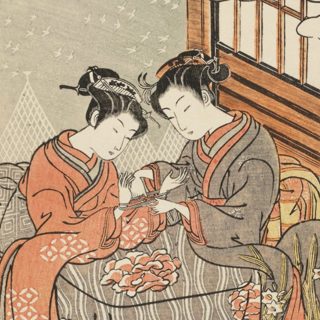
Where would our species be without string? It's one of our most basic technologies—so basic that it's easy to overlook. But humans have used string—and its cousins rope, yarn, cordage, thread, etc.—for all kinds of purposes, stretching back tens of thousands of years. We've used it for knots and textiles and fishing nets and carrier bags and bow-strings and record-keeping devices. It's one of the most ubiquitous, flexible, and useful technologies we have. But we haven't only put string to practical purposes. We've also long used it to tickle our minds.

My guest today is Dr. Roope Kaaronen. Roope is a cognitive anthropologist and postdoc at the University of Helsinki in Finland. Along with an interdisciplinary team, Roope recently conducted two studies that showcase the centrality of string in human culture. One is on the history and diversity of "string figures" (which are visual designs made with a loop of string held between the hands, often known to English speakers as "Cat's Cradle"). The other study is on the history and diversity of knots.

Here Roope and I discuss the deep history of string in human culture. We talk about the seemingly universal spread of string figures across the globe. We zoom in on one string figure in particular—the Jacob's ladder—which seems to be the most widespread string figure of all, despite its complexity. We talk about how both knots and string figures are related to the branch of mathematics known as "topology," and about how knots and string figures have evolved under different constraints. Finally, we discuss what our fascination with string designs might tell us about the human mind. And we lament the fact that much of our string-based cultural heritage is headed—quite rapidly—for extinction.

Just a reminder that applications are now open for the 2025 Diverse Intelligences Summer Institute or DISI. If you are an early career researcher and you like this show, you would probably like DISI. Actually, fun fact: our guest today, Roope, is a DISI alum. We met at the Institute a couple years ago and I've followed his work ever since. That should give you some flavor for the people who attend. In any case, for more info, check out disi.org—that's d-i-s-i. org.

Alright friends, on to my conversation with Dr. Roope Kaaronen. Enjoy!

A transcript of this episode is available here.

Notes and links

3:00 – The 2020 paper reporting the use of string by Neanderthals.

8:00 – A paper describing the Antrea Net and its discovery.

10:00 – On the issue of gender bias in the study of textiles, see Virginia Postrel's book, The Fabric of Civilization.

12:00 – Dr. Kaaronen's other ethnomathematical projects include work on measurement across cultures.

16:30 – The website of the International String Figure Association.

19:30 – The 1969 paper first introducing the Standard Cross-Cultural Sample.

22:20 – A step-by-step explanation for how to make Jacob's Ladder.

30:30 – A step-by-step explanation for how to make the Swan.

38:00 – An example of a string figure that uses the Caroline Extension.

40:35 – A video demonstrating the string figure game of Cat's Cradle, which is played with a partner.

44:30 – A preprint of the knot study by Dr. Kaaronen and colleagues.

45:00 – The website of HRAF—the Human Relations Area Files—is here.

49:00 – A step-by-step explanation for how to make the knot known as the "sheet bend."

55:00 – An interactive article about what is known about Incan khipus.

59:30 – The "bible of knots" is the Ashley Book of Knots.

1:08:30 – An illustrated article on the so-called Austronesian expansion.

1:16:00 – An image of the ochre stone from 70,000 years ago, found at Blombos cave, featuring net-like imagery. A study finding sensitivity to abstract shapes in humans but not baboons.

Recommendations

The Fabric of Civilization, by Virginia Postrel

String Figures: A Study of Cat's Cradle in Many Lands, by Caroline Furness Jayne

WhyKnot (YouTube channel)

Many Minds is a project of the Diverse Intelligences Summer Institute, which is made possible by a generous grant from the John Templeton Foundation to Indiana University. The show is hosted and produced by Kensy Cooperrider, with help from Assistant Producer Urte Laukaityte and with creative support from DISI Directors Erica Cartmill and Jacob Foster. Our artwork is by Ben Oldroyd. Our transcripts are created by Sarah Dopierala.

Subscribe to Many Minds on Apple, Stitcher, Spotify, Pocket Casts, Google Play, or wherever you listen to podcasts. You can also now subscribe to the Many Minds newsletter here!

We welcome your comments, questions, and suggestions. Feel free to email us at: manymindspodcast@gmail.com.

For updates about the show, visit our website or follow us on Twitter (@ManyMindsPod) or Bluesky (@manymindspod.bsky.social).

Det här avsnittet är hämtat från ett öppet RSS-flöde och publiceras inte av Podme. Det kan innehålla reklam.

Avsnitt(162)

Babies, dogs, and the riddles of word learning

Babies, dogs, and the riddles of word learning

It's kind of astonishing, really, that kids ever learn words. Each one poses a little riddle. Does this sound string refer to a person? A category of things? Or maybe some other feature of the bloomin...

22 Maj 1h 18min

The inner life of the hand

The inner life of the hand

Newton saw in the human hand proof of the divine; Darwin saw a key to our species' success. Many others, too, have described the hand in hyperbolic terms, as a paragon of design, a cornerstone of huma...

7 Maj 1h 10min

From the archive: The cuttlefish and its coat of many colors

From the archive: The cuttlefish and its coat of many colors

Hi friends! We're skipping a beat to take care of some spring housekeeping tasks. We will be back in May! In the meanwhile, enjoy this listener favorite from our archives! ----- [originally aired Apri...

22 Apr 1h 33min

Illuminating cave art

Illuminating cave art

Deep in our past, in the dark depths of caves, our ancestors did something strange and beautiful. Working by firelight, some doodled little designs. Others made hand stencils. Some saw a bulge of rock...

9 Apr 1h 25min

What can AI teach us about the mind?

What can AI teach us about the mind?

Everyone is talking about AI these days. Often these conversations are about how AI might upend education, or work, or social life, or maybe civilization itself. But among cognitive scientists and psy...

26 Mars 1h 21min

Mutualisms all the way down

Mutualisms all the way down

No one is an island. We all depend on each other in critical, often tangled ways. And when I say "we" and "each other" I don't just mean humans. Yes, we humans rely on other humans. But we also rely o...

11 Mars 1h 8min

Seven metaphors for AI

Seven metaphors for AI

If you wanted a petri dish for understanding metaphors—how they emerge and evolve and jostle with each other—it would be hard to do better than the world of AI. We talk about AI systems variously as c...

26 Feb 55min

Origins of the kiss

Origins of the kiss

Humans do some pretty weird things. Some of us will sit in searingly hot rooms or jump into icy ponds. Others risk their lives trying to climb to new heights or dive to new depths. And every once in a...

12 Feb 1h 1min

Populärt inom Utbildning

historiepodden-se
det-skaver
rss-bara-en-till-om-missbruk-medberoende-2
harrisons-dramatiska-historia
nu-blir-det-historia
johannes-hansen-podcast
roda-vita-rosen
allt-du-velat-veta
rss-viktmedicinpodden
not-fanny-anymore
sa-in-i-sjalen
i-vantan-pa-katastrofen
sektledare
rss-foraldramotet-bring-lagercrantz
kan-jag-sa-kan-du-podden
rss-om-vi-ska-vara-arliga
rss-sjalsligt-avkladd
rss-max-tant-med-max-villman
rikatillsammans-om-privatekonomi-rikedom-i-livet
rss-traningsklubben