Universal emotions in fact and fiction
Many Minds2 Apr 2025

Universal emotions in fact and fiction

Are human emotions universal? Or do they vary from one place to the next and from one time period to the next? It's a big question, an old question. And every discipline that's grappled with it brings its own take, its own framings and forms of evidence. Some researchers appeal to cross-cultural experiments; others turn to neuroimaging studies or conceptual analysis. Some even look to fiction.

My guest today is Dr. Bradley Irish, an Associate Professor of English Literature at Arizona State University. Brad is the author of a new book, The Universality of Emotion: Perspectives from the Sciences and Humanities; in it he maps the landscape of debate around this long-contested topic. Brad is also the author of numerous articles and books on the emotions in Shakespeare's plays, as well as in the work of other early modern authors.

Here, Brad and I talk about both sides of his work—his writing as an observer of cross-disciplinary debates about the universality of emotion and his writing as a scholar of literature. We sketch four prominent theories of emotions—basic emotions theory, appraisal theories, psychological construction theories, and social construction theories. We weigh the idea that some emotions are more universal than others. We talk about the role that language might play in our emotional experience. And we consider why many literary scholars tend to be deeply suspicious of claims about human universality. Along the way, Brad and I also touch on: the theory of ur-emotions, the aims of literary analysis; disgust, anger, schadenfreude, anxiety; frogs and public dissections; Shakespeare as a supposedly universal poet; and Brad's latest project on neurodiversity in literature.

If you're enjoying the show, we would be most grateful if you could give us a rating or review, maybe even a shout-out on your social media platform of choice. For those who listen on Spotify, you can also now leave comments on individual episodes—which is a great way to let us know what you think.

Alright friends, on to my conversation with Brad Irish. Enjoy!

A transcript of this episode is available here.

Notes and links

7:00 – For an example of an anti-universalist treatment from a literary scholar, see here. See also Dr. Irish's brief essay on the idea of universality in literary studies.

12:00 – For Dr. Irish's first book—on emotions in the early modern period—see here.

15:00 – For a recent review/update of the "basic emotions theory" tradition, see here.

21:00 – An influential early paper on facial expressions of emotion across cultures. A more recent, critical perspective on the relationship between facial expressions and emotions.

23:00 – For a review of social constructionist approaches to emotion, see here.

24:00 – A recent review of the "appraisal theories" of emotion.

26:00 – Psychological constructionist theories of emotion are most strongly associated with the work of Dr. Lisa Feldman Barrett and colleagues. For an articulation of these views, see here.

33:00 – For more on the relationship between language and emotion, see influential recent studies here, here, and here.

39:00 – The paper introducing the concept of "ur-emotions."

44:00 – Dr. Patrick Colm Hogan's book, What Literature Teaches Us about Emotion.

49:00 – Dr. Irish's book, Shakespeare & Disgust: The History and Science of Early Modern Revulsion.

58:00 – For an influential paper on disgust in general, see here. For more on moral disgust in particular, see here.

1:07:00 – For the idea that disgust evolved to help us avoid disease, see here.

1:15:00 – For more on the idea that fictions can be thought of as simulations of psychology and the social world, see our earlier episode on stories.

1:16:00 – For more about Dr. Irish's latest research project, see his new book, Literary Neurodiversity Studies.

Recommendations

Emotion Theory: The Routledge Comprehensive Guide, edited by Andrea Scarantino

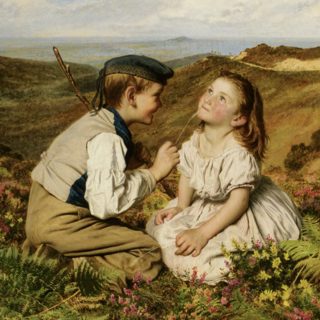
Tile image credit: 'It's Touch and Go to Laugh or No' (1857) by Sophie Gengembre Anderson via Wikipedia

Many Minds is a project of the Diverse Intelligences Summer Institute, which is made possible by a generous grant from the John Templeton Foundation to Indiana University. The show is hosted and produced by Kensy Cooperrider, with help from Assistant Producer Urte Laukaityte and with creative support from DISI Directors Erica Cartmill and Jacob Foster. Our artwork is by Ben Oldroyd. Our transcripts are created by Sarah Dopierala.

Subscribe to Many Minds on Apple, Stitcher, Spotify, Pocket Casts, Google Play, or wherever you listen to podcasts. You can also now subscribe to the Many Minds newsletter here!

We welcome your comments, questions, and suggestions. Feel free to email us at: manymindspodcast@gmail.com.

For updates about the show, visit our website or follow us on Twitter (@ManyMindsPod) or Bluesky (@manymindspod.bsky.social).

Det här avsnittet är hämtat från ett öppet RSS-flöde och publiceras inte av Podme. Det kan innehålla reklam.

Avsnitt(167)

From the archive: Varieties of childhood

From the archive: Varieties of childhood

Hi friends! We're taking a bit of a summer pause. We'll be back soon—in the meanwhile, enjoy this listener favorite from our archives! ----- [originally aired July 10, 2025] Childhood is a special tim...

31 Juli 1h 28min
From the archive: Philosophers on psychedelics

From the archive: Philosophers on psychedelics

Hi friends! We're taking a bit of a summer pause. We will be back soon—in the meanwhile, enjoy this listener favorite from our archives! ----- [originally aired May 14, 2025] Some call it the "psyched...

17 Juli 1h 40min
The origins of Darwin's ideas

The origins of Darwin's ideas

No discipline, no sphere of intellectual life, has been untouched by the work of Charles Darwin. He died in 1882 but his ideas are very much alive; they're now central to how we understand the natural...

3 Juli 1h 19min
The sparkling deep

The sparkling deep

It's tempting to see bioluminescence as an oddity, one of those rare eccentricities of life on earth. And, on land, maybe that's true. But our planet is mostly water, and out in the open ocean biolumi...

20 Juni 1h 20min

Is Man the Hunter just a myth?

Is Man the Hunter just a myth?

There's a story about of our past that you know well. It goes like this: At some point earlier in human evolution, we started to hunt. Men in particular—perhaps channeling some deep-seated aggressive ...

5 Juni 1h 32min

Babies, dogs, and the riddles of word learning

Babies, dogs, and the riddles of word learning

It's kind of astonishing, really, that kids ever learn words. Each one poses a little riddle. Does this sound string refer to a person? A category of things? Or maybe some other feature of the bloomin...

22 Maj 1h 18min

The inner life of the hand

The inner life of the hand

Newton saw in the human hand proof of the divine; Darwin saw a key to our species' success. Many others, too, have described the hand in hyperbolic terms, as a paragon of design, a cornerstone of huma...

7 Maj 1h 10min

From the archive: The cuttlefish and its coat of many colors

From the archive: The cuttlefish and its coat of many colors

Hi friends! We're skipping a beat to take care of some spring housekeeping tasks. We will be back in May! In the meanwhile, enjoy this listener favorite from our archives! ----- [originally aired Apri...

22 Apr 1h 33min

Populärt inom Utbildning

det-skaver
rss-bara-en-till-om-missbruk-medberoende-2
historiepodden-se
nu-blir-det-historia
allt-du-velat-veta
harrisons-dramatiska-historia
johannes-hansen-podcast
not-fanny-anymore
roda-vita-rosen
rss-viktmedicinpodden
i-vantan-pa-katastrofen
rikatillsammans-om-privatekonomi-rikedom-i-livet
sa-in-i-sjalen
sektledare
rss-max-tant-med-max-villman
rss-autismandan
rss-basta-livet
rss-traningsklubben
rss-i-skenet-av-blaljus
vi-gar-till-historien