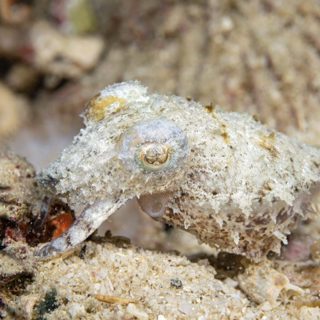
The cuttlefish and its coat of many colors
Many Minds30 Apr 2025

The cuttlefish and its coat of many colors

We humans have a hard time becoming invisible. For better or worse, we're basically stuck with the skin and body we have; we're pretty fixed in our color, our shape, our overall appearance. And so we're fascinated by creatures that aren't—creatures that morph to meet the moment, that can functionally disappear, that can shape-shift on a dime. And no creatures are more skilled, more astonishing, more bedazzling in their abilities to do this kind of thing than the cephalopods. But how do they do this exactly? What's going on in their skin? What's going on under their skin? And what's going on in their brains that makes this all possible?

My guest today is Dr. Tessa Montague. Tessa is a neuroscientist in the Axel Lab at Columbia University; she studies the brain and behavior of the dwarf cuttlefish, with a special focus on the biology of their dynamic skin behaviors.

Here, Tessa and I talk about how cuttlefish and other cephalopods exhibit the most impressive camouflaging abilities on the planet. We discuss how they change their skin's appearance with remarkable speed and fidelity—and not just when trying to blend in, but also when hunting, courting, fighting, and more. We talk about whether these behaviors are flexible and whether they're voluntary. We linger on the cruel irony that cuttlefish seem to be colorblind. We talk about the idea that a cephalopod's skin is kind of a window into their brain. We lay out the cells and organs in the cephalopod skin the make these behaviors possible—especially the tiny pigment-bearing structures called "chromatophores." And of course we also dive deep into the cephalopod brain and its sometimes bizarre and poorly understood structures.

Excited to share it with you friends—I think you'll enjoy it. Without further ado, here's my chat with Dr. Tessa Montague.

A transcript of this episode is available here.

Notes and links

3:00 – For more on Dr. Montague's recent expeditions to the Philippines, including photos, see here.

7:30 – Dr. Montague has published two recent reviews of dynamic skin behaviors in cephalopods—see here and here. We previously discussed cephalopod intelligence in a 2021 episode with Dr. Alex Schnell and a 2023 episode with the novelist Ray Nayler.

18:30 – For discussion of a recent "renaissance" in new model organisms, see here.

20:30 – For more on how chameleons change color, see this video.

25:00 – A video primer on cuttlefish camouflage, featuring the researcher Dr. Robert Hanlon.

30:30 – A recent paper on the details of pattern matching in cuttlefish camouflage.

31:00 – For more on the mimicking plant Boquila trifoliolata, see this popular article. See also our earlier episode with Dr. Paco Calvo and Dr. Natalie Lawrence.

35:00 – A video about the so-called mimic octopus.

40:00 – For the hypothesis about color discrimination via chromatic aberration and pupil shape, see here.

44:00 – For more on the "split body" skin behaviors observed in some cuttlefish, see here.

51:00 – For the David Attenborough clip about a cuttlefish hypnotizing a crab, see here. For the recent New York Times article on cuttlefish hunting behavior, including videos, see here. For the academic article that inspired the New York Times piece, see here.

58:00 – A recent scientific study on the possibility of octopus skin activity during dreaming. A video that helped popularize the idea of cephalopod skin activity as evidence of dreaming. Our earlier episode on why we—and other creatures—dream.

1:06:00 – For a study on chromatophore development from the lab of Dr. Gilles Laurent, see here.

1:11:00 – For more on papillae, including videos, see here.

1:17:00 – To explore an animated model of the cuttlefish brain, see this page of Dr. Montague's website, Cuttlebase.

Recommendations

Monarchs of the Sea, Danna Staaf

Other Minds, Peter Godfrey-Smith

Cephalopod Behavior, Roger Hanlon & John B. Messenger

Tile image credit: Noel Guevara

Many Minds is a project of the Diverse Intelligences Summer Institute, which is made possible by a generous grant from the John Templeton Foundation to Indiana University. The show is hosted and produced by Kensy Cooperrider, with help from Assistant Producer Urte Laukaityte and with creative support from DISI Directors Erica Cartmill and Jacob Foster. Our artwork is by Ben Oldroyd. Our transcripts are created by Sarah Dopierala.

Subscribe to Many Minds on Apple, Stitcher, Spotify, Pocket Casts, Google Play, or wherever you listen to podcasts. You can also now subscribe to the Many Minds newsletter here!

We welcome your comments, questions, and suggestions. Feel free to email us at: manymindspodcast@gmail.com.

For updates about the show, visit our website or follow us on Twitter (@ManyMindsPod) or Bluesky (@manymindspod.bsky.social).

Det här avsnittet är hämtat från ett öppet RSS-flöde och publiceras inte av Podme. Det kan innehålla reklam.

Avsnitt(167)

From the archive: Varieties of childhood

From the archive: Varieties of childhood

Hi friends! We're taking a bit of a summer pause. We'll be back soon—in the meanwhile, enjoy this listener favorite from our archives! ----- [originally aired July 10, 2025] Childhood is a special tim...

31 Juli 1h 28min
From the archive: Philosophers on psychedelics

From the archive: Philosophers on psychedelics

Hi friends! We're taking a bit of a summer pause. We will be back soon—in the meanwhile, enjoy this listener favorite from our archives! ----- [originally aired May 14, 2025] Some call it the "psyched...

17 Juli 1h 40min
The origins of Darwin's ideas

The origins of Darwin's ideas

No discipline, no sphere of intellectual life, has been untouched by the work of Charles Darwin. He died in 1882 but his ideas are very much alive; they're now central to how we understand the natural...

3 Juli 1h 19min

The sparkling deep

The sparkling deep

It's tempting to see bioluminescence as an oddity, one of those rare eccentricities of life on earth. And, on land, maybe that's true. But our planet is mostly water, and out in the open ocean biolumi...

20 Juni 1h 20min

Is Man the Hunter just a myth?

Is Man the Hunter just a myth?

There's a story about of our past that you know well. It goes like this: At some point earlier in human evolution, we started to hunt. Men in particular—perhaps channeling some deep-seated aggressive ...

5 Juni 1h 32min

Babies, dogs, and the riddles of word learning

Babies, dogs, and the riddles of word learning

It's kind of astonishing, really, that kids ever learn words. Each one poses a little riddle. Does this sound string refer to a person? A category of things? Or maybe some other feature of the bloomin...

22 Maj 1h 18min

The inner life of the hand

The inner life of the hand

Newton saw in the human hand proof of the divine; Darwin saw a key to our species' success. Many others, too, have described the hand in hyperbolic terms, as a paragon of design, a cornerstone of huma...

7 Maj 1h 10min

From the archive: The cuttlefish and its coat of many colors

From the archive: The cuttlefish and its coat of many colors

Hi friends! We're skipping a beat to take care of some spring housekeeping tasks. We will be back in May! In the meanwhile, enjoy this listener favorite from our archives! ----- [originally aired Apri...

22 Apr 1h 33min

Populärt inom Utbildning

det-skaver
rss-bara-en-till-om-missbruk-medberoende-2
historiepodden-se
nu-blir-det-historia
allt-du-velat-veta
harrisons-dramatiska-historia
johannes-hansen-podcast
not-fanny-anymore
roda-vita-rosen
rss-viktmedicinpodden
i-vantan-pa-katastrofen
rikatillsammans-om-privatekonomi-rikedom-i-livet
sa-in-i-sjalen
sektledare
rss-max-tant-med-max-villman
rss-autismandan
rss-basta-livet
rss-traningsklubben
rss-i-skenet-av-blaljus
vi-gar-till-historien