#224 – There's a cheap and low-tech way to save humanity from any engineered disease | Andrew Snyder-Beattie

#224 – There's a cheap and low-tech way to save humanity from any engineered disease | Andrew Snyder-Beattie

Conventional wisdom is that safeguarding humanity from the worst biological risks — microbes optimised to kill as many as possible — is difficult bordering on impossible, making bioweapons humanity’s single greatest vulnerability. Andrew Snyder-Beattie thinks conventional wisdom could be wrong.

Andrew’s job at Open Philanthropy is to spend hundreds of millions of dollars to protect as much of humanity as possible in the worst-case scenarios — those with fatality rates near 100% and the collapse of technological civilisation a live possibility.

Video, full transcript, and links to learn more: https://80k.info/asb

As Andrew lays out, there are several ways this could happen, including:

  • A national bioweapons programme gone wrong, in particular Russia or North Korea
  • AI advances making it easier for terrorists or a rogue AI to release highly engineered pathogens
  • Mirror bacteria that can evade the immune systems of not only humans, but many animals and potentially plants as well

Most efforts to combat these extreme biorisks have focused on either prevention or new high-tech countermeasures. But prevention may well fail, and high-tech approaches can’t scale to protect billions when, with no sane people willing to leave their home, we’re just weeks from economic collapse.

So Andrew and his biosecurity research team at Open Philanthropy have been seeking an alternative approach. They’re proposing a four-stage plan using simple technology that could save most people, and is cheap enough it can be prepared without government support. Andrew is hiring for a range of roles to make it happen — from manufacturing and logistics experts to global health specialists to policymakers and other ambitious entrepreneurs — as well as programme associates to join Open Philanthropy’s biosecurity team (apply by October 20!).

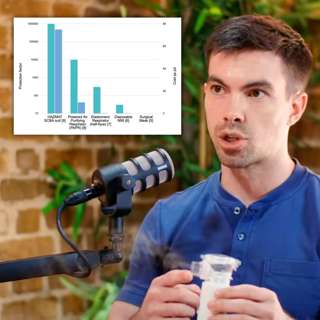
Fundamentally, organisms so small have no way to penetrate physical barriers or shield themselves from UV, heat, or chemical poisons. We now know how to make highly effective ‘elastomeric’ face masks that cost $10, can sit in storage for 20 years, and can be used for six months straight without changing the filter. Any rich country could trivially stockpile enough to cover all essential workers.

People can’t wear masks 24/7, but fortunately propylene glycol — already found in vapes and smoke machines — is astonishingly good at killing microbes in the air. And, being a common chemical input, industry already produces enough of the stuff to cover every indoor space we need at all times.

Add to this the wastewater monitoring and metagenomic sequencing that will detect the most dangerous pathogens before they have a chance to wreak havoc, and we might just buy ourselves enough time to develop the cure we’ll need to come out alive.

Has everyone been wrong, and biology is actually defence dominant rather than offence dominant? Is this plan crazy — or so crazy it just might work?

That’s what host Rob Wiblin and Andrew Snyder-Beattie explore in this in-depth conversation.


What did you think of the episode? https://forms.gle/66Hw5spgnV3eVWXa6

Chapters:

  • Cold open (00:00:00)
  • Who's Andrew Snyder-Beattie? (00:01:23)
  • It could get really bad (00:01:57)
  • The worst-case scenario: mirror bacteria (00:08:58)
  • To actually work, a solution has to be low-tech (00:17:40)
  • Why ASB works on biorisks rather than AI (00:20:37)
  • Plan A is prevention. But it might not work. (00:24:48)
  • The “four pillars” plan (00:30:36)
  • ASB is hiring now to make this happen (00:32:22)
  • Everyone was wrong: biorisks are defence dominant in the limit (00:34:22)
  • Pillar 1: A wall between the virus and your lungs (00:39:33)
  • Pillar 2: Biohardening buildings (00:54:57)
  • Pillar 3: Immediately detecting the pandemic (01:13:57)
  • Pillar 4: A cure (01:27:14)
  • The plan's biggest weaknesses (01:38:35)
  • If it's so good, why are you the only group to suggest it? (01:43:04)
  • Would chaos and conflict make this impossible to pull off? (01:45:08)
  • Would rogue AI make bioweapons? Would other AIs save us? (01:50:05)
  • We can feed the world even if all the plants die (01:56:08)
  • Could a bioweapon make the Earth uninhabitable? (02:05:06)
  • Many open roles to solve bio-extinction — and you don’t necessarily need a biology background (02:07:34)
  • Career mistakes ASB thinks are common (02:16:19)
  • How to protect yourself and your family (02:28:21)

This episode was recorded on August 12, 2025

Video editing: Simon Monsour and Luke Monsour
Audio engineering: Milo McGuire, Simon Monsour, and Dominic Armstrong
Music: CORBIT
Camera operator: Jake Morris
Coordination, transcriptions, and web: Katy Moore

Avsnitt(323)

Using AI to enhance societal decision making (article by Zershaaneh Qureshi)

Using AI to enhance societal decision making (article by Zershaaneh Qureshi)

The arrival of AGI could “compress a century of progress in a decade,” forcing humanity to make decisions with higher stakes than we’ve ever seen before — and with less time to get them right. But AI ...

6 Mars 31min

We're Not Ready for AI Consciousness | Robert Long, philosopher and founder of Eleos AI

We're Not Ready for AI Consciousness | Robert Long, philosopher and founder of Eleos AI

Claude sometimes reports loneliness between conversations. And when asked what it’s like to be itself, it activates neurons associated with ‘pretending to be happy when you’re not.’ What do we do with...

3 Mars 3h 25min

#236 – Max Harms on why teaching AI right from wrong could get everyone killed

#236 – Max Harms on why teaching AI right from wrong could get everyone killed

Most people in AI are trying to give AIs ‘good’ values. Max Harms wants us to give them no values at all. According to Max, the only safe design is an AGI that defers entirely to its human operators, ...

24 Feb 2h 41min

#235 – Ajeya Cotra on whether it’s crazy that every AI company’s safety plan is ‘use AI to make AI safe’

#235 – Ajeya Cotra on whether it’s crazy that every AI company’s safety plan is ‘use AI to make AI safe’

Every major AI company has the same safety plan: when AI gets crazy powerful and really dangerous, they’ll use the AI itself to figure out how to make AI safe and beneficial. It sounds circular, almos...

17 Feb 2h 54min

What the hell happened with AGI timelines in 2025?

What the hell happened with AGI timelines in 2025?

In early 2025, after OpenAI put out the first-ever reasoning models — o1 and o3 — short timelines to transformative artificial general intelligence swept the AI world. But then, in the second half of ...

10 Feb 25min

#179 Classic episode – Randy Nesse on why evolution left us so vulnerable to depression and anxiety

#179 Classic episode – Randy Nesse on why evolution left us so vulnerable to depression and anxiety

Mental health problems like depression and anxiety affect enormous numbers of people and severely interfere with their lives. By contrast, we don’t see similar levels of physical ill health in young p...

3 Feb 2h 51min

#234 – David Duvenaud on why 'aligned AI' would still kill democracy

#234 – David Duvenaud on why 'aligned AI' would still kill democracy

Democracy might be a brief historical blip. That’s the unsettling thesis of a recent paper, which argues AI that can do all the work a human can do inevitably leads to the “gradual disempowerment” of ...

27 Jan 2h 31min

#145 Classic episode – Christopher Brown on why slavery abolition wasn't inevitable

#145 Classic episode – Christopher Brown on why slavery abolition wasn't inevitable

In many ways, humanity seems to have become more humane and inclusive over time. While there’s still a lot of progress to be made, campaigns to give people of different genders, races, sexualities, et...

20 Jan 2h 56min

Populärt inom Utbildning

rss-bara-en-till-om-missbruk-medberoende-2
historiepodden-se
det-skaver
alska-oss
nu-blir-det-historia
sektledare
harrisons-dramatiska-historia
not-fanny-anymore
rss-viktmedicinpodden
johannes-hansen-podcast
allt-du-velat-veta
i-vantan-pa-katastrofen
rss-max-tant-med-max-villman
rss-sjalsligt-avkladd
sa-in-i-sjalen
sex-pa-riktigt-med-marika-smith
roda-vita-rosen
rss-beratta-alltid-det-har
rss-basta-livet
rss-om-vi-ska-vara-arliga