Peter Breggin - The Conscience of Psychiatry (Part 1)

Peter Breggin - The Conscience of Psychiatry (Part 1)

This week we have a very special guest for you, it has been my honour to be able to interview Dr. Peter Breggin.

Dr. Breggin is a Harvard-trained psychiatrist and former Consultant at the National Institute of Mental Health (NIMH). He has been called "The Conscience of Psychiatry" for his many decades of successful efforts to reform the mental health field.

His work provides the foundation for modern criticism of psychiatric diagnoses and drugs, and leads the way in promoting more caring and effective therapies. His research and educational projects have brought about major changes in the FDA-approved Full Prescribing Information or labels for dozens of antipsychotic and antidepressant drugs. He continues to educate the public and professions about the tragic psychiatric drugging of America's children.

He has authored dozens of scientific articles and more than twenty books, including medical books and the bestsellers Toxic Psychiatry and Talking Back to Prozac. His most recent three books are Guilt, Shame and Anxiety: Understanding and Overcoming Negative Emotions; Medication Madness: the Role of Psychiatric Drugs in Cases of Violence, Suicide and Murder; and Psychiatric Drug Withdrawal: A Guide for Prescribers, Therapists, Patients and their Families.

As a medical-legal expert, Dr. Breggin has unprecedented and unique knowledge about how the pharmaceutical industry too often commits fraud in researching and marketing psychiatric drugs. He has testified many times in malpractice, product liability and criminal cases, often in relation to adverse drug effects and more occasionally electroshock and psychosurgery. A list of his trial testimony since 1985 is contained in the last section of his Resume on Dr. Breggin's website.

Dr. Breggin has taught at many universities and has a private practice of psychiatry in Ithaca, New York.

For a career as long and distinguished as Dr. Breggin's we have decided to devote two episodes to hearing him speak. This first part covers Dr. Breggin's career, his views on psychiatry and psychiatric drugs and also recent developments with the trial involving Michelle Carter.

Part 2 of the interview will focus more on the trial and Dr. Breggin's involvement.

In this episode, we discuss:

How, age just 18, Dr. Breggin worked as a volunteer in a metropolitan state hospital in 1954.

That his immediate impression was a comparison with German concentration camps as he witnessed the brutality including lobotomy and insulin coma therapy.

How when the drugs were introduced, primarily Thorazine, the patients would quieten, becoming docile and obedient.

That this was brain damage for the purpose of control.

That Dr. Breggin then wanted to go to medical school and become part of the reform movement.

That, in the 1950s, there were still psychiatrists that had an interest and training in psychological therapy or psychoanalytic approaches, and social and community psychology.

That this also resulted in psychiatry becoming very hostile towards psychosocial approaches, which were less expensive and better.

Then, in the 1960s, psychiatry went into partnership with the drug companies and got richer.

That Dr. Breggin then entered private practice and learned that lobotomy was making a comeback. This led to a multi year, international campaign to halt the use of lobotomy and psychosurgery in the western world.

Since then, Dr. Breggin has also campaigned tirelessly to make changes in the FDA labelling of psychotropic drugs.

That Dr. Breggin feels blessed to have been able to stand up for others but also occasionally feels worried by the attacks from the psychiatric establishment.

How Dr. Breggin feels that we should tell the truth about psychiatric drugs and that claims of 'scaremongering' is a mechanism to reduce criticism of the drugs.

That informing people is very different compared to frightening them.

That each individual person is still the best judge of when and how to go about withdrawing from psychiatric medications.

That Dr. Breggin feels that psychiatry has no economic incentive to change, so the consumer has to stop going to psychiatrists for medications.

How the District Attorney in the Michelle Carter case is now trying to stop Dr. Breggin's Mad in America blogs about her case.

Relevant Links

Peter Breggin's personal website

Dr. Breggin's blogs on Mad in America:

Part 1

Part 2

Michelle Carter Blogs and Archives

The handwritten note from the DA to the Judge about stopping Dr. Breggin's blog

Toxic Psychiatry

Talking Back to Prozac

Guilt, Shame and Anxiety: Understanding and Overcoming Negative Emotions

Medication Madness: the Role of Psychiatric Drugs in Cases of Violence, Suicide and Murder

Psychiatric Drug Withdrawal: A Guide for Prescribers, Therapists, Patients and their Families.

To get in touch with us email: podcasts@madinamerica.com

© Mad in America 2017

Det här avsnittet är hämtat från ett öppet RSS-flöde och publiceras inte av Podme. Det kan innehålla reklam.

Avsnitt(308)

When Stopping Prescription Drugs Isn't Simple: Alicia Martin and the TaperMate Story

When Stopping Prescription Drugs Isn't Simple: Alicia Martin and the TaperMate Story

Alicia Martin is an Australian community pharmacist, a member of the Not Broken Project and founder of TaperMate. Through her work in pharmacy, Alicia saw patients struggling with unusual and severe s...

16 Sep 34min
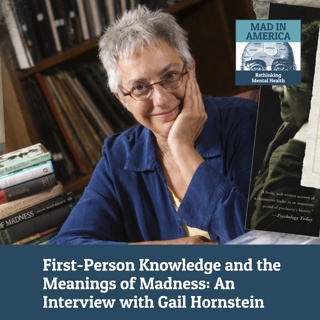
First-Person Knowledge and the Meanings of Madness: An Interview with Gail Hornstein

First-Person Knowledge and the Meanings of Madness: An Interview with Gail Hornstein

Gail Hornstein is Professor Emerita of Psychology at Mount Holyoke College. Across a long and influential career, her work has moved between psychology, psychoanalysis, history, qualitative research, ...

2 Sep 1h 8min
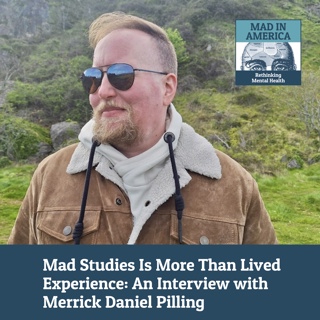
Mad Studies Is More Than Lived Experience: An Interview with Merrick Daniel Pilling

Mad Studies Is More Than Lived Experience: An Interview with Merrick Daniel Pilling

Merrick Daniel Pilling is an Associate Professor and Interim Co-Director of the School of Disability Studies at Toronto Metropolitan University. He is the author of Queer and Trans Madness: Struggles ...

19 Aug 49min

The West Doesn't Have All the Answers: An Interview with Dinesh Bhugra

The West Doesn't Have All the Answers: An Interview with Dinesh Bhugra

Dinesh Bhugra is a leading voice in social and cultural psychiatry. He is Emeritus Professor of Mental Health and Cultural Diversity at King's College London and has served as president of the Royal ...

12 Aug 36min
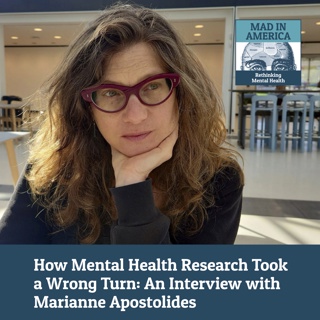
Go/No Go - How Mental Health Research Took a Wrong Turn: An Interview with Marianne Apostolides

Go/No Go - How Mental Health Research Took a Wrong Turn: An Interview with Marianne Apostolides

Marianne Apostolides is the award-winning author of eight books, four of which have been translated and published internationally. She is a two-time recipient of the Chalmers Arts Fellowship and winne...

29 Juli 48min
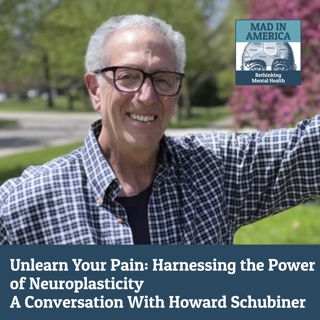
Unlearn Your Pain: Harnessing the Power of Neuroplasticity – A Conversation With Howard Schubiner

Unlearn Your Pain: Harnessing the Power of Neuroplasticity – A Conversation With Howard Schubiner

Welcome to the Mad in America podcast. My name is Brooke Siem, and I am the author of the award-winning memoir on antidepressant withdrawal, May Cause Side Effects. Today, I'm excited to have Dr. Howa...

15 Juli 41min
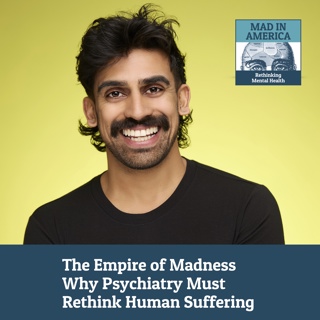
The Empire of Madness: Why Psychiatry Must Rethink Human Suffering - An Interview with Khameer Kidia

The Empire of Madness: Why Psychiatry Must Rethink Human Suffering - An Interview with Khameer Kidia

Khameer Kidia is a physician and an anthropologist, works at Harvard Medical School and the University of Zimbabwe, and spends his life between Washington DC and Harare. Kidia has many accolades to hi...

8 Juli 48min
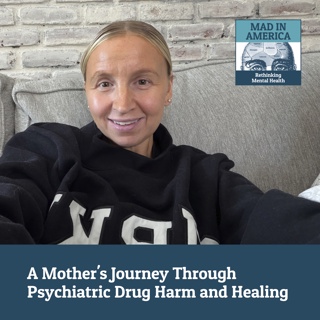
A Mother's Journey Through Psychiatric Drug Harm and Healing

A Mother's Journey Through Psychiatric Drug Harm and Healing

Chelsea McVeigh began her journey with psychiatric medications at 16, never imagining where it would lead. At 31, during a new pregnancy, she suffered a severe adverse reaction that turned her world u...

1 Juli 24min

Populärt inom Hälsa

somna-med-henrik
rss-jossan-nina
rss-bara-en-till-om-beroende-medberoende
inga-beiga-morsor
rss-vuxna-pa-latsas
bullfika
not-fanny-anymore
sexnoveller-deluxe
rss-viktmedicinpodden
angestpodden
johannes-hansen-podcast
sova-med-dan-horning
sa-in-i-sjalen
rss-ronden
tyngre-traningssnack
rss-basta-livet
rss-traningsklubben
rss-angra-inget-3
halsoveckan-by-tyngre
rss-hos-psykologen