John Read and Irving Kirsch – Electroconvulsive Therapy (ECT) Does the Evidence From Clinical Trials Justify its Continued Use?

John Read and Irving Kirsch – Electroconvulsive Therapy (ECT) Does the Evidence From Clinical Trials Justify its Continued Use?

This week on MIA Radio we turn our attention to electroconvulsive therapy (known as electroshock in the US). It's fair to say that ECT remains a controversial subject with proponents and detractors regularly disagreeing on its safety and efficacy. The number of psychiatrists willing to administer ECT, particularly in the UK, is in decline but we are still using it to administer electric shocks to the brains of an estimated 2,000 people each year.

In this interview, we discuss a recent paper from the journal Ethical Human Psychology and Psychiatry. The title is 'Electroconvulsive Therapy for Depression: A Review of the Quality of ECT versus Sham ECT Trials and Meta-Analyses' and it is written by John Read, Irving Kirsch and Laura McGrath. On MIA we have previously written about the study and its findings.

We hear from two of the authors, Professor of Psychology John Read from the University of East London and Professor of Psychology Irving Kirsch from Harvard Medical School.

We discuss:
  • That the work aimed to review the quality of meta-analyses and any relevant clinical studies of ECT.
  • How there have only ever been 11 studies that have compared ECT with sham ECT (SECT).
  • Sham ECT is when the anaesthetic is administered but not followed by shocks to the brain.
  • That in addition to reviewing the quality of the studies, the paper went on to consider the effect of placebo in the administration of ECT.
  • That when reviewing the quality of studies, a 24-point scale was used and that the scorers were blinded to each other's ratings.
  • The 24-point scale included 5 basic Cochrane Collaboration criteria and an additional 19 quality indicators, some of which were specific to ECT procedures.
  • The average quality score across all the studies was 12.3 out of a 24 maximum.
  • One of the most important findings was that none of the studies reviewed were double-blind.
  • The reason for this is that the patients can't be blinded to the procedure because the adverse after-effects are very obvious.
  • In reviewing the studies it was sometimes the case that only the treating psychiatrist was rating the effectiveness of the procedure, not the patient.
  • The 5 meta-analyses themselves only contained between 1 and 7 of the eleven available studies.
  • The recommendation from the paper is that the use of ECT should be suspended pending a properly controlled, rigorous clinical trial.
  • That the UK's National Institute for Health and Clinical Excellence (NICE) has decided to review their ECT recommendations in their depression guidelines, considering the review.
  • That the Royal College of Psychiatrists has indicated that they will update their ECT position statement in light of the review.
  • It has come to light recently that NHS Trusts in the UK are sometimes using out of date or incorrect information in their ECT guidance leaflets, an example of this is referring to ECT correcting a 'chemical imbalance in the brain'.
  • How the expectations of the treating doctor can influence the condition of the person undergoing the treatment.
  • That the placebo effect can be large and long-lasting and that the more invasive the procedure, the larger the effect.
  • That one of the characteristics of depression is the feeling of hopelessness and that when you are given a new treatment, it can instil a sense of hope which counters the hopelessness.
  • That the call to prohibit ECT is because the negative effects of ECT are so strong, the fact that the evidence supporting it is so weak (especially in the long-term and beyond the improvement due to placebo) and that there are other means of addressing the difficulties that the person is dealing with.
  • That placebos are, in essence, a type of psychological therapy.
Links and further reading:

Electroconvulsive Therapy for Depression: A Review of the Quality of ECT versus Sham ECT Trials and Meta-Analyses

Richard P. Bentall: ECT is a classic failure of evidence-based medicine

NICE guidance on the use of electroconvulsive therapy

Avsnitt(293)

Psychiatric Drugs: The Real World is Where the Harms Live

Psychiatric Drugs: The Real World is Where the Harms Live

Joining us for a roundtable discussion are Brooke Siem, David Antonuccio, Kim Witzak, Angie Peacock and David Healy. They discuss the challenges of openly discussing psychiatric drug withdrawal, the t...

29 Okt 202545min
Medical Organizations Turn Blind Eye to Harms of Maternal Antidepressant Use: A Conversation With Adam Urato and Joanna Moncrieff

Medical Organizations Turn Blind Eye to Harms of Maternal Antidepressant Use: A Conversation With Adam Urato and Joanna Moncrieff

On July 21st 2025, the FDA convened a hearing on maternal use of antidepressants during pregnancy and the impact this use has on fetal development. Around 400,000 children in the United States are bor...

8 Okt 202548min
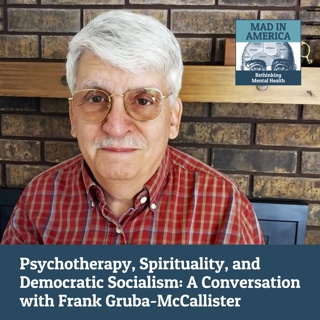
Psychotherapy, Spirituality, and Democratic Socialism: A Conversation with Frank Gruba-McCallister

Psychotherapy, Spirituality, and Democratic Socialism: A Conversation with Frank Gruba-McCallister

Frank Gruba-McCallister is a clinical psychologist, educator, and scholar whose career spans more than three decades of teaching and academic leadership. He served as Vice President of Academic Affai...

24 Sep 202544min
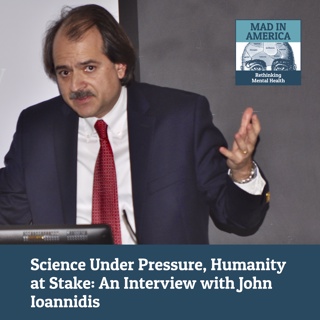
Science Under Pressure, Humanity at Stake: An Interview with John Ioannidis

Science Under Pressure, Humanity at Stake: An Interview with John Ioannidis

John Ioannidis is a Stanford professor, a physician, and one of the most eminent scholars in the world in the field of evidence-based medicine. Ioannidis has spent his career exposing the weak foundat...

10 Sep 202551min
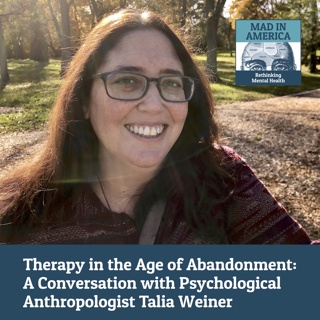
Therapy in the Age of Abandonment: A Conversation with Psychological Anthropologist Talia Weiner

Therapy in the Age of Abandonment: A Conversation with Psychological Anthropologist Talia Weiner

Talia Weiner is a psychological anthropologist, licensed professional counselor, and assistant professor of psychology at the University of West Georgia. As a medical and psychological anthropologist,...

3 Sep 202537min

How to be a Critical Psychologist Without Losing Your Soul: A Conversation With Zenobia Morrill, José Giovanni Luiggi-Hernández and Justin Karter

How to be a Critical Psychologist Without Losing Your Soul: A Conversation With Zenobia Morrill, José Giovanni Luiggi-Hernández and Justin Karter

On the Mad in America podcast this week, we explore the importance of raising awareness of psychological approaches that challenge mainstream perspectives. Joining us today are three people who are pr...

13 Aug 202545min

Is Dialogue the Best Medicine? A Conversation With Jaakko Seikkula

Is Dialogue the Best Medicine? A Conversation With Jaakko Seikkula

Welcome to MIA Radio. Today, we are pleased to have as our guest Jaakko Seikkula. Jaakko is a psychologist who helped develop the Open Dialogue practice at Keropudas Hospital in Tornio, Finland, in th...

30 Juli 202545min
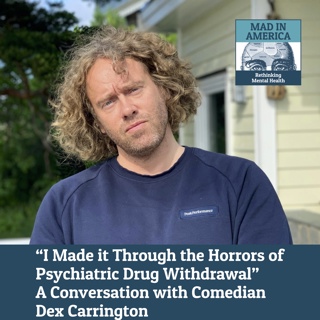
"I Made it Through the Horrors of Psychiatric Drug Withdrawal" A Conversation with Comedian Dex Carrington

"I Made it Through the Horrors of Psychiatric Drug Withdrawal" A Conversation with Comedian Dex Carrington

Jørgen Kjønø, whose stage name is Dex Carrington, is a Norwegian-American stand-up comedian based in Oslo, Norway. He is also an actor, host of the Truth Train podcast, and former travel show host who...

9 Juli 202542min

Populärt inom Hälsa

somna-med-henrik
rss-jossan-nina
inga-beiga-morsor
rss-bara-en-till-om-missbruk-medberoende-2
alska-oss
rss-vuxna-pa-latsas
angestpodden
johannes-hansen-podcast
sexnoveller-deluxe
not-fanny-anymore
rss-viktmedicinpodden
brottarbroder
sa-in-i-sjalen
sova-med-dan-horning
rss-the-house-podcast-3
rss-sjalsligt-avkladd
rss-basta-livet
smartare-fitness-podden
tyngre-traningssnack
rss-psykoterapipodden