
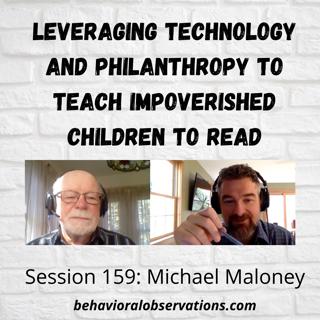
Leveraging Technology and Philanthropy to Teach Impoverished Children to Read: Session 159 with Michael Maloney
In Session 159 of The Behavioral Observations Podcast, Michael Maloney returns to the show. We spend a few minutes catching up since the last time we spoke (see Session 129), but then pivot to his recent collaboration with the Canadian charity organization, the Amorak Society. With help from the Rotary International's literacy initiative, these partners deployed Michael's reading program, The Maloney Method, to over 2500 children in some of the poorest areas of Bangladesh via a smartphone-based app. I won't spoil the all the good parts here in the episode description, but let me just say that this is an amazing story of dissemination that I hope you enjoy as much as I did. For those interested in learning more about Michael and/or the reading software, check out his website, MaloneyMethod.com. Michael will also be conducting a series of webinars with Behavior Development Solutions throughout the month of June, so please check those out if you'd like to learn directly from him. This episode of Behavioral Observations was brought to you with support from: HRIC Recruiting. Barb Voss has been placing BCBAs in permanent positions throughout the US for just about a decade, and has been in the business more generally for 30 years. When you work with HRIC, you work directly with Barb, thereby accessing highly personalized service. So if you're about to graduate, you're looking for a change of pace, or you just want to know if the grass really is greener on the other side, head over to HRIColorado.com to schedule a confidential chat right away. Consider joining the BOP Patreon. Patreon members get early access to podcasts, bonus podcast material, discounts on CEU events from FTF and other continuing ed purveyors, occasional Zoom hangouts, and more! The Whoop Strap! I've been wearing the Whoop Strap for just a few weeks and I can't tell you how much I've enjoyed getting quantitative information on all aspects of my health, including sleep analytics, heart rate, along with heart rate variability, calorie burn, exercise intensity, and Whoop's proprietary "strain" score. I could extol this neat device's virtues indefinitely to you, but instead, you can go check it out for yourself. To get your first month free, head over to behavioralobservations.com/whoop! Also, feel free to join the Behavior Analysts who Whoop Facebook group! Lastly, check out the 2021 Stone Soup Conference! I challenge you to find a better CEU value in any virtual conference out there. With pod faves like Drs. Linda LeBlanc, Dithu Rajaraman, Jim Moore, Kerri Milyko, and more, there's something for everyone at this event. Use promo code PODCAST to save even more at checkout! Click here for additional details.
12 Juni 202150min
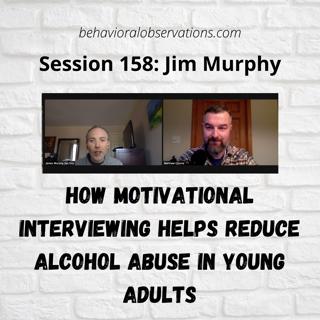
How Motivational Interviewing Helps Reduce Alcohol Use Problems in Young Adults: Session 158 with Jim Murphy
Rather than writing up a compelling introduction to this episode, I'm tempted to say, "just listen to the whole thing!" and leave it there. In Session 158, I chat with one of my oldest friends and Auburn classmate (obligatory "War Eagle!"), Dr. Jim Murphy from the University of Memphis, about the impossibly-broad topic of Substance Use Disorders (SUDs). Fortunately for us, Jim has spent over 20 years studying this issue from Behavior Analytic/Behavioral Economic points of view, and he has developed an uncanny ability to discuss these complicated repertoires in easy to understand, everyday terms. As such, in this episode we cover the following: How the environment often plays a key role in substance use. Why the abstinence model for problem drinkers may not be the best fit for some individuals. Why the terms, "alcoholic," and "addict," are neither descriptive, nor helpful. Why we should be more concerned about binge drinkers. How alcohol increases social interactions. How certain age-ranges are at risk for binge-style use patterns. What is Motivational Interviewing, and how it can be used to address binge drinking. The differences in substance use patterns between young adults who do and don't go to college. How developing hobbies and other values-based activities can help curb problem drinking. What does the research say about Alcoholics Anonymous and similar 12-step programs, and in general, the pros and cons of these approaches. How using a Hypothetical Demand Curve analysis can be used to assess motivation to reduce drinking behavior. Why BCBAs should consider getting training in Motivational Interviewing. Jim was also kind enough to stick around after the interview for a few more minutes in the commercial-free Patreon feed. In this bonus segment, Jim shares his thoughts on drug legalization in America, particularly the legalization of cannabis. If you're interested in checking this out, as well as partaking in other Patreon-only benefits, check out patreon.com/behavioralobservations. Here are the links to the resources we discussed: Jim's page at The University of Memphis. Jim's Google Scholar page. Drunk Monkeys video. Rat Park study. Alcohol/Social Bonding experiment. Marlatt, et al. (1999). Screening and Brief Intervention for High-Risk College Student Drinkers. A scientific review of Alcoholics Anonymous. Relevant APA Divisions: Division 50 (Society of Addiction Psychology) and Division 28 (Psychopharmacology and Substance Abuse). National Institute on Alcohol Abuse and Alcoholism. Maureen Dowd's NYT column (2014; will make sense for those listening to the extended Patreon episode). Please permit me a few quick housekeeping notes: We had a few connection issues, so the audio fades in a few places, but I don't think it detracts from the overall content of the show. As with Session 157, this episode was recorded in December of 2020, so there may be a few time-based references that will seem out of sync... however, I don't think they have much bearing on the overall gist of the podcast. This episode is brought to you today with the generous support of: Institutional Tier Patron Greenspace Behavioral Technology. For more information on their products and services check out greenspacebehavior.com. The Whoop Strap! I've been wearing the Whoop Strap for just a few weeks and I can't tell you how much I've enjoyed getting quantitative information on all aspects of my health, including sleep analytics, heart rate, along with heart rate variability, calorie burn, exercise intensity, and Whoop's proprietary "strain" score. I could extol this neat device's virtues indefinitely to you, but instead, you can go check it out for yourself. To get your first month free, head over to behavioralobservations.com/whoop! Also, feel free to join the Behavior Analysts who Whoop Facebook group! Behavior University. Their mission is to provide university quality professional development for the busy Behavior Analyst. Learn about their CEU offerings, including their brand new 8-hour Supervision Course, as well as their RBT offerings over at behavioruniversity.com/observations. Consider joining the BOP Patreon. Patreon members get early access to podcasts, bonus podcast material, discounts on CEU events from FTF and other continuing ed purveyors, occasional Zoom hangouts, and more!
27 Maj 20211h 11min
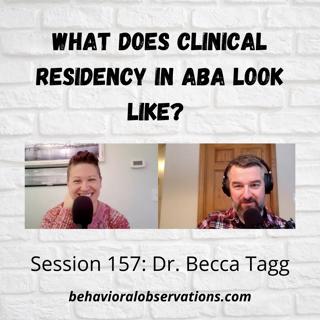
What Does Clinical Residency in Applied Behavior Analysis Look Like? Session 157 with Becca Tagg
Dr. Becca Tagg from Del Mar Behavioral Health joins me to discuss the unique approach her agency uses to train early-career BCBAs. This conversation was inspired by the interview I conducted with Dr. Mary Jane Weiss last year, in which we talked about how cool it would be if the field had an ABA equivalent of a medical residency model, so that BCBAs can learn about practicing with a variety of populations. As you'll hear in the interview, Becca heard this and reached out to say that this is exactly what they do, and we spend the majority of the conversation discussing just how they implement this unique training strategy. Before we get to the residency topic, we spent a little bit of time catching up since our last chat, and especially focus on how Del Mar's services adapted to the Covid-19 pandemic. To this end, I should also note that we recorded this conversation in December, and as such, some of the references may seem a bit anachronistic, but many of these challenges are still with us in the Spring of 2021, so I chose to keep that part of the conversation in this episode. If you like these types of topics, I suggest that you join the ABA Business Builders Facebook Group if you haven't already done so. While you're there, say hello to Becca! Here are the links to resources we discussed: Becca's first episode with me, Session 97. My interview with Mary Jane Weiss (definitely check out if you haven't heard it yet), Session 128. A golden oldie, my conversation with Tim Courtney, Session 46. Becca's podcast and business consulting services. Sniffy, the Virtual Rat. #DoBetterMovement. Difficult Conversations: How to Discuss What Matters Most, Stone, Patton, Heen and Fisher. This episode of Behavioral Observations was brought to you with support from: HRIC Recruiting. Barb Voss has been placing BCBAs in permanent positions throughout the US for just about a decade, and has been in the business more generally for 30 years. When you work with HRIC, you work directly with Barb, thereby accessing highly personalized service. So if you're about to graduate, you're looking for a change of pace, or you just want to know if the grass really is greener on the other side, head over to HRIColorado.com to schedule a confidential chat right away. Consider joining the BOP Patreon. Patreon members get early access to podcasts, bonus podcast material, discounts on CEU events from FTF and other continuing ed purveyors, occasional Zoom hangouts, and more! The Whoop Strap! I've been wearing the Whoop Strap for just a few weeks and I can't tell you how much I've enjoyed getting quantitative information on all aspects of my health, including sleep analytics, heart rate, along with heart rate variability, calorie burn, exercise intensity, and Whoop's proprietary "strain" score. I could extol this neat device's virtues indefinitely to you, but instead, you can go check it out for yourself. To get your first month free, head over to behavioralobservations.com/whoop! Also, feel free to join the Behavior Analysts who Whoop Facebook group!
18 Maj 20211h 3min
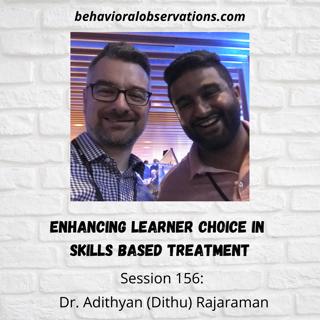
Enhancing Learner Choice in Skills-Based Treatment: Session 156 with Adithyan Rajaraman
Dr. Adithyan "Dithu" Rajaraman joins me in Session 156 to discuss his work in the Practical Functional Assessment/Skills-Based Treatment literature. Dithu is a former student of pod-fave Dr. Greg Hanley, and as one might expect, Dithu approaches his work with a similar degree of humility and open-mindedness. He earned his Ph.D. at Western New England University, and is now an Assistant Professor at the University of Maryland Baltimore County As we discuss in the first few minutes of the show, I met Dithu about four or five years ago at APBA, and I was instantly struck with how well he communicated complex ideas in a manner that just about anybody can understand. We've kept in touch since then, and I was fortunate enough to find a time where we could get together for an in-depth conversation on the podcast. In this episode, we covered his entry into the field of ABA, the seemingly false distinction of behavior-reduction vs. skill instruction, the basics of the Practical Functional Assessment and Skills-Based Treatment models, dealing with caregiver objections to these approaches, Dithu's research on what he calls the Enhanced Choice Model of skill instruction, implementing these procedures in public school settings, and much more. We also talk about how he stumped me with a question when I was a panelist at an ABAI event… You're going to want to stay through to the very end because Dithu provides some really unique advice – not only for newly-minted BCBAs, but practitioners of all experience levels. The Patreon version of this show involves an extra 45-50 minutes of content, in which we talk about Dithu's passion for the sport Cricket and field questions from Patrons. Last but not least, Dithu, as some of you might know, is quite the singer, and he ends the bonus footage by sharing his vocal stylings. To get access to this content, as well as commercial-free podcast feeds, discounts on FTF trainings, and more, check out patreon.com/behavioralobservations. And while we're on the topic of Patreon, Dithu has agreed to do a Zoom call with members, where he'll take questions directly from listeners. I should also add that Dithu insisted I give some shoutouts to the following folks who helped him with his research, and they include the aforementioned Greg Hanley, as well as Holly Gover, Johanna Staubitz, John Staubitz, Kathleen Simcoe, Rachel Metras, Robin Landa, and Kelsey Ruppel. This research has been recently published in Behavior Analysis in Practice as well, so I recommend you check it out when you get a chance. If you like Dithu's approach and want to learn more from him, my friends at Behavior University are hosting a webinar with him titled: Enhanced Choice Model: Trauma-informed Process for Assessing and Treating Dangerous Behavior. Behavior University is a sponsor of the podcast, and if you'd like to save on your registration for this event, use the code PODCAST at checkout. Also, if you're looking for a grad program and you really want to dive deep into this area, UMBC is always accepting applicants to their Master's program in ABA, which is closely affiliated with the Kennedy Krieger Institute, and that Dithu is accepting doctoral students in the Applied Developmental Psychology program. In addition to Behavior University and the Patreon Group, this episode is also brought to you by How-to-ABA. Being a BCBA can be lonely and overwhelming. At howtoaba.com, we help BCBA's feel supported and confident by providing easy to access printables, CEU's and a collaborative community. Also, your monthly pro membership includes access to CEU's! Along with the community of over 1000 ABA professionals, howtoaba.com will help you save time, feel confident and master what you love! For more information, Go to howtoaba.com/joinbxresource. When you join today and use code BOP, you'll receive 10% off a yearly subscription (includes CEU's!).
4 Maj 20211h 28min
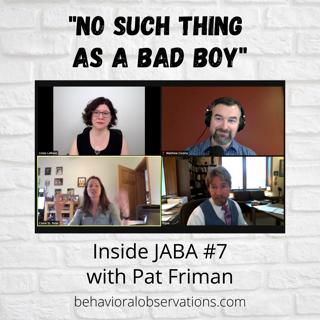
Inside JABA #7: There's No Such Thing as a Bad Boy, with Pat Friman
In previous appearances on this podcast and elsewhere, Pat Friman has told the story of Father Flanagan, founder of BoysTown. According to Pat, Father Flanagan often made the following statement when describing his philosophy of helping troubled youths: "there is no such thing as a bad boy, only bad environments, bad modeling, and bad teaching." For the Spring 2021 issue of the Journal of Applied Behavior Analysis, Dr. Linda LeBlanc invited Pat to expand on these remarks in the issue's lead paper. In this podcast, I'm joined by both Linda and Pat, as well as Inside JABA regular, Dr. Claire St. Peter, where we talk at length about the "circumstantial view" of behavior as it applies to both clinical practice in particular, and societal trends more generally. Specifically, we discuss the following: How this paper fits into LeBlanc's "big idea paper" concept. How "big idea" papers are often conceptual rather than data based. Why Pat stopped presenting papers with original data, and why he started giving more thematic talks. The difference, from Pat's perspective between giving a talk and writing a journal article. A brief history of BoysTown. Just what is the Circumstantial View of problem behavior? Some examples from Pat's life where he failed to take the Circumstantial View of behavior. Why the Circumstantial View has failed to flourish? How supervisors can incorporate these views with trainees and other team members? Why it is important to tell a real-life story as a vehicle for explain a behavioral principles. Why Pat's view of Walden Two has changed. Movies that demonstrate both the Circumstantial and Characterological View of behavior. And much more! During this conversation, we discussed many papers and other resources. I've done my best to capture all of them below: The paper that inspired this podcast, "There is no such thing as a bad boy: The circumstantial view of problem behavior." The JABA Homepage. Pat Friman's appearances on Behavioral Observations (Session 10, Session 16, Session 42, and Session 77). Goldiamond (2002). Toward a Constructional Approach to Social Problems: Ethical and Constitutional Issues Raised by Applied Behavior Analysis. Pat's TedTalk. The short film Pat referenced. The DailyBA clip we discussed (Pink Sweater/Didn't Know her Circumstances). This Way of Thinking (CE/Short film by Team OnLocation). Session 72: Compassionate Service Delivery. Quotable Quote: "When a flower doesn't bloom, you fix the environment in which it grows, not the flower." – Alexander Den Heijer. Thinking Fast and Slow, Daniel Kahneman. A Clockwork Orange. Walden Two. In keeping with previous Inside JABA Series podcasts, there will be no ads in this episode. However, this show happens to be eligible for BACB Continuing Education. So click here for more information. And, to help incentivize getting Pat's important message out there, I'm running a 50% 55% off sale from now, through the first week of May, 2021. Use offer code Boystown, to get more than half off any CEU in the Behavioral Observations catalog. I hope you enjoy this conversation as much as I did. If so, please consider sharing with friends and colleagues!
26 Apr 20211h 38min
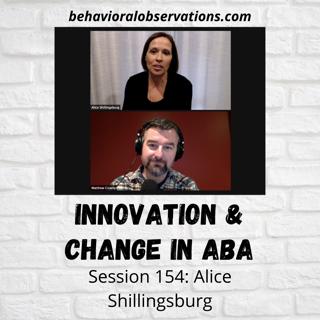
Innovation and Change in ABA: Session 154 with Alice Shillingsburg
I had a great chat with fellow Auburn University alum Dr. Alice Shillingsburg. Alice has been doing great work in the field for decades, as you can see from her bio below: Dr. Shillingsburg currently serves as Sr. Vice President of Children's Clinical Services and Training at May Institute. She received her PhD in clinical psychology from Auburn University and completed her predoctoral internship and post-doctoral fellowship at the Marcus Institute. She previously served as the Director of the Language and Learning Clinic at the Marcus Autism Center and held an appointment of Associate Professor at Emory University in the Division of Autism and Related Developmental Disabilities. Dr. Shillingsburg is a licensed psychologist and Board Certified Behavior Analyst (BCBA-D). Her clinical expertise includes the development of language and behavioral programming to address a variety of behavioral difficulties and social communication deficits associated with autism and other developmental disabilities. She has published over 50 empirical papers and book chapters on interventions for children with autism and related developmental disabilities. She is currently an associate editor for the Journal of Applied Behavior Analysis, editorial board member of Focus on Autism and Other Developmental Disabilities, and is past associate editor for The Analysis of Verbal Behavior. In this episode we talk about: How she got into the ABA field. Our similar experiences at Auburn University's Psychology Department. Her work in clinical leadership at The May Institute. Things to avoid when trying to advocate for change. Her upcoming talks (two of them!) at the Verbal Behavior Conference 2021. Teaching Social Skills. Using Speech Generation Devices... and so much more. As noted in the interview, the VBC is coming up right around the corner. If you do decide to register, use the code Podcast10 at checkout to save some $$$. As we mentioned towards the end of the show, the May Institute is looking for staff to invest in, so click here to learn more about available job opportunities. This podcast is brought to you by the following: Behavior University. Their mission is to provide university quality professional development for the busy Behavior Analyst. Learn about their CEU offerings, including their brand new 8-hour Supervision Course, as well as their RBT offerings over at behavioruniversity.com/observations. How-to-ABA. Being a BCBA can be lonely and overwhelming. At howtoaba.com, we help BCBA's feel supported and confident by providing easy to access printables, CEU's and a collaborative community. Also, your monthly pro membership includes access to CEU's! Along with the community of over 1000 ABA professionals, howtoaba.com will help you save time, feel confident and master what you love! For more information, Go to howtoaba.com/joinbxresource. When you join today and use code BOP, you'll receive 10% off a yearly subscription (includes CEU's!). Consider joining the BOP Patreon. Patreon members get early access to podcasts, bonus podcast material, discounts on CEU events from FTF and other continuing ed purveyors, occasional Zoom hangouts, and more!
13 Apr 202154min
Diverse Interests in ABA: Session 153 with Nicole Rodriguez
In Session 153, , which I'll get to in just a minute. But to set the context for our conversation, I'd like to start by noticing that I often see the quote by Skinner, "When you run into something interesting, drop everything else and study it," posted on social media quite frequently. In fact, when I plugged that quote into Google, it returned almost 9 million results! Now, I could be wrong about this, but this notion of following one's interests would seem to fly in the face of developing a successful research career. That is, it may be more productive from a publishing point of view to go an inch-wide and mile-deep into a particular topic, and that academic contingencies perhaps nudge researchers away from investigating a wider range of phenomena. What does all this have to do with this interview? Well, it seems that Nicole had done quite well in bucking this tendency, and that she has been quite successful doing research across a wide area of clinical topics. And in this conversation, we cover many of these research and practice interests, including supporting individuals with restricted and repetitive problem behaviors, the effects of physical reactions to aggressive behavior, what she's going to be talking about at the 2021 Verbal Behavior Conference, her outreach to Spanish speaking clients and families, and what it's like to pursue so many different research ideas. She closes out the show with some fantastic advice that is not only applicable to newly minted BCBA's, but practitioners of all experience levels. I don't want to spoil it here in the intro, so you'll want to make sure to listen all the way through. Long story short, this was a fun conversation, and I hope you enjoy it as much as I did. In this episode, we discussed the following: Athens and Vollmer (2010). Hood, Rodriguez, Luczynski, and Fisher (2019). Fisher et al. (1996). Howard and Rice (1988). Dr. Solandy Forte on ABA Inside Track. The 2021 VBC. If you decide to attend, use code Podcast10 to save at checkout! This podcast is brought to you with support from the following: Institutional Tier Patron Greenspace Behavioral Technology. For more information on their products and services check out greenspacebehavior.com. HRIC Recruiting. Barb Voss has been placing BCBAs in permanent positions throughout the US for just about a decade, and has been in the business more generally for 30 years. When you work with HRIC, you work directly with Barb, thereby accessing highly personalized service. So if you're about to graduate, you're looking for a change of pace, or you just want to know if the grass really is greener on the other side, head over to HRIColorado.com to schedule a confidential chat right away. Consider joining the BOP Patreon. Patreon members get early access to podcasts, bonus podcast material, discounts on CEU events from FTF and other continuing ed purveyors, occasional Zoom hangouts, and more! Become a Patron!
5 Apr 20211h 11min
How to Mitigate Covid-19 Risk in ABA Treatment: Session 152
Are you consulting Google to determine how to keep your clients and co-workers safe in this seemingly never-ending Covid-19 pandemic? Well, lucky for you, my guests in Session 152 have done the heavy lifting and thoroughly researched best practices in risk-mitigation in ABA clinical practice. My guests for this episode include Drs. Zahra Hajiaghamohseni, Mary Caruso-Anderson, Jennifer Sweeny, Sarah Duarte, and Christy Evanko. These Behavior Analysts hail from all over the country and came together to develop a continuum of care screener, which is a tool that ABA providers can use to manage risk in their practice. In this show, we discuss what risk-mitigation means, why the practice of ABA presents unique risk-mitigation challenges, and steps providers can take to reduce the likelihood of becoming infected with Covid-19. We cover a lot of ground in this episode, and this may be one that you want to share with your co-workers, supervisors, and anyone else who is charged with the health and safety of clients and staff members. Here are the links to some resources that were discussed: World Behavior Analysis Day (shout out Elizabeth Drago!). Greenspace workshop on Covid-19 Risk Mitigation. The Continuum of Care Screener. The Whoop Strap discount link (disclosure, this is an affiliate link). Zahra's appearance in Session 90 of the BOP. Apollo's Arrow: The Profound and Enduring Impact of Coronavirus on the Way We Live (Christakis, 2020). Inside JABA Series #1, Peer Review. OSHA Covid-19 page. CDC Covid-19 page. Session 143, The Whoop episode. This episode is brought to you with support from: The 2021 Virginia Association for Behavior Analysis Conference! This year's VABA conference is April 15th and 16th. While this will be a safe and socially-distanced in-person event, it will also be available online, so don't worry if you're not local to the Virginia area. If you do sign up for it, use the promo code, GOMBU - a nod to conference sponsor, Mary Baldwin University, to save at checkout. HRIC Recruiting. Barb Voss has been placing BCBAs in permanent positions throughout the US for just about a decade, and has been in the business more generally for 30 years. When you work with HRIC, you work directly with Barb, thereby accessing highly personalized service. So if you're about to graduate, you're looking for a change of pace, or you just want to know if the grass really is greener on the other side, head over to HRIColorado.com to schedule a confidential chat right away. The Whoop Strap! I've been wearing the Whoop Strap for just a few weeks and I can't tell you how much I've enjoyed getting quantitative information on all aspects of my health, including sleep analytics, heart rate, along with heart rate variability, calorie burn, exercise intensity, and Whoop's proprietary "strain" score. I could extol this neat device's virtues indefinitely to you, but instead, you can go check it out for yourself. To get your first month free, head over to behavioralobservations.com/whoop! Also, feel free to join the Behavior Analysts who Whoop Facebook group! Consider joining the BOP Patreon. Patreon members get early access to podcasts, bonus podcast material, discounts on CEU events from FTF and other continuing ed purveyors, occasional Zoom hangouts, and more!
17 Mars 20211h 26min