
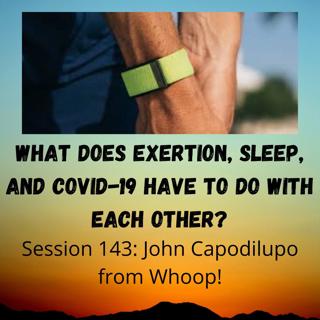
What does exertion, sleep, and Covid-19 have to do with each other? Session 143 with John Capodilupo
In Session 143, I chat with John Capodilupo, co-founder of Whoop, the maker of the Whoop strap system I've been talking about for the last several episodes. At the risk of sounding like an informercial for this neat product, I've really enjoyed using the Whoop strap for the last few months. If you aren't familiar with it, the Whoop strap is a wearable device that tracks all sorts of cool metrics, including sleep, calorie burn, heart rate, and more. As John notes in the podcast, the folks at Whoop are using data science and machine learning to optimize personal health. And they do this through these proprietary metrics that are generated from the device. John gets into the weeds on this topic, and regardless of whether you're in the market for wearable tech, I think you'll find it quite fascinating! We also discuss Whoop's involvement in research in detecting the early stages of both Covid-19 and Alzheimer's disease. I think this device and the data it produces, is giving us a window to the future of big data and public health research. Fascinating times we live in for sure! If you're interested in trying out a Whoop strap for yourself, check out join.whoop.com/matt and save $30 in the process. You can also go to behavioralobservations.com/whoop, and that will take you in the right direction too. At the request of a listener who's been a Whoop user for quite a while, I've created a Facebook group, Behavior Analysts who Whoop, so feel free to join the group, ask questions, and so on. Here are the links to the resources we discussed: The Plos One article on Covid-19 detection. Research from Cornell on Alzheimer's. The Locker, Whoop's blog. The Whoop Podcast. I also wanted to let you know that I've decided to start a Patreon for Behavioral Observations. I arrived at this after much consideration. When I first heard about Patreon, it felt like a mechanism for asking for a handout... kind of like an internet tip jar, and I didn't start one because there was not enough value in it for the listener. Fortunately, Patreon has really stepped up their game to the point where they are able to offer subscribers really cool benefits. Specifically, depending on which membership tier is chosen, subscribers can access an ad-free podcast feed, subscribers-only bonus content, discounts in the Behavioral Observations CEU store, and much more. Earlier today, I just uploaded a great Q & A session with Greg Hanley that we recorded last spring, which is available for All Access and Institutional level subscribers. I'm also working with a few different companies and I hope to be able to offer subscriber-only discounts for products and services from other folks in the ABA space. So if this sounds good to you, head over to patreon.com/behavioralobservations to learn more!
5 Jan 202145min
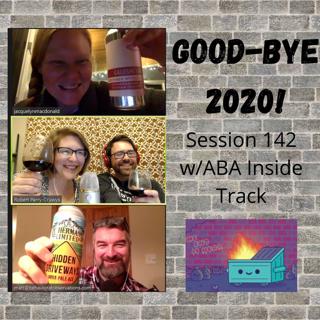
Good-bye 2020! Year in Review with ABA Inside Track
My friends over at ABA Inside Track - Robert Parry-Crews, Diana Parry-Crews, and Jackie Macdonald, got together for our third annual year-in-review collaboration. And suffice to say, what a year it has been. In this episode, we discuss the events of 2020, both in the world of Behavior Analysis and beyond. We spoke at great length about the impact of the Coronavirus pandemic on the provision of services, as well as how Behavior Analysis responded to the challenges of racism, policing, and the like. Finally, we round out the episode by honoring the memories of some of the pioneers in our field who passed away in 2020. So grab a beverage of choice, put your earbuds in, and join us in kicking 2020 to the curb and look forward to a hopefully more reinforcing 2021! Here is a very likely incomplete list of links to things we discussed: Previous Year in Review Shows: 2018 Year in Review. 2019 Year in Review. Cox, Plavnick, and Brodhead (2020). A Proposed Process for Risk Mitigation During the COVID-19 Pandemic. LeBlanc, et al. (2020). The Role of Compassion and Ethics in Decision Making Regarding Access to Applied Behavior Analysis Services During the COVID-19 Crisis: A Response to Cox, Plavnick, and Brodhead. BOP Covid-19 Facebook Banter Part 1. BOP Covid-19 Facebook Banter Part 2 (140 comments!). Session 116, Wendy Machalicek on Telemedicine. Session 13, Megan Miller on Telemedicine. Session 113, The Behavioral Economics of Toilet Paper with Derek Reed. Session 114, Keep your kids learning at home with Amy Evans. Session 121, Coping in Quarantine with Russ Harris. Session 128, Mary Jane Weiss. Session 120, Listening to Perspectives that Matter (please check out if you missed this one!!!). ABA Inside Track 128, Diversity and Inclusion with Adrienne Bradley and Kat Jackson. Session 124, Behavior Analysis and policing with John O'Neill. Session 138, More on policing with Tina Long and Officer Joe Schlenz. BACB Podcast on global certification changes. Operants fall issue with Adithyan Rajaraman re: Online instruction. In Memoriam: Jack Michael. Jose Martinez-Diaz. Patricia Krantz. On a final note, I'd be remiss if I didn't say how grateful I am for everyone who listens to and supports the show. I was raised to not discuss money in public, but the pandemic has cut the revenue of my consultation practice by more than half, and despite that, we managed to get through the worst of it because of the support from the audience. So whether you've purchased CEU's, subscribed to the membership community, patronized my wonderful sponsors, or simply shared favorite episodes with friends and minded behavior peeps, you've really come through and helped me avoid what could have been a financial disaster. For all of this and more, to say that I am thankful doesn't even scratch the surface. I'm looking forward to 2021, and I'm excited to continue to produce and share these conversations. And from my family to yours, please have a happy and safe holiday! Special thanks to the following (apologies in advance, as they're likely to be folks that I forgot to mention): HRIC Recruiting. Behavior University. Gateway Learning Group's Autism Leadership Academy. How-to-ABA.com. New Hampshire Association for Behavior Analysis. FTF Behavioral Consulting/Greg Hanley. Essential for Living/Pat McGreevy. Brett DiNovi and Associates. Central Reach/Rick Kubina. The Applied Behavior Analysis Center/Adrienne Fitzer. Connections Behavior Planning and Intervention. Britton Behavioral Consulting/Lisa Britton. Praxis Continuing Education and Training. Hillcrest Educational Centers. University of Kent Tizard Centre ABA Program. Rich Brooks and the crew at Flyte New Media. My friends over at WHOOP.
23 Dec 20201h 40min
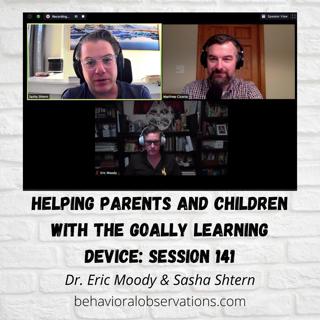
How to Help Parents and Children with the Goally Learning Device: Session 141
In Session 141 I speak with Sasha Shtern and Dr. Eric Moody about using the Goally Learning Device with families. Sasha is the CEO of Goally and Eric holds the title of Research Professor at the Wyoming Institute for Disabilities. Goally is an Android-based stand-alone device that allows users to program visuals schedules, create task analyses, manage token economies, and even log problem behaviors. In this episode we talk about the conditions that motivated the creation of this device, the research and implementation science that's been conducted with it, and how both clinicians and parents have been using it to support children across their day. If you'd like to learn more about Goally, click here to check them out. While there, be sure to check out their blog (I found the articles on supporting kids in remote learning situations particularly interesting... here is one of them). In the spirit of transparency, I'd like to make clear that as of this writing, Goally is not a sponsor of Behavioral Observations, nor is there any affiliate relationship. However, this episode is brought to you with the support of the following: How-to-ABA. Being a BCBA can be lonely and overwhelming. At howtoaba.com, we help BCBA's feel supported and confident by providing easy to access printables, CEU's and a collaborative community. Imagine, having an all-in-one resource to save you time and help your clients, having getting your toughest questions answered, and being part of a collaborative group of professionals to share ideas. Plus, your monthly pro membership includes CEU's! Along with over 1000 ABA professionals, howtoaba.com will help you save time, feel confident and master what you love! For more information, Go to howtoaba.com/joinbxresource. When you join today and use code BOP, you'll receive 10% off a yearly subscription (includes CEU's!). The Whoop Strap! I've been wearing the Whoop Strap for just a few weeks and I can't tell you how much I've enjoyed getting quantitative information on all aspects of my health, including sleep analytics, heart rate, along with heart rate variability, calorie burn, exercise intensity, and Whoop's proprietary "strain" score. I could extol this neat device's virtues indefinitely to you, but instead, you can go check it out for yourself. To get your first month free, just click here! HRIC Recruiting. Barb Voss has been placing BCBAs in permanent positions throughout the US for just about a decade, and has been in the business more generally for 30 years. When you work with HRIC, you work directly with Barb, thereby accessing highly personalized service. So if you're about to graduate, you're looking for a change of pace, or you just want to know if the grass really is greener on the other side, head over to HRIColorado.com to schedule a confidential chat right away.
17 Dec 202040min
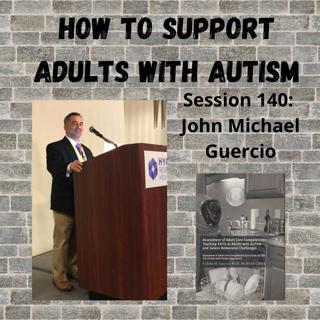
How to Support Adults with Autism: Session 140 with John Michael Guercio
In Session 140, Dr. John Michael Guercio joins me to talk about best practices for supporting adults with Autism. He is well suited to do just this, as John has been working with adults with various developmental disabilities for decades. He is currently the Clinical Director for Benchmark Human Services in St. Louis, Missouri, and is the author of the recently published book, "Assessment of Adult Core Competencies: Teaching Skills to Adults with Autism and Severe Behavioral Challenges." As you'll likely tell, I really enjoyed talking with John, and I think you're likely to learn a lot from his knowledge and expertise in the area of serving adults. In this episode we obviously get into John's formative experiences in the field of Behavior Analysis and talk about his book for a bit. But we also spend quite a bit of time discussing Behavioral Relaxation Training, escalation, crisis management, and so much more. I really think there's something in here for just about anyone in the field. Also, early on in the conversation, John and I discover that we both saw the original line up of The Grateful Dead back in the day. Don't worry though if you're not interested in this because we got back on topic right away. However, after the official interview concluded, we resumed this discussion on our favorite jam bands for about 15 minutes, and this bonus footage is available to those who are signed up in the Behavioral Observations Membership group. John mentioned numerous resources during our chat, and I have attempted to note them all here: John's book. The Controversial Exchange #16, reacting to Skinner's address to the APA (highly recommended!). Guercio et al, 2004: Using stimulus equivalence technology to teach emotion recognition to adults with acquired brain injury. Guercio and Dixon, 2011: The Observer Effect and Its Impact on Staff Behavior in an Acquired Brain Injury Neurobehavioral Treatment Setting. Guercio and Dixon, 2010: Improving the Quality of Staff and Participant Interaction in an Acquired Brain Injury Organization. Wilson, et al., 2014: Exploring the Clinical Utility of a Stimulus Avoidance Model to Enhance a Relaxation Training Model. Dr. Camille Kolu's BOP episode on Trauma. Dr. Merrill Winston's BOP episode on Restraint. Jay Moore: The Conceptual Foundations of Radical Behaviorism.* Singh, et al., 2003: Mindfulness on the Soles of the Feet study. Dixon, et al., 2015: Research Rankings of Behavior Analytic Graduate Training Programs and Their Faculty. LeBlanc, Sellers, and Ala'I, 2020: Building and Sustaining Meaningful and Effective Relationships as a Supervisor and Mentor.* The Aura Ring. Carr et al, 2013: The original Performance Diagnostic Checklist article, An Assessment-based Solution to a Human-Service Employee Performance Problem. Felitti, et al., 1998: Relationship of Childhood Abuse and Household Dysfunction to Many of the Leading Causes of Death in Adults: The Adverse Childhood Experiences (ACE) Study. LaFrance, et al., 2019: Multidisciplinary Teaming: Enhancing Collaboration Through Increased Understanding. Adler, et al., 1987: Relaxation Induced Panic (RIP): When Resting Isn't Peaceful. This show is brought to you with support from the following: Gateway Learning Group, and their Autism Leadership Academy. Designed for new Regional Directors, the Autism Leadership Academy develops motivated BCBAs into successful leaders in the autism field. If you're interested in running your own regional center and want to learn the skills to do so successfully, check out gatewaylg.com/BOP. Behavior University. Their mission is to provide university quality professional development for the busy Behavior Analyst. Learn about their CEU offerings, including their brand new 8-hour Supervision Course, as well as their RBT offerings over at behavioruniversity.com/observations. The Whoop Strap! I've been wearing the Whoop Strap for just a few weeks and I can't tell you how much I've enjoyed getting quantitative information on all aspects of my health, including sleep analytics, heart rate, along with heart rate variability, calorie burn, exercise intensity, and Whoop's proprietary "strain" score. I could extol this neat device's virtues indefinitely to you, but instead, you can go check it out for yourself. To get your first month free, head over to behavioralobservations.com/whoop!
9 Dec 20201h 20min
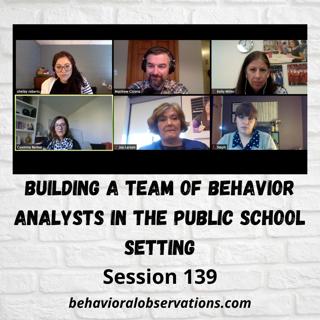
Building a Team of Behavior Analysts in the Public School Setting
A few months ago, a few BCBA's from the Boulder Valley School District reached out to me and offered to share the story of how they are fielding a team of Behavior Analysts in the public school setting. As someone who has spent a career consulting to public schools, I was instantly sold. I believe that as if this recording, the BVSD employs about 10 BCBA's, and in Session 139, I'm joined by four of them: Kelly Miller, Cosmina Barbat, Stephanie Gregory, and Shelly Roberts. We were also fortunate enough to be joined by their fearless leader, their Director of Special Education, Joy Larson. Someone who understood the value of developing internal behavior-analytic resources to support the district's students. In this episode we cover the following: How the district decided to invest in the hiring of internally placed behavior analysts. How the district BCBA's work collaboratively with professionals in other disciplines. How BCBA's support students not just with specialized educational and behavioral needs, but also in mainstream educational settings. How working as a public school employee is different than working in an at-home or clinic setting. And advice for schools that want to hire their own BCBA's, as well as advice for BCBA's who want to dip their toes into the public school waters. Lastly, I think the argument for having more Behavior Analysts in school settings speaks for itself. As we discuss in the interview, these amazing BCBA's have contributed to reducing Boulder Valley's out of district placements by 70%! Here are the links for Session 139: The Boulder Valley School District. Just in case you're thinking of relocating. Well Managed Schools curriculum. The Mystery Motivator. Questions / comments for these guests? Kelly Miller has agreed to field them. Contact her here. Session 139 is brought to you with generous support from: How-to-ABA. Being a BCBA can be lonely and overwhelming. At howtoaba.com, we help BCBA's feel supported and confident by providing easy to access printables, CEU's and a collaborative community. In the howtoaba.com membership, Shira Karpel and Shayna Gaunt share their best resources from years of practice in the field. Whether you're a beginner or a long time practitioner, you will benefit from both these resources as well as a supportive community. Imagine, having an all-in-one resource to save you time and help your clients, having getting your toughest questions answered, and being part of a collaborative group of professionals to share ideas. Plus, your monthly pro membership includes CEU's! Along with over 1000 ABA professionals, howtoaba.com will help you save time, feel confident and master what you love! For more information, Go to howtoaba.com/joinbxresource. When you join today and use code BOP, you'll receive 10% off a yearly subscription (includes CEU's!). The Whoop Strap! I've been wearing the Whoop Strap for just a few weeks and I can't tell you how much I've enjoyed getting quantitative information on all aspects of my health, including sleep analytics, heart rate, along with heart rate variability, calorie burn, exercise intensity, and Whoop's proprietary "strain" score. I could extol this neat device's virtues indefinitely to you, but instead, you can go check it out for yourself. To get your first month free, just click here!
30 Nov 20201h 33min
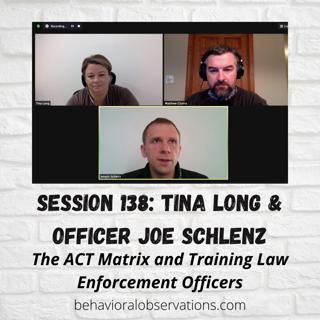
The ACT Matrix and Training Law Enforcement Officers: Session 138 with Tina Long and Joe Schlenz
Shortly after I published Session 124 on Police Academy training with John O'Neill, Tina Long, a BCBA from Northern Virginia, emailed me to share the outreach work that she has done with her local police department in Fairfax County. Specifically, in the wake of the nationwide re-examination of the role of policing, Tina felt compelled share what she has learned about the ACT Matrix with local law enforcement personnel, and after leaning more about her story, I thought it was definitely worth sharing on the podcast. Tina and I had a brief conversation that we recorded back in August. At the time, she had the opportunity to do a training with the police department, but unfortunately, due to circumstances beyond her control, her allotted time was cut to 20 minutes. As such, we made plans to connect later on and record another segment once Tina was able to get deeper into the material. So this podcast consists of both the original conversation from August, and our follow up, which was recorded in November 2020. For Part 2 of this conversation, Tina was able to get Officer Joe Schlenz, the lead crisis intervention training instructor, from the Fairfax County Police Department to join us as well. In this segment, Joe provides a wide-ranging perspective on the role of empathy and compassion in policing, de-escalation, triaging and managing risk, officer burnout and suicide, and so much more. If you're concerned about policing in America, I hope that the work he and his colleagues are doing will give you a sense of optimism. And as I've said in previous shows, it is always great to talk about how people from different fields consume and apply concepts from the behavioral sciences. Here are some of the resources we discussed: Tina's website for NV Instruction (clearinghouse for lots of related content). Facebook Group for clinicians using the ACT Matrix. Tina's Crowdcast page (lots of free training resources). The ACT Matrix: A new approach to building psychological flexibility across settings and populations (Polk and Schoendorff 2014)* Crisis Intervention Team International. University of Memphis CIT Center. I think this is really the first podcast where we talk about the ACT Matrix. If you're a long time listener, we've done many shows on ACT itself, but I'm looking forward to learning more about the ACT Matrix itself, so you can probably expect to hear more about it in 2021. This podcast is brought to you with the support of the following: HRIC Recruiting. Barb Voss has been placing BCBAs in permanent positions throughout the US for just about a decade, and has been in the business more generally for 30 years. When you work with HRIC, you work directly with Barb, thereby accessing highly personalized service. So if you're about to graduate, you're looking for a change of pace, or you just want to know if the grass really is greener on the other side, head over to HRIColorado.com to schedule a confidential chat right away. The Whoop Strap! I've been wearing the Whoop Strap for just a few weeks and I can't tell you how much I've enjoyed getting quantitative information on all aspects of my health, including sleep analytics, heart rate, along with heart rate variability, calorie burn, exercise intensity, and Whoop's proprietary "strain" score. I could extol this neat device's virtues indefinitely to you, but instead, you can go check it out for yourself. To get your first month free, head over to behavioralobservations.com/whoop! CEU's from ... Yours Truly... or, more specifically, podcast guests such as Greg Hanley, Steve Hayes, Mark Dixon, Megan Miller, Pat Friman, and much more. Head over to behavioralobservations.com/get-ceus to learn more about which trainings are available, as well as some pretty steep discounts for multiple event purchases. *denotes Amazon Affiliate link
23 Nov 20201h 47min
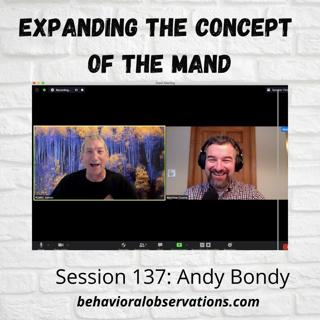
Expanding the Concept of the Mand: Session 137 with Andy Bondy
I can't believe it's been over two years since Andy Bondy of PECS fame came on the show! How time flies... This episode was inspired by a Facebook post Andy made a few weeks ago talking about how mand repertoires go beyond simply requesting preferred items. There were some interesting exchanges that followed Andy's post, and upon reading them, it occurred to me that this would make for a fun and educational podcast chat. (IMAGE CREDIT J. MCANINCH) So in this episode, we talk about what inspired Andy to write the post in the first place, and discuss teaching mand repertoires across a variety of contexts, many of them beyond requesting preferred items. We also take some excellent questions that were generated by The Behavioral Observations Membership Group. Specifically, Andy gets asked about autoclitic frames, core versus fringe vocabulary, and why prompts - from Andy's perspective - are like knives (you'll have to listen to understand what this means). Here are links to resources, etc... that we discussed: The Facebook post that spurred this conversation. The new extended edition of Verbal Behavior. The PECS USA homepage. Latest PECS research. Delaware Autism Program. Eve Skinner multi-part interview w/BF Skinner (YouTube). Andy's first appearance on BOP. An upcoming workshop from Andy on prompting, stimulus control, and error correction. (more workshops here). Schreibman and Stahmer (2014). Randomized control trial study comparing PECS and Pivotal Response Training. Charlop-Christy, et al., (2002). Using the picture exchange communication system (PECS) with children with autism: assessment of PECS acquisition, speech, social-communicative, and problem behavior. The BOP membership program. This podcast is brought to you by: Gateway Learning Group, and their Autism Leadership Academy. Designed for new Regional Directors, the Autism Leadership Academy develops motivated BCBAs into successful leaders in the autism field. If you're interested in running your own regional center and want to learn the skills to do so successfully, check out gatewaylg.com/BOP. Behavior University. Their mission is to provide university quality professional development for the busy Behavior Analyst. Learn about their CEU offerings, including their brand new 8-hour Supervision Course, as well as their RBT offerings over at behavioruniversity.com/observations. The Whoop Strap! I've been wearing the Whoop Strap for just a few weeks and I can't tell you how much I've enjoyed getting quantitative information on all aspects of my health, including sleep analytics, heart rate, along with heart rate variability, calorie burn, exercise intensity, and Whoop's proprietary "strain" score. I could extol this neat device's virtues indefinitely to you, but instead, you can go check it out for yourself. To get your first month free, head over to behavioralobservations.com/whoop!
12 Nov 20201h 28min
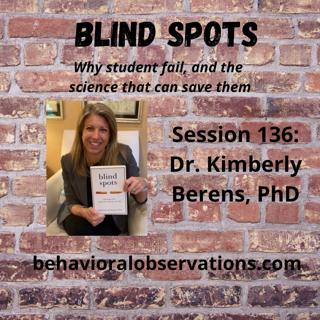
Blind Spots in the American Education System: Session 136 with Kim Berens
Dr. Kim Berens (@KimberlyBerens5) joins me for a third time to discuss her new book, Blind Spots: Why Students Fail and the Science That Can Save Them.* In this show, we talk about her motivation to write this book, what she believes is wrong with the current approach to educating children in the United States, and what can be done to remedy this situation. Like our recent episode with Amelia Bowler earlier this month, this is another great example of people trained in Behavior Analysis stepping out of our community and speak directly to a broader community. In short, it's an excellent model of dissemination, and should be applauded for this reason, along with all the other excellent attributes of the book. I was honored to write a blurb for the promotion of the book, and if you'll indulge me, I'll share it here: In 1984, B.F. Skinner wrote The Shame of American Education, in which he described how the American educational system failed to incorporate scientifically validated instructional practices. Sadly, this paper is just as relevant after almost four decades since its publication. In Blind Spots: Why Students Fail and the Science That Can Save Them, Dr. Kimberly Berens courageously picks up where Skinner left off by shining a light on the dysfunctional practices of the American educational establishment. In doing so, she debunks many popular myths that pervade current educational practices. More importantly, Dr. Berens offers concrete solutions for helping all students learn through the application of the natural science of behavior. This is a book that should be read by every parent, school board member, administrator, and teacher. I could go on and on both about this book as well as the interview I'm about to play. But instead, I'll just ask you to give the show a listen, and if you're so moved, to pick up a copy of the book. Or even better, gift a copy of the book if you happen to know a teacher, school administrator, and so forth. Here are the links for the references that came up in Session 136: Blind Spots: Why Students Fail and the Science That Can Save Them.* Kim's first and second appearance on the podcast. Kim's website, DrKimberlyBerens.com. Kim's interview on The Controversial Exchange. A Liberated Mind,* by Steve Hayes. Re-Booting Capitalism,* by Anthony Biglan. Dr. Biglan's Twitter handle. Neuroplasticity,* The MIT Press Essential Knowledge Series, by Moheb Costandi. FitLearning Atlanta Lab. Cambridge Center white paper on Project Follow Through. My interview with Michael Maloney (with discussion of Project Follow Through). IXL.com (K-12 website that uses fluency based strategies). Today's episode was brought to you with support from: Market Your ABA Practice Like a Pro! A Digital Masterclass with Rich Brooks! Is your ABA practice located in a highly competitive area? Do you struggle with name-recognition and visibility among Autism service providers in your community? Do you wish more parents and stakeholders knew about the awesome services you provide? During this event, you'll discover marketing strategies that will allow you to get your ABA practice to get in front of ideal community stakeholders (parents, guardians, etc…) and referral sources (pediatricians, etc…), by using the digital tools that everyone is being forced to use these days. This can help to attract new clients, families, schools, and even employees! The price of the event is $149, but if you register by Halloween, you can attend the event for just $99. Click here to sign up! The Whoop Strap! I've been wearing the Whoop Strap for just a few weeks and I can't tell you how much I've enjoyed getting quantitative information on all aspects of my health, including sleep analytics, heart rate, along with heart rate variability, calorie burn, exercise intensity, and Whoop's proprietary "strain" score. I could extol this neat device's virtues indefinitely to you, but instead, you can go check it out for yourself. To get your first month free, head over to behavioralobservations.com/whoop! *denotes Amazon Affiliate Link
28 Okt 20201h 49min