
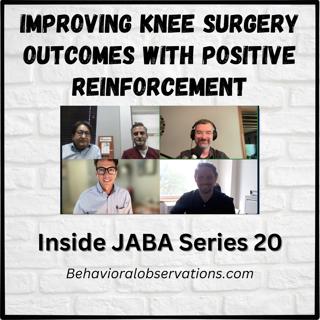
Improving knee surgery outcomes with positive reinforcement: Inside JABA Series 20
In the 20th installment of the Inside JABA Series, I'm joined by Drs. Brennan Armshaw, Manish Vaidya, and Sachen Mehta. As always, I'm also joined by JABA Editor in Chief, Dr. John Borerro. In this episode we discuss a fantastic paper that is out in the summer issue of JABA titled, "Surface electromyography-based biofeedback can facilitate recovery from total knee arthroplasty." In brief, this study that examined a novel treatment approach for rehabilitating patients following knee replacement surgery. And guess what, they used simple behavioral techniques to radically improve physical therapy outcomes! Orthopedics is something that's been on my mind lately as I am recovering from a broken metacarpal bone in my hand. It's probably something of interest to others who have either had orthopedic problems themselves, or who have taken care of hose who have. However, even if you're not interested in orthopedics, I encourage you to really dig into this episode because it's just a great case study of applying our science to a novel problem that affects millions of people . As always, there are no advertisements in the Inside JABA Series shows, but I will mention that if you would like to get a CEU for listening to this episode an answering series of questions related to its content, you can find out how to do just that by clicking here. So if you would like to learn from your favorite podcast guests, especially while you're on the go, check out what we have to offer over. I should also mention that there are discounts available for multiple event purchases. I recently crunched some numbers and found out that CEU customers, on average, save almost $100 when they leverage these discount codes. Here are the links to resources mentioned in the podcast: Armshaw, Vaidya, and Mehta (2024). Surface electromyography-based biofeedback can facilitate recovery from total knee arthroplasty. Vaidya and Armshaw (2021). Surface electromyography and gamification: Translational research to advance physical rehabilitation. Inside JABA 9: Applied and Translational Research in Healthcare. The Institute for Behavior Science and Technology in Rehabilitation. Comprehensive Orthopedics and Rehabilitation. Brennan's WVU faculty page and LinkedIn. Manish's LinkedIn page.
17 Juli 20241h 8min
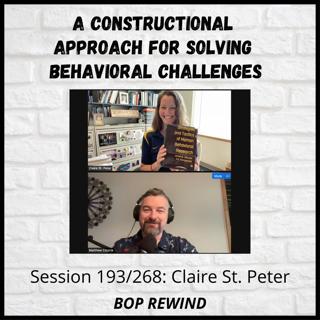
BOP REWIND: A Constructional Approach for Solving Behavioral Challenges, with Claire St. Peter
Hey everybody I hope you're having a great summer so far, or whatever season it happens to be whenever you listen to this episode. Some of the things I've been doing recently is going back through the behavioral observations archives and giving episodes a second or third listen. One of those episodes was Session 193 that I published in July 2022, and my guest was Dr. Claire Saint Peter. In that episode we talked about the constructional approach, as it were, and how it relates to solving behavior problems. This topic has been getting a lot of attention lately. When I was at ABAI in Philadelphia a few weeks ago, I attended several talks on the constructional approach, which prompted me to listen to this episode again. And when I did listen to this episode for a second time I felt that there were so many really helpful pieces of information that I wanted to republish it. What I did with this episode is essentially started after the part in which Claire talked about her background and getting into behavior analysis. Now if you want to go back and listen to that story, and I think it is a good story by the way as it's a bit of a microcosm of the history of applied behavior analysis, you can certainly do so. However, for the purposes of brevity, I decided just cut out that introductory section so the overall experience is a bit more focused, especially for those of us who are listening to this for a second, third, or fourth time. With that said, I really hope you listen to this episode and it's entirety there are so many great nuggets have information. Although we talk about the application of the constructional approach to a student in a school setting, I am sure that you will make connections to all sorts of applications. I will also make this episode eligible for a continuing education unit, as I have been doing with many older episodes as well. So if you are looking to get caught up on your continuing education, go to behavioralobservations.com to see the nearly 60 episodes we have available for your continuing education. The last thing I'll say about this episode is that this is not the last thing I'll say about the constructional approach. I guess I'm saying that out loud for some accountability, because of said this before, but I want to have some other guests on to talk about this because I think it's an interesting way to look at behavior analysis and it's ability to address problems of social importance. Here are links to some of the resources we mentioned: The original Session 193 Claire's lab website Claire's Google Scholar Page Goldiamond (1974): Toward a constructional approach to social problems: ethical and constitutional issues raised by applied behavior analysis More Goldiamond: A Programming Contingency Analysis of Mental Health Layng (2009). The Search for an Effective Clinical Behavior Analysis: The Nonlinear Thinking of Israel Goldiamond Romano, St. Peter, Milyko, Mesches, and Foreman (2021). Incorporating Curricular Revision to Treat Escape-Maintained Behavior for Children with ADHD Mammacare Word of the Podcast Inside JABA 7: There's No Such Thing as a Bad Boy, with Pat Friman Session 158: Motivational Interviewing with Dr. Jim Murphy Friman (2021). There is no such thing as a bad boy: The Circumstances View of problem behavior Johnston, Pennypacker, and Green: Strategies and Tactics for Behavioral Research and Practice (note: Amazon Associates link). This podcast is brought to you by: How to ABA…The Bx Resource Membership saves you time, lends you support, and helps you keep up with your CEUs. It's a growing library of resources, materials, programs, datasheets, assessments, and how-to videos to help you tackle any ABA program with ease. It also includes live CEUs each month, live mentorship sessions, a full library of CEUs (60+, enough for recertification), and a community of fellow behavior professionals where you can ask questions when you need support. Join us at howtoaba.com/join. The New England Center for Children! I am beyond thrilled to partner with one of the oldest and well-respected ABA institutions to help them find staff to continue their mission of supporting individuals with Autism. Learn more about careers at NECC over at necc.org/jobs. The Behavioral Toolbox. thebehavioraltoolbox.com is a new education and training site that my colleagues Anika Costa and Dr. Paulie Gavoni and I have been working on for over two years. We have two courses available: our first course, Ready, Set, Consult! and our newly released course, When Not to FBA: 5 Quick Strategies for Improving Behavior in Classrooms. HRIC Recruiting. Barb Voss has been placing BCBAs in permanent positions throughout the US for just about a decade, and has been in the business more generally for 30 years. When you work with HRIC, you work directly with Barb, thereby accessing highly personalized service. So if you're about to graduate, you're looking for a change of pace, or you just want to know if the grass really is greener on the other side, head over to HRIColorado.com to schedule a confidential chat right away.
9 Juli 20241h 20min
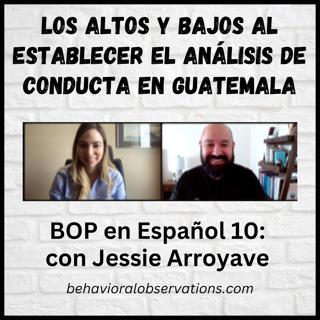
BOP en Español 10: Los altos y bajos al establecer el análisis de conducta en Guatemala con Jessie Arroyave
En este episodio tenemos la oportunidad de conocer la trayectoria de Jessie Arroyave, la primera BCBA de Guatemala. Jessie publicó un artículo en la revista Behavior Analysis in Practice, en el que habla de los altos y bajos al tratar de dar los primeros pasos para el establecimiento del análisis de conducta en Guatemala. Ella decidió tomar el camino difícil de regresar a su país después de formarse en Estados Unidos a pesar de los múltiples obstáculos. ¿Qué estamos haciendo para apoyar a profesionales como Jessie? Lo que sé es que con nuestra ayuda o sin ella, su compromiso y dedicación están intactos. Tenemos mucho que aprender de su ejemplo. The ups and downs of establishing behavior analysis in Guatemala with Jessie Arroyave In this episode we have the opportunity to learn about the career of Jessie Arroyave, the first BCBA in Guatemala. Jessie published an article in the journal Behavior Analysis in Practice, in which she talks about the ups and downs of trying to take the first steps toward establishing behavior analysis in Guatemala. She decided to take the difficult path of returning to her country after training in the United States despite multiple obstacles. What are we doing to support professionals like Jessie? What I know is that with or without our help, her commitment and dedication are intact. We have much to learn from her example.
2 Juli 20241h 23min
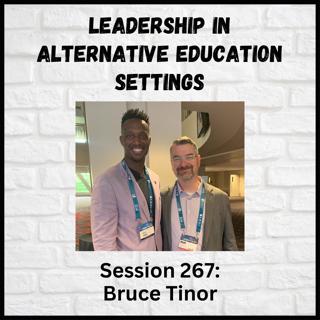
Leadership in Alternative Education Settings: Session 267 with Bruce Tinor
Dr. Bruce Tinor returns to the podcast for an informative conversation about his work as a principal at The Child and Career Developmental Center of Chester County, Pennsylvania. Long-time listeners will recall that Bruce originally joined me in Session 197. In this podcast, we talk all things alternative ed. Specifically, Bruce gives a quick review of how students find their way to his school, and in doing so, provides a mini-seminar in FAPE (and if you're not familiar with that acronym, you will be shortly). We talk about working in a multidisciplinary setting, how those related services are provided, improving academic skills as a behavioral intervention, and in general, what it's like to be a BCBA and a school principal. In many ways, this is a podcast about culture and leadership too. Bruce talks about his interview practices and how he supports teachers and staff throughout the day. We also talk about some of the unique Tier 1 and Tier 2 behavioral practices, how he makes new students feel welcome, his behavioral approach to social-emotional learning, and lots more. We close the podcast with what I thought was a really special discussion about Bruce being a role model. I don't want to spoil that part of the podcast here. You'll definitely want to listen to it for yourself, so I hope you check that part of the show out. Say 'hi' to Bruce on LinkedIn. Whole Group Responding (Interview with Dr. Bill Heward). Using Behavioral Contracts (Interview with Drs. Jill Dardig and Bill Heward). Back to School with PBIS (Interview with Elissa Johnson). How to Get Better Results (Interview with Dr. John Austin). Improving Classroom Management (Interview with Dr. Jeannie Donaldson). When Not to FBA: 5 Quick Strategies for Improving Behavior in Classrooms (asynchronous course from thebehavioraltoolbox.com). This podcast is brought to you by the following: How to ABA…The Bx Resource Membership saves you time, lends you support, and helps you keep up with your CEUs. It's a growing library of resources, materials, programs, datasheets, assessments, and how-to videos to help you tackle any ABA program with ease. It also includes live CEUs each month, live mentorship sessions, a full library of CEUs (60+, enough for recertification), and a community of fellow behavior professionals where you can ask questions when you need support. Join us at howtoaba.com/join. The New England Center for Children! I am beyond thrilled to partner with one of the oldest and well-respected ABA institutions to help them find staff to continue their mission of supporting individuals with Autism. Learn more about careers at NECC over at necc.org/jobs. ACE Approved CEUs from .... Behavioral Observations. That's right, get your CEUs while driving, walking your dog, doing the dishes, or whatever else you might have going on, all while learning from your favorite podcast guests! The Behavioral Toolbox. thebehavioraltoolbox.com is a new education and training site that my colleagues Anika Costa and Dr. Paulie Gavoni and I have been working on for over two years. We have two courses available: our first course, Ready, Set, Consult! and our newly released course, When Not to FBA: 5 Quick Strategies for Improving Behavior in Classrooms.
25 Juni 20241h 33min
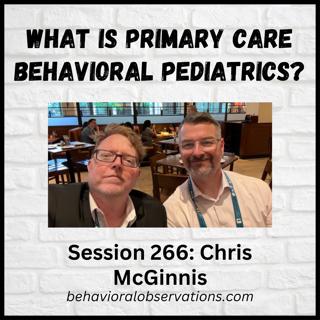
What is Primary Care Behavioral Pediatrics? Session 266 with Chris McGinnis
Dr. Chris McGinnis joins me in Session 266 to talk about his work in Primary Care Behavioral Pediatrics. If you're not sure what that is, don't worry. We go over that right away and learn that this area of work sits in an important and underserved niche: The niche between the general behavioral advice dispensed by pediatricians, and intensive treatment for serious mental health challenges. In a way, this conversation expands on something that Pat Friman brought up in our most recent interview: The idea that BCBAs are uniquely suited to provide families with this type of care. In order to provide direction to those who are interested in doing just this, Chris recently published Introduction to Primary Care Behavioral Pediatrics: A Guide for Behavior Analysts. In our conversation, we covered: · His background in Behavioral Pediatrics, including his work at BoysTown (and meeting Pat Friman for the first time). · The motivation for writing his book. · The reification of psychological terms (see Skinner '45). · The myth of the Chemical Imbalance Hypothesis. · The range of behavior challenges he sees in his practice. · Thoughts on caregiver adherence. · The pros and cons of reimbursement practices, including the concierge model he has currently adopted. · Chris' study of Trauma-Informed Care. · Permissive vs. Authoritative, and how those related to adolescent mental health.... In other words, why parenting is like The Marshmallow Test. · Advice for the newly-minted BCBA. This podcast is brought to you by the following: Please welcome our newest sponsor, The New England Center for Children! I am beyond thrilled to partner with one of the oldest and well-respected ABA institutions to help them find staff to continue their mission of supporting individuals with Autism. Learn more about careers at NECC over at necc.org/jobs. ACE Approved CEUs from .... Behavioral Observations. That's right, get your CEUs while driving, walking your dog, doing the dishes, or whatever else you might have going on, all while learning from your favorite podcast guests! HRIC Recruiting. Barb Voss has been placing BCBAs in permanent positions throughout the US for just about a decade, and has been in the business more generally for 30 years. When you work with HRIC, you work directly with Barb, thereby accessing highly personalized service. So if you're about to graduate, you're looking for a change of pace, or you just want to know if the grass really is greener on the other side, head over to HRIColorado.com to schedule a confidential chat right away. The Behavioral Toolbox. thebehavioraltoolbox.com is a new education and training site that my colleagues Anika Costa and Dr. Paulie Gavoni and I have been working on for over two years. We have two courses available: our first course, Ready, Set, Consult! and our newly released course, When Not to FBA: 5 Quick Strategies for Improving Behavior in Classrooms.
12 Juni 20241h 47min
Buffers That Protect Against Adverse Childhood Experiences: Session 265 with Camille Kolu
Dr. Camille Kolu joins me again on the podcast, and let's just say that she came back loaded with great insights like these to share with you. If you're not familiar with Camille, she's been on the show before (see here), and is one of the predominant voices discussing the impact of trauma, and how it interacts with what we do as Behavior Analysts. In this episode, we discuss her recent paper in Behavior Analysis in Practice, Providing Buffers, Solving Barriers: Value‐Driven Policies and Actions that Protect Clients Today and Increase the Chances of Thriving Tomorrow. This article is not about trauma, but instead, it's about practices and repertoires that can protect individuals from the harmful health impacts of adverse childhood experiences. We also discuss Camille's article in Operants Magazine, called, Understanding Choice, which is where that audio segment was clipped from. If you like the work that Camille does and want more training from her, she has generously provided listeners with a discount on her training materials over at Cusp Emergence University. If you want to go deeper into this topic of Buffers and Barriers, she has not one, but two courses on it, providing both Ethics and Supervision CEUs. If you want take her other courses in the area of Trauma, you can do that too (just click here to check it out). When you do so, be sure to use the promo code summerofBOP24 to save 24% off at checkout. Camille also created a free, 15-minute course called, The Buffers Story: Simple, Important Things We Almost Forgot, and she'll be doing a workshop later this month with Connections-Behavior. Lastly, if you like Camille's content, perhaps the easiest way to keep up with it is to sign up for her mailing list. Burke-Harris (2018). The Deepest Well: Healing the Long-Term Effects of Childhood Adversity (note: Amazon Associates link). Kaiser ACES studies information. Ala'i-Rosales et al. (2019). The Big Four: Functional Assessment Research Informs Preventative Behavior Analysis. Ratey (2008). Spark: The Revolutionary New Science of Exercise and the Brain (note: Amazon Associates link). Inside JABA 10: Towards Trauma-Informed Applications of Behavior Analysis. Session 179: Behavioral Relaxation Training. Maier and Seligman (2016). Learned helplessness at fifty: Insights from neuroscience. In full disclosure, these are not sponsored products and events; I'm just trying to get the word out there. However, the sponsors that are responsible for bringing this episode to you include: Please welcome our newest sponsor, The New England Center for Children! I am beyond thrilled to partner with one of the oldest and well-respected ABA institutions to help them find staff to continue their mission of supporting individuals with Autism. Learn more about careers at NECC over at necc.org/jobs. ACE Approved CEUs from .... Behavioral Observations. That's right, get your CEUs while driving, walking your dog, doing the dishes, or whatever else you might have going on, all while learning from your favorite podcast guests! The Behavioral Toolbox. thebehavioraltoolbox.com is a new education and training site that my colleagues Anika Costa and Dr. Paulie Gavoni and I have been working on for over two years. We have two courses available: our first course, Ready, Set, Consult! and our newly released course, When Not to FBA: 5 Quick Strategies for Improving Behavior in Classrooms. Behavior University. Their mission is to provide university quality professional development for the busy Behavior Analyst. Learn about their CEU offerings, including their 8-hour Supervision Course, as well as their RBT offerings over at behavioruniversity.com/observations. Don't forget to use the coupon code, PODCAST to save at checkout!
5 Juni 20241h 13min
How Does Interviewer Behavior Influence Children's Responses? Inside JABA 19
Did you rate and review Behavioral Observations on Apple Podcasts? You rated and reviewed Behavioral Observations on Apple Podcasts, right? John Borrero told me that you rated and reviewed Behavioral Observations on Apple Podcasts. Is that true? Did you rate and review Behavioral Observations on Apple Podcasts? Again, did you rate and review Behavioral Observations on Apple Podcasts? If you've ever watched a police procedural show on television, you're probably noticed that there are different ways to phrase questions to people. I've just given you a few examples that will be salient to the forthcoming discussion. And, all kidding aside, if you haven't done so already, if you enjoy what we do here, head over to Apple Podcasts and kindly leave a rating and review of the show. In the 19th installment of Behavioral Observations' Inside JABA Series, Dr. John Borrero and I discuss a paper in the most recent issue called, Idiosyncratic effects of interviewer behavior on the accuracy of children's responses, with its authors: Milad Najafichaghabouri, Dr. Ray Joslyn, and Emma Preston. Here's some additional background on our guests: Dr. Ray Joslyn is currently an assistant professor in the psychology department at West Virginia University. He has research interests in group contingencies, behavior analysis in education, and crime and delinquency. Milad Najafichaghabouri is a doctoral student in the Disability Disciplines program at Utah State University specializing in ABA. His primary research interests include group contingency-based intervention in the classroom, and social validity practices in research Emma Preston is currently a graduate student in the Disabilities Disciplines program at Utah State University specializing in ABA. Her research and practice interests include the Good Behavior Game, manipulating parameters of reinforcement to improve intervention outcomes, and Tier 3 school-based interventions. I'll refrain from spoiling the discussion here, but there are a few things to note. First, this is the first time we've discussed a replication in the Inside JABA Series, and John dons his Editor in Chief hat for a few minutes at the end and discusses the importance of replication studies in general, and what makes for good replication more specifically. Second, this topic - describing the conditions in which children do and do not report incidents accurately - has huge implications. From schools, to child services, to law enforcement, understanding the potential influences of phrasing questions and acknowledging responses could be crucial contributions in these areas. Third, this study featured a clever assent procedure that again, I won't spoil here, but it's worth tuning into. And lastly, we get into all sorts of nitty-gritty details, including some of the participants' unexpected responses to the experimental procedure... and these are the things that generally do not make the printed page that you can only get in these types of conversations. This podcast, along with all of the Inside JABA Series ones, is eligible for continuing education. If you've never gotten CEUs from Behavioral Observations before, it's really easy. Just listen to the episode, go to behavioralobservations.com/get-ceus, make purchase... and fun fact: there are great discounts available if you need to snap up many CEUs, take a quiz, and you're good to go.
22 Maj 20241h 4min
El Análisis de Conducta en Venezuela: BOP en Español 9, con Corina Jimenez-Gomez, Mirari Elcoro y Amalix Flores
El Análisis de Conducta en Venezuela: Un legado finalmente reconocido con Corina Jimenez-Gomez, Mirari Elcoro y Amalix Flores No una, ni dos, sino 3 venezolanas rindiendo tributo al legado de Venezolanos en nuestra ciencia del análisis de conducta. Un legado del cual (siendo Venezolano) desconocía y que gracias a ellas tengo ahora el privilegio y orgullo de conocer y que será reconocido en nuestra comunidad a través del artículo que publicaron en la revista Behavior Analysis in Practice (Análisis de Conducta en la Práctica). Una conversación de 2 horas que les recomiendo sean Venezolanos, Iberoamericanos y/o simplemente, como nuestras invitadas y coautores de este artículo, estudiantes de nuestra historia. Mirar atrás trajo muchas reflexiones, no solo acerca de un legado importante, sino también del estado actual del análisis de conducta y su posible futuro. Importante reconocimiento a las mujeres fundadoras y líderes del análisis de conducta en Venezuela, a las idiosincrasias de los Venezolanos 'echados pa'lante', recursivos y pluralistas; a la dedicación y vocación de tantas personas, finalmente publicado en un producto permanente. Gracias Corina, Mirari y Amalix, 'se me agua el guarapo'. Behavior Analysis in Venezuela: A legacy finally recognized with Corina Jimenez-Gomez, Mirari Elcoro and Amalix Flores Not one, not two, but 3 Venezuelans paying tribute to the legacy of Venezuelans in our science of behavior analysis. A legacy that (being Venezuelan) I was unaware of and that thanks to them I now have the privilege and pride of knowing and that will be recognized in our community through the article they published in Behavior Analysis in Practice. A 2-hour conversation that I recommend wether you are Venezuelans, Ibero-Americans and/or simply, like our guests and co-authors of this article, students of our history. Looking back brought many reflections, not only about an important legacy, but also about the current state of behavior analysis and its possible future. Important recognition to the founding women and leaders of behavioral analysis in Venezuela, to the idiosyncrasies of Venezuelans 'echados pa'lante', recursive and pluralistic; to the dedication and vocation of so many people, finally published in a permanent product. Thanks Corina, Mirari and Amalix, 'se me agua el guarapo'.
20 Maj 20242h 6min