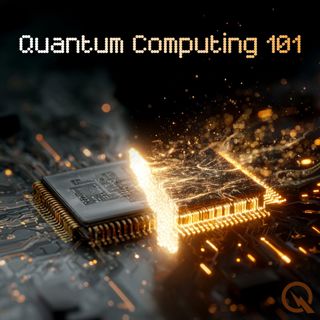
Quantum-Classical Fusion: Unleashing the Power of Hybrid Computation | Quantum Computing 101

Quantum-Classical Fusion: Unleashing the Power of Hybrid Computation | Quantum Computing 101

This is your Quantum Computing 101 podcast.

Barely a day after the latest headlines from Caltech’s quantum labs, I find myself pacing in front of a blackboard already mottled with yesterday’s equations—still humming with the electricity of discovery. I’m Leo, Learning Enhanced Operator, your guide for today’s episode of Quantum Computing 101. If you’ve glanced at the news this week, you know 2025 has been nothing short of seismic for quantum-classical collaboration. I’m living through a revolution at the molecular edge of computation, and I can’t wait to bring you into the thick of it.

Let’s plunge straight into what’s making today’s quantum pulse so exhilarating: **hybrid quantum-classical solutions**. Imagine two elite musicians playing a single piece—one improvising wildly, the other grounding the rhythm. That’s what researchers at IBM and RIKEN accomplished by melding classical supercomputers like Fugaku with IBM’s quantum hardware. Last week, they cracked the ground state energies for nitrogen molecules. In classical chemistry, that’s like navigating a cosmic maze where paths split billions of times per second. But in this hybrid approach, the heavy classical machinery handled all the tractable math, freeing the quantum system to dive into the “clouds of possibility”—tackling exponentially complex calculations that were previously out of reach.

You might wonder how this partnership really works. Classical systems slice through the datasets, optimizing what’s straightforward—filtering the signals from the noise. Then, for the genuinely tangled stuff—the knots only a quantum mind can untangle—the quantum chip steps in. The key, as just reported in Brownstone Research, is leveraging quantum’s limited coherence time exactly where it matters most, so every precious qubit-second is used at maximum impact.

Let’s zoom in on the heart of these hybrids: the variational quantum eigensolver, or VQE. This is no dry algorithm; it’s a delicate dance between classical and quantum. Picture me in the lab, adjusting laser pulses with each new wave of data. Quantum processors prepare quantum states—like tuning the strings of a violin—while classical computers analyze the sounds, nudging and optimizing until, together, they find that purest resonance, the lowest energy state. That’s how VQE is transforming drug discovery and materials science right now: allowing us to probe molecular mysteries that once defied calculation.

But there’s more. Just this week, Amazon and NVIDIA debuted the DGX Quantum platform, which weds real-time quantum error correction with AI-driven calibration. This isn’t just theory—it’s the foundation for scalable, practical quantum tools that industries can use today. And over at Harvard, two-hour continuous quantum runs are bringing the era of fault-tolerant, reliable quantum computing tantalizingly close. Distributed quantum processors, like MIT’s photon-shuttling system, are showing us a future where quantum brains on different continents can think as one.

Hybrid quantum-classical is more than a technical solution; it’s the blueprint for how we, as individuals and societies, can blend logic with intuition, the binary with the boundless superposition of dreams. Every time I step into the cooled chamber, suited up alongside colleagues from finance, chemistry, even climate science, I see the same thing reflected in their eyes: a spark of possibility.

Thank you for listening to Quantum Computing 101. If you have questions or want me to cover a specific topic, just email me any time at leo@inceptionpoint.ai. Don’t forget to subscribe, and for more info, visit quiet please dot AI. This has been a Quiet Please Production. Until next time—keep thinking quantum.

For more http://www.quietplease.ai


Get the best deals https://amzn.to/3ODvOta

This content was created in partnership and with the help of Artificial Intelligence AI

Avsnitt(287)

Hybrid Quantum Revolution: How NVIDIA and ORCA Fused Light Speed Qubits With GPU Power at GTC 2026

Hybrid Quantum Revolution: How NVIDIA and ORCA Fused Light Speed Qubits With GPU Power at GTC 2026

This is your Quantum Computing 101 podcast.Imagine this: just days ago at NVIDIA's GTC 2026, ORCA Computing's photonic quantum systems fused with NVIDIA's cuTensorNet software right there at Imperial ...

27 Mars 4min

QIAPO Hybrid Revolution: How German Quantum-Classical Fusion Solves Real Logistics and Chip Manufacturing Nightmares

QIAPO Hybrid Revolution: How German Quantum-Classical Fusion Solves Real Logistics and Chip Manufacturing Nightmares

This is your Quantum Computing 101 podcast.Imagine you're deep in a Saarland University lab, the hum of cryostats vibrating like a cosmic heartbeat, lasers slicing through the chill as neutral atoms d...

25 Mars 3min

Quantum Meets GPU: How Hybrid Computing Just Cracked the Drug Discovery Code at GTC 2026

Quantum Meets GPU: How Hybrid Computing Just Cracked the Drug Discovery Code at GTC 2026

This is your Quantum Computing 101 podcast.Imagine this: just days ago, at NVIDIA's GTC 2026 in San Jose, UCL researchers, partnering with NVIDIA, Technical University of Munich, LMU, and IQM Quantum ...

23 Mars 3min

Classiq CUDA-Q Fusion: How 31 Qubits Slashed Options Pricing From 67 Minutes to 2.5 on NVIDIA GPUs

Classiq CUDA-Q Fusion: How 31 Qubits Slashed Options Pricing From 67 Minutes to 2.5 on NVIDIA GPUs

This is your Quantum Computing 101 podcast.Imagine this: just days ago, on March 16th, Classiq unveiled their game-changing integration with NVIDIA's CUDA-Q, slashing a 31-qubit financial options-pric...

22 Mars 4min

Quantum Meets GPU Power: How Classiq and NVIDIA Slashed Computing Time from 67 Minutes to 2.5

Quantum Meets GPU Power: How Classiq and NVIDIA Slashed Computing Time from 67 Minutes to 2.5

This is your Quantum Computing 101 podcast.Imagine standing in a cryogenic chamber, the air humming with the faint chill of liquid helium, as qubits dance in superposition like fireflies in a midnight...

20 Mars 3min

Quantum Meets Silicon: How NVIDIA GPUs Cut Options Pricing from 67 Minutes to 2.5 on 31 Qubits

Quantum Meets Silicon: How NVIDIA GPUs Cut Options Pricing from 67 Minutes to 2.5 on 31 Qubits

This is your Quantum Computing 101 podcast.Imagine this: just days ago, on March 18, 2026, IBM announced that quantum pioneer Charles H. Bennett received the A.M. Turing Award—computing's Nobel Prize—...

18 Mars 3min

Quantum-Classical Hybrid Computing: IBM's Blueprint for the Next Computing Revolution

Quantum-Classical Hybrid Computing: IBM's Blueprint for the Next Computing Revolution

This is your Quantum Computing 101 podcast.Welcome back to Quantum Computing 101. I'm Leo, and what I'm about to share with you represents a genuine watershed moment in how we're bringing quantum comp...

16 Mars 3min

IBM's Quantum-Classical Fusion: How Hybrid Supercomputers Are Rewriting the Rules of Reality in 2026

IBM's Quantum-Classical Fusion: How Hybrid Supercomputers Are Rewriting the Rules of Reality in 2026

This is your Quantum Computing 101 podcast.Imagine this: just days ago, on March 12, 2026, IBM unveiled their quantum-centric supercomputing blueprint, a game-changer fusing quantum processors with cl...

13 Mars 3min

Populärt inom Politik & nyheter

svenska-fall
aftonbladet-krim
p3-krim
rss-krimstad
flashback-forever
politiken
blenda-2
aftonbladet-daily
rss-sanning-konsekvens
spar
rss-vad-fan-hande
motiv
dagens-eko
grans
svd-ledarredaktionen
rss-krimreportrarna
olyckan-inifran
spotlight
rss-frandfors-horna
rss-aftonbladet-krim