Monsters and their makers
Many Minds23 Okt 2025

Monsters and their makers

It seems we've always had monsters among us. We've long been enthralled by dragons and giants, by the likes of Frankenstein and Godzilla and Dracula, by witches and werewolves and countless others. They roam our maps and creation myths; they crop up in our dreams, in our children's books, in our political rhetoric. Where do these beings spring from? What do they do for us? How have they changed over time? And, ultimately, what do our monsters say about their makers?

My guests today are Dr. Natalie Lawrence and Dr. Surekha Davies. Both are historians of science and authors of recent books on monsters: Natalie's book is Enchanted creatures: Our monsters and their meanings. Surekha's book is Humans: A monstrous history.

Here, Surekha, Natalie, and I talk about monsters as category breakers and boundary walkers—and about how monstrosity is in the eye of the beholder. We walk through a menagerie of monsters—from the apocryphal blemmyes of old travelogues, to a hairy-faced girl in 16th century France, to the figure of Caliban in The Tempest. We discuss the psychological and cultural forces that generate monsters. And we talk about whether anyone would want to live in a world without them.

Along the way, we touch on the "monstrification" of social groups; psychoanalysis; our primal fear of snakes; curiosity cabinets; therianthropes and the Cave of the Three Brothers; the relationship between monstrosity and geography; our long fascination with so-called monstrous births; the Muppet Show; dinosaurs and sea creatures; and the question of what monsters might do for children in particular.

Alright friends, it's the monstrous season and this is a fun one to help you celebrate. Enjoy!

Notes

3:00 – Grendel's mother has often been a subject of critical discussion and adaptation. See, for instance, the 2018 novel, The Mere Wife.

12:30 – For a classic history-of-science treatment of "wonders" (including monsters) and our conceptions of nature, see here.

18:30 – For those unfamiliar with muppets, an episode of the Muppet Show, which premiered in 1976.

24:00 – The blemmyes were often the subjects of illustration—for examples, see here.

26:00 – For more on Sir Walter Raleigh and the blemmyes, see Dr. Davies' recent newsletter post.

29:00 – One example of monsters at the margins of maps can be seen in the Psalter World Map.

32:00 – For more on Cave of the Trois-Frères and the Sorcerer, see here.

34:00 – For more on shamanism, see our recent episode with Manvir Singh.

37:00 – Therianthropes are relatively rare in cave art, but have nonetheless been widely discussed. For an example, see here.

39:00 – For more on Antonietta Gonsalvus and her family, including examples of how she was represented in paintings of the era, see here.

45:00 – The trope of monsters in creation stories is often called "chaoskampf."

47:00 – The meanings of Medusa have been widely discussed and debated. See here for an example.

52:00 – For more about Caliban, and the racial and colonial dimensions of the Tempest, see here.

57:00 – The Steinbeck quote comes from his book, The Log from 'The Sea of Cortez.'

Recommendations

The Ashgate Research Companion to Monsters and the Monstrous, edited by Asa Simon Mittman & Peter J. Dendle

Spectacle of Deformity, by Nadja Durbach

The Modern Myths, by Philip Ball

The Monsters and the Critics (and other essays), by J.R.R. Tolkien

No Go the Bogeyman, by Marina Warner

Where the Wild Things Are, by Maurice Sendak

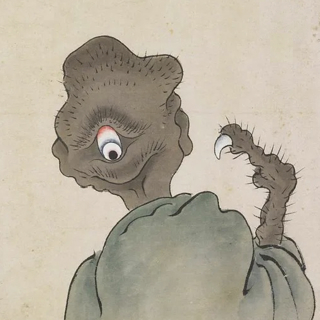
Tile image credit: Image from the Bakemono Zukushi "Monster" Scroll via Public Domain Review

Many Minds is a project of the Diverse Intelligences Summer Institute, which is made possible by a generous grant from the John Templeton Foundation to Indiana University. The show is hosted and produced by Kensy Cooperrider, with help from Assistant Producer Urte Laukaityte and with creative support from DISI Directors Erica Cartmill and Jacob Foster. Our artwork is by Ben Oldroyd.

Subscribe to Many Minds on Apple, Stitcher, Spotify, Pocket Casts, Google Play, or wherever you listen to podcasts. You can also now subscribe to the Many Minds newsletter here!

We welcome your comments, questions, and suggestions. Feel free to email us at: manymindspodcast@gmail.com.

For updates about the show, visit our website or follow us on Bluesky (@manymindspod.bsky.social).

Det här avsnittet är hämtat från ett öppet RSS-flöde och publiceras inte av Podme. Det kan innehålla reklam.

Avsnitt(167)

From the archive: Varieties of childhood

From the archive: Varieties of childhood

Hi friends! We're taking a bit of a summer pause. We'll be back soon—in the meanwhile, enjoy this listener favorite from our archives! ----- [originally aired July 10, 2025] Childhood is a special tim...

31 Juli 1h 28min
From the archive: Philosophers on psychedelics

From the archive: Philosophers on psychedelics

Hi friends! We're taking a bit of a summer pause. We will be back soon—in the meanwhile, enjoy this listener favorite from our archives! ----- [originally aired May 14, 2025] Some call it the "psyched...

17 Juli 1h 40min
The origins of Darwin's ideas

The origins of Darwin's ideas

No discipline, no sphere of intellectual life, has been untouched by the work of Charles Darwin. He died in 1882 but his ideas are very much alive; they're now central to how we understand the natural...

3 Juli 1h 19min
The sparkling deep

The sparkling deep

It's tempting to see bioluminescence as an oddity, one of those rare eccentricities of life on earth. And, on land, maybe that's true. But our planet is mostly water, and out in the open ocean biolumi...

20 Juni 1h 20min

Is Man the Hunter just a myth?

Is Man the Hunter just a myth?

There's a story about of our past that you know well. It goes like this: At some point earlier in human evolution, we started to hunt. Men in particular—perhaps channeling some deep-seated aggressive ...

5 Juni 1h 32min

Babies, dogs, and the riddles of word learning

Babies, dogs, and the riddles of word learning

It's kind of astonishing, really, that kids ever learn words. Each one poses a little riddle. Does this sound string refer to a person? A category of things? Or maybe some other feature of the bloomin...

22 Maj 1h 18min

The inner life of the hand

The inner life of the hand

Newton saw in the human hand proof of the divine; Darwin saw a key to our species' success. Many others, too, have described the hand in hyperbolic terms, as a paragon of design, a cornerstone of huma...

7 Maj 1h 10min

From the archive: The cuttlefish and its coat of many colors

From the archive: The cuttlefish and its coat of many colors

Hi friends! We're skipping a beat to take care of some spring housekeeping tasks. We will be back in May! In the meanwhile, enjoy this listener favorite from our archives! ----- [originally aired Apri...

22 Apr 1h 33min

Populärt inom Utbildning

det-skaver
rss-bara-en-till-om-missbruk-medberoende-2
historiepodden-se
nu-blir-det-historia
allt-du-velat-veta
harrisons-dramatiska-historia
johannes-hansen-podcast
not-fanny-anymore
roda-vita-rosen
rss-viktmedicinpodden
i-vantan-pa-katastrofen
rikatillsammans-om-privatekonomi-rikedom-i-livet
sa-in-i-sjalen
sektledare
rss-max-tant-med-max-villman
rss-autismandan
rss-basta-livet
rss-traningsklubben
rss-i-skenet-av-blaljus
vi-gar-till-historien