
Insulin Marketplace, Hair, Whale Size. December 13, 2019, Part 2
Science Friday13 Dec 2019

Insulin Marketplace, Hair, Whale Size. December 13, 2019, Part 2

Why Diabetes Patients Are Getting Insulin From Facebook

Almost one in ten Americans are diagnosed with diabetes, according to the most recent statistics from the CDC. With those odds, you likely know someone with the disease. And you may also know that most diabetes patients need to be treated with insulin therapy—frequent injections of a hormone that helps regulate their blood sugar—or face serious complications, like blindness, nerve damage, or kidney failure.

Unfortunately, a good number of these patients can’t afford to purchase insulin through official channels, like pharmacies and hospitals, even with the help of health insurance. In such cases, diabetes patients are turning to what one recent study called “underground exchanges”—platforms like Craigslist, Ebay and Facebook—to get access to the drug they need.

Ira is joined by one of the authors of that study, Michelle Litchman, a nurse practitioner and researcher at the University of Utah College of Nursing in Salt Lake City, to talk about what patients are doing to combat the high cost of insulin in the U.S.

Combing Over What Makes Hair So Strong

Hair is one of the strongest materials—when stretched, hair is stronger than steel. A team of researchers collected and tested hair from eight different mammals including humans, javelinas, and capybaras to measure what gives hair its strength. The basic structure of hair is similar across species with an outer cuticle layer surrounding fibers, but each species’ hair structure accommodates different needs. Javelinas have stiffer fibers to allow them to raise their hair when it’s in danger. Their results, published in the journal Matter, found that thinner hair was stronger than thicker strands.

Engineer Robert Ritchie, who was one of the authors of that study, talks about the structure that gives hair its strength and how bio-inspired design can create better materials.

How Whales Got Whale-Sized

We live in a time of giants. Whales are both the largest living animals, and, in the case of 110-foot-long blue whales, the largest animals that have ever been alive on the planet.

But whales haven’t always been gigantic. Until about 3 million years ago, the fossil record shows that the average whale length was only about 20 feet long. They were big, but not big. The rise—and growth—of the lineages that gave rise to humpbacks, fin whales, and other behemoths happened, in evolutionary time, overnight.

So, why are whales big—and why are whales so big now?

Now, researchers who parsed data from feeding events of a dozen different whale species think they have the mathematical confirmation. Writing in Science this week, they say baleen whales, who become more energy-efficient as they grow, benefit from bigness because it lets them migrate to food sources that appear and disappear at different points around the globe.

Study co-author Jeremy Goldbogen, a marine biologist for Stanford University’s Hopkins Marine Station, explains the delicate balance of energy and size for giant mammals, and why bigness is such a compelling biological question.

Subscribe to this podcast. Follow our show on Instagram, TikTok, Facebook, and Bluesky @scifri and sign up for our newsletters. Got a science question that’s keeping you up at night? Call us: 877-472-4374


Hosted by Simplecast, an AdsWizz company. See pcm.adswizz.com for information about our collection and use of personal data for advertising.

Det här avsnittet är hämtat från ett öppet RSS-flöde och publiceras inte av Podme. Det kan innehålla reklam.

Avsnitt(1380)

Colorado’s snow drought deals a major blow to recreation

Colorado’s snow drought deals a major blow to recreation

Winter in Colorado looked very different this year. Many parts of the state experienced record-high temperatures and record-low snowpack, which had downstream effects on farming, sports, tourism, and ...

17 Aug 11min
How do you find a ‘lost’ species?

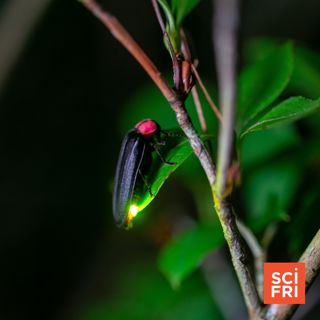
How do you find a ‘lost’ species?

The earth is facing a biodiversity crisis, and there’s a lot of attention on species that are threatened, or at risk of dying out completely. But, there’s another critter category that’s a little more...

14 Aug 18min
What we get wrong about vaccine hesitancy

What we get wrong about vaccine hesitancy

President Trump has signed an executive order calling for a change to the childhood vaccination schedule. Specifically, he wants to separate the MMR vaccine, which protects against measles, mumps, and...

13 Aug 12min

Why this lab studies the speed of bug pee and other curiosities

Why this lab studies the speed of bug pee and other curiosities

In a lab in the Rocky Mountains, a group of scientists is hard at work trying to find answers across biology, physics, and engineering: They’re looking into things like the hydrodynamics of insect pee...

12 Aug 18min

Some primates undergo even more extreme childbirth than humans

Some primates undergo even more extreme childbirth than humans

Human childbirth is often difficult and incredibly painful—just ask anyone who’s been through it. And for a long time, childbirth seemed to be uniquely difficult for humans. But a new study suggests t...

11 Aug 11min

Deb Haaland is a politician, and proud of it

Deb Haaland is a politician, and proud of it

Former Interior Secretary Deb Haaland, a member of the Laguna Pueblo tribe, was the first Native person to hold a cabinet position. Now she’s running to be governor of New Mexico.  Haaland joins Host ...

10 Aug 17min

Sitting all day is terrible for us. Moving a little can help

Sitting all day is terrible for us. Moving a little can help

Keeping your butt in a seat for hours a day increases the risk of heart attacks, diabetes, psychiatric conditions, and more. But in our tech-filled world, many of us lead sedentary lives, whether beca...

7 Aug 18min

A Nagasaki survivor and physician recounts his life's work

A Nagasaki survivor and physician recounts his life's work

Dr. Masao Tomonaga was only 2 years old when the United States bombed his home city of Nagasaki. He survived, and grew up to become a physician for other survivors, known as hibakusha. He also studied...

6 Aug 18min

Populärt inom Vetenskap

p3-dystopia
dumma-manniskor
allt-du-velat-veta
hacka-livet
bildningspodden
rss-vetenskapsradion
medicinvetarna
rss-ufobortom-rimligt-tvivel
sexet
ufo-sverige
rss-vetenskapsradion-2
halsorevolutionen
paranormalt-med-caroline-giertz
svd-nyhetsartiklar
det-morka-psyket
vetenskapsradion
ufo-sverige-2
rss-spraket
dumforklarat
rss-kriminologerna