
Thanksgiving Food Science, Force of Infection, Food Inequality. Nov 19, 2021, Part 2
Science Friday19 Nov 2021

Thanksgiving Food Science, Force of Infection, Food Inequality. Nov 19, 2021, Part 2

Blunting The Force Of Disease Is Complicated

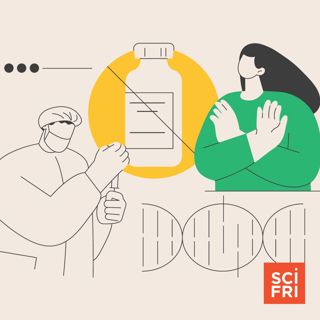
COVID-19 vaccines are highly effective at preventing severe disease. But their efficacy in lab-controlled trials may not exactly correlate to how well they work in the real world.

David Kaslow, chief scientific officer at the global public health nonprofit PATH, explains that a factor known as the “force of infection” plays a role in determining how well vaccines work. The force of infection describes the attack rate of a pathogen—the amount of time it takes a susceptible individual to get infected in a given population.

In a study recently published in the academic journal NPJ Vaccines, Kaslow and his colleagues found that in vaccine trials for rotavirus and malaria in Africa, efficacy could vary widely between two trial sites. When there were many infections in the community, the overall efficacy of the vaccines appeared lower than in communities where disease incidence was low.

While the same sort of studies haven’t yet been done on the coronavirus outbreak, Kaslow argues that similar factors may be at play now—pointing to a continued need for non-pharmaceutical measures to control transmission, from masking to social distancing.

The Chemistry Of The Perfect Cookie

With several major food-related holidays on the horizon, we’ve got a challenge for you—checking your cookie chemistry. Each batch of cookies you make has the potential to be a mini-science experiment, with the specific ingredients you use, the ratios between them, and cooking times and temperatures all variables in the mix.

Jennifer Powers, a science educator at the Oregon Museum of Science and Industry, discusses the role of types of sugar in transforming your cookie’s texture from chewy to crispy. She encourages listeners to take on her educational resource—the Cookie Chemistry Challengeto engineer the best batch of cookies possible.

Food Failures: Add A Dash Of Science To Your Thanksgiving Recipes

This Thanksgiving, put your cooking skills to the test. Looking for tips to avoid singed sweet potatoes, acrid apple pies, and a burned bird? In this archival segment from November 18, 2016, Molly Birnbaum and Dan Souza from Cook’s Science help us understand the science behind favorite Thanksgiving recipes so you can avoid food failures, and get the most out of your roast and side dishes.

America Has A Food Disparity Problem

As of 2016, more than half of American children had a diet that standard nutritional recommendations would consider “poor quality.” And there are stark differences between children in wealthier and poorer households. Poor nutrition can have lifelong impacts on health, including Type 2 diabetes, heart problems, and dental cavities. But it isn’t always clear what families need to provide healthier foods for their children. One popular explanation, now debunked, was the theory of food deserts: Poorer neighborhoods just don’t have grocery stores, and families must buy their food from convenience stores and gas stations. But if more grocery stores aren’t the solution, what is?

Sociologist Priya Fielding-Singh explores these questions in a new book, How The Other Half Eats: The Untold Story of Food and Inequality in America. Her research, the product of months of immersive time spent with families in their kitchens and as they navigated grocery stores with kids in tow, describes an alternative explanation for the socioeconomic disparity between kids’ diets. Fielding-Singh explains healthy food takes emotional and energy resources that lower-income parents must often spend in other ways.

Guest host Roxanne Khamsi talks to Fielding-Singh about her research on family food choices, and the kinds of changes that might allow children from all backgrounds to enjoy healthier foods.

Subscribe to this podcast. Follow our show on Instagram, TikTok, Facebook, and Bluesky @scifri and sign up for our newsletters. Got a science question that’s keeping you up at night? Call us: 877-472-4374


Hosted by Simplecast, an AdsWizz company. See pcm.adswizz.com for information about our collection and use of personal data for advertising.

Det här avsnittet är hämtat från ett öppet RSS-flöde och publiceras inte av Podme. Det kan innehålla reklam.

Avsnitt(1339)

FDA approves a well-known sunscreen ingredient—finally

FDA approves a well-known sunscreen ingredient—finally

The FDA recently approved a sunscreen ingredient called bemotrizinol, or BEMT, that’s been used in Europe and Asia for years. This is the first new sunscreen ingredient approved in the United States i...

22 Juni 12min

Why do sports announcers talk like that?

Why do sports announcers talk like that?

If you watch sports, whether the recent NBA finals or the ongoing World Cup matches, you may have noticed that the athletes aren’t the only ones putting on a show. The announcers seem to be playing a ...

19 Juni 13min

Swords, cannibalism, poison: inside the world of killer microbes

Swords, cannibalism, poison: inside the world of killer microbes

There is a murderous crime spree happening right under—and perhaps inside—our noses. Killer microbes armed with weapons are eviscerating, assassinating, and detonating their fellow microbes. And the n...

18 Juni 21min

When music transports you to a different place

When music transports you to a different place

Do you ever hear a song that transports you to a specific place and time? This auditory wormhole has a name: musical daydreams. Music cognition expert Elizabeth Margulis studies why they happen, and w...

17 Juni 18min

A vast whale graveyard + Zombie sea cucumbers

A vast whale graveyard + Zombie sea cucumbers

Researchers just published details of a massive undersea graveyard of whales deep in the Indian Ocean. Spanning about 1,200 kilometers (745 miles), it contains whale remains dating back more than 5 mi...

16 Juni 18min

Should we bring mountain lions back to the Northeast?

Should we bring mountain lions back to the Northeast?

Big cats used to roam the entire United States. You might know them as mountain lions, pumas, cougars, or catamounts. Though they go by many names, they're actually all the same species.  Their curren...

15 Juni 12min

Blue Origin explosion hits NASA timeline + Artemis III crew

Blue Origin explosion hits NASA timeline + Artemis III crew

When Blue Origin’s New Glenn spacecraft exploded in an enormous fireball during a ground test a couple weeks ago, it sent shockwaves not only through the air, but through NASA’s timeline for the upcom...

12 Juni 12min

Why can I handle tequila but not rum?

Why can I handle tequila but not rum?

‘Tis the season for porch beers and happy hours, and we’re taking on listener questions about how alcohol affects us. Like, is a glass of wine at dinner really good for you? And why do sugary drinks g...

11 Juni 21min

Populärt inom Vetenskap

p3-dystopia
dumma-manniskor
doden-hjarnan-kemisten
allt-du-velat-veta
medicinvetarna
svd-nyhetsartiklar
rss-kriminologerna
kapitalet-en-podd-om-ekonomi
sexet
bildningspodden
ufo-sverige
rss-ufobortom-rimligt-tvivel
rss-vetenskapsradion-2
dumforklarat
rss-vetenskapsradion
4health-med-anna-sparre
halsorevolutionen
rss-arkeologi-historia-podden-som-graver-i-vart-kulturlandskap
hacka-livet
rss-ronden