
Vocal Fry, Indigenous Tribes And The Colorado River, Year In Space. December 10, 2021, Part 2
Science Friday10 Dec 2021

Vocal Fry, Indigenous Tribes And The Colorado River, Year In Space. December 10, 2021, Part 2

The Why Of Vocal Fry

For decades, vocal fry lived a relatively quiet existence. A creaky or breathy sound that occurs when your voice drops to its lowest register, this phenomenon was long known to linguists, speech pathologists, and voice coaches—but everyday people didn’t pay much attention to it.

Then in 2011, people started noticing it everywhere. So, what happened? What’s going on in our vocal chords when we fry? And why does it bother so many people so very much?

“Science Diction” host Johanna Mayer explains the history of vocal fry, and looks at languages where fry is a feature, not a bug.

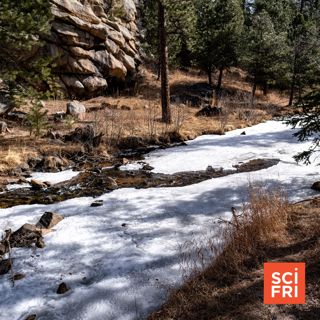
Tribal Concerns Grow As Water Levels Drop In The Colorado River Basin

Lorenzo Pena pulls off the highway and into a drive-through water distribution center on the Southern Ute Indian Tribe reservation in southwest Colorado. He parks his truck and connects the empty tank it’s hauling to a large hose and thousands of gallons of water quickly rush in. Pena, who works for the Southern Ute Indian Tribe’s hauled water program, has made this trip countless times to deliver water to tribal members who don’t have clean water piped to their homes from the local utility. “It’s pretty dry around here,” Pena said. “So if people have wells, they’re real slow or the wells aren’t really producing much water.” If a family on the reservation doesn’t use well water or lives outside of town, they have to haul water to fill their cistern to flow through their home.

The Colorado River is the lifeblood for the Southern Ute and dozens of federally recognized tribes who have relied on it for drinking water, farming, and supporting hunting and fishing habitats for thousands of years. The river also holds spiritual and cultural significance. Today, 15 percent of Southern Utes living on the reservation in southwest Colorado don’t have running water in their homes at all. That rate is higher for other tribes that rely on the Colorado River, including 40 percent of the Navajo Nation.

Native American households are 19 times more likely to lack piped water services than white households, according to a report from the Water & Tribes Initiative. The data also show Native American households are more likely to lack piped water services than any other racial group. Leaders of tribes who depend on the Colorado River say the century-old agreement on managing a resource vital to 40 million people across the West is a major factor fueling these and other water inequalities. State water managers and the federal government say they will include tribes in upcoming Colorado River policymaking negotiations for the first time.

Read more at sciencefriday.com.

Space Tourists, Asteroids, And Anti-Satellite Tests, Oh My!

Space has been a busy place this year. In February, NASA’s Perseverance rover landed on Mars and embarked on its mission to collect samples, alongside the first ever helicopter to fly on the Red Planet. July and September saw the launches of billionaires, space tourists, and civilian astronauts to various elevations above the Earth. Human beings are arriving to the International Space Station via Cape Canaveral for the first time since the discontinuation of the shuttle program in 2011. In November, NASA launched a mission to test our ability to deflect dangerous asteroids. And China, the United Arab Emirates, and Russia have all continued to make their way through the solar system as well.

But what about the continued concerns astronomers have about the steep rise and future plans for fleets of private telecommunications satellites in low Earth orbit, like SpaceX’s StarLink? Will the increasing footprint of private industry in space exploration have potential drawbacks for science? And what about that Russian anti-satellite test, which disrupted operations at the International Space Station for several days after?

Ira and a trio of star space reporters—WFME’s Brendan Byrne, Axios’ Miriam Kramer, and The Verge’s Loren Grush—round up 2021’s out-of-this-world headlines.

Subscribe to this podcast. Follow our show on Instagram, TikTok, Facebook, and Bluesky @scifri and sign up for our newsletters. Got a science question that’s keeping you up at night? Call us: 877-472-4374


Hosted by Simplecast, an AdsWizz company. See pcm.adswizz.com for information about our collection and use of personal data for advertising.

Det här avsnittet är hämtat från ett öppet RSS-flöde och publiceras inte av Podme. Det kan innehålla reklam.

Avsnitt(1339)

FDA approves a well-known sunscreen ingredient—finally

FDA approves a well-known sunscreen ingredient—finally

The FDA recently approved a sunscreen ingredient called bemotrizinol, or BEMT, that’s been used in Europe and Asia for years. This is the first new sunscreen ingredient approved in the United States i...

22 Juni 12min

Why do sports announcers talk like that?

Why do sports announcers talk like that?

If you watch sports, whether the recent NBA finals or the ongoing World Cup matches, you may have noticed that the athletes aren’t the only ones putting on a show. The announcers seem to be playing a ...

19 Juni 13min

Swords, cannibalism, poison: inside the world of killer microbes

Swords, cannibalism, poison: inside the world of killer microbes

There is a murderous crime spree happening right under—and perhaps inside—our noses. Killer microbes armed with weapons are eviscerating, assassinating, and detonating their fellow microbes. And the n...

18 Juni 21min

When music transports you to a different place

When music transports you to a different place

Do you ever hear a song that transports you to a specific place and time? This auditory wormhole has a name: musical daydreams. Music cognition expert Elizabeth Margulis studies why they happen, and w...

17 Juni 18min

A vast whale graveyard + Zombie sea cucumbers

A vast whale graveyard + Zombie sea cucumbers

Researchers just published details of a massive undersea graveyard of whales deep in the Indian Ocean. Spanning about 1,200 kilometers (745 miles), it contains whale remains dating back more than 5 mi...

16 Juni 18min

Should we bring mountain lions back to the Northeast?

Should we bring mountain lions back to the Northeast?

Big cats used to roam the entire United States. You might know them as mountain lions, pumas, cougars, or catamounts. Though they go by many names, they're actually all the same species.  Their curren...

15 Juni 12min

Blue Origin explosion hits NASA timeline + Artemis III crew

Blue Origin explosion hits NASA timeline + Artemis III crew

When Blue Origin’s New Glenn spacecraft exploded in an enormous fireball during a ground test a couple weeks ago, it sent shockwaves not only through the air, but through NASA’s timeline for the upcom...

12 Juni 12min

Why can I handle tequila but not rum?

Why can I handle tequila but not rum?

‘Tis the season for porch beers and happy hours, and we’re taking on listener questions about how alcohol affects us. Like, is a glass of wine at dinner really good for you? And why do sugary drinks g...

11 Juni 21min

Populärt inom Vetenskap

p3-dystopia
dumma-manniskor
doden-hjarnan-kemisten
allt-du-velat-veta
medicinvetarna
svd-nyhetsartiklar
rss-kriminologerna
kapitalet-en-podd-om-ekonomi
sexet
bildningspodden
ufo-sverige
rss-ufobortom-rimligt-tvivel
rss-vetenskapsradion-2
dumforklarat
rss-vetenskapsradion
4health-med-anna-sparre
halsorevolutionen
rss-arkeologi-historia-podden-som-graver-i-vart-kulturlandskap
hacka-livet
rss-ronden