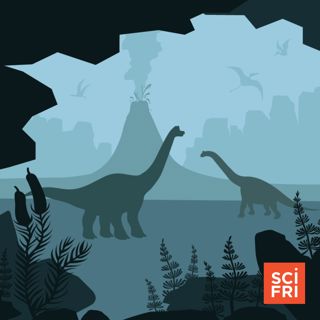
Old Things Considered: La Brea, Megalodon, Dino Footprints, Surviving History. Aug 25, 2023, Part 2
Science Friday25 Aug 2023

Old Things Considered: La Brea, Megalodon, Dino Footprints, Surviving History. Aug 25, 2023, Part 2

How Early Humans May Have Transformed L.A.’s Landscape Forever

Join us on a time traveling adventure, as we go back 15,000 years to visit what’s now southern California. During the last Ice Age, saber-toothed cats, wooly mammoths, and dire wolves prowled the landscape, until … they didn’t. The end of the Ice Age coincided with the end of these species. And for decades, scientists have been trying to figure out a big question: Why did these animals go extinct?

A new study in the journal Science offers new clues and suggests that wildfires caused by humans might’ve been the nail in these critters’ coffins.

Guest host Flora Lichtman talks with paleoecologist Dr. Emily Lindsey and paleobotanist Dr. Regan Dunn, both curators at the La Brea Tar Pits and Museum in Los Angeles, California, about what we can learn from animals preserved in tar pits, how fire transformed the ecosystem, and why we have to look to the past for modern day conservation and land management.

How Scientifically Accurate Are The Sharks In ‘Meg 2: The Trench’?

“Meg 2: The Trench” is the sequel to the 2018 movie “The Meg,” in which a team of ocean scientists discover a megalodon, the largest shark that ever lived, thriving at the bottom of the Mariana Trench. Megalodon went extinct over 2.6 million years ago … or so the movie’s characters thought.

When the team’s research sub gets damaged, a skilled rescue diver, played by Jason Statham, is brought in, who happened to have encountered the same megalodon years earlier. Over the course of the movie, the team discovers how this long-thought extinct apex predator survived, and what they can do to stop it before it wreaks havoc on the surface world.

“Meg 2: The Trench” largely follows in that movie’s footsteps, but this time, it features not just one, but multiple megalodons. Oh, and they’re even bigger this time.

Universe of Art host D. Peterschmidt chats with Dr. Sora Kim, an associate professor of paleoecology at University of California, Merced, about what science the movie got wrong (and right) and how these over-the-top blockbusters can inspire the scientists of the future.

Scientists Discover Dinosaur ‘Coliseum’ In Alaska’s Denali National Park

Researchers recently discovered a rocky outcrop at Denali National Park in Alaska covered in dinosaur tracks, which they dubbed the “Coliseum.” It’s the largest dinosaur track site ever found in Alaska.

The area has thousands of prints from generations of dinosaurs living about 70 million years ago, including: duck-billed dinosaurs, horned dinosaurs, raptors, tyrannosaurs.

Flora Lichtman talks with Dustin Stewart, former graduate student at the University of Alaska Fairbanks and paleontologist for the environmental consulting firm Stantec, based in Denver, Colorado, about this dino hotspot.

Your Guide To Conquering History’s Greatest Catastrophes

Guest host Flora Lichtman takes us back to some of the scariest, deadliest moments in history. Think along the lines of the eruption of Mount Vesuvius, the Ice Age, and the asteroid that wiped out the dinos. But we’re going to revisit them using what we know now—and science, of course—to figure out if and how we could survive those events.

The idea of using science and hindsight to survive history is the premise of a new book, How to Survive History: How to Outrun a Tyrannosaurus, Escape Pompeii, Get Off the Titanic, and Survive the Rest of History’s Deadliest Catastrophes by Cody Cassidy.

We have a new podcast! It’s called Universe Of Art, and it’s all about artists who use science to bring their creations to the next level. Listen on Apple Podcasts, Spotify, or wherever you get your podcasts.

To stay updated on all-things-science, sign up for Science Friday's newsletters.

Transcripts for each segment will be available the week after the show airs on sciencefriday.com.

Subscribe to this podcast. Follow our show on Instagram, TikTok, Facebook, and Bluesky @scifri and sign up for our newsletters. Got a science question that’s keeping you up at night? Call us: 877-472-4374


Hosted by Simplecast, an AdsWizz company. See pcm.adswizz.com for information about our collection and use of personal data for advertising.

Det här avsnittet är hämtat från ett öppet RSS-flöde och publiceras inte av Podme. Det kan innehålla reklam.

Avsnitt(1342)

That chlorine smell at the pool? It’s pee

That chlorine smell at the pool? It’s pee

On a hot summer day, there’s nothing better than a dip in a cold pool. But you know who can ruin that for you? A scientist who studies pool chemistry. What chemical reactions are happening in that swi...

25 Juni 12min

Under proposed rule, science funding must pass political review

Under proposed rule, science funding must pass political review

The federal Office of Management and Budget (OMB) has proposed rule changes that would bring a major shift in how scientific grants are awarded by U.S. government agencies. Under the current process, ...

24 Juni 12min

Can you learn to love the scorpion?

Can you learn to love the scorpion?

If you have arachnophobia, consider this your opportunity to try exposure therapy: A new study suggests that 415 million years ago, in modern-day England and Wales, a scorpion the length of a golden r...

23 Juni 18min

FDA approves a well-known sunscreen ingredient—finally

FDA approves a well-known sunscreen ingredient—finally

The FDA recently approved a sunscreen ingredient called bemotrizinol, or BEMT, that’s been used in Europe and Asia for years. This is the first new sunscreen ingredient approved in the United States i...

22 Juni 12min

Why do sports announcers talk like that?

Why do sports announcers talk like that?

If you watch sports, whether the recent NBA finals or the ongoing World Cup matches, you may have noticed that the athletes aren’t the only ones putting on a show. The announcers seem to be playing a ...

19 Juni 13min

Swords, cannibalism, poison: inside the world of killer microbes

Swords, cannibalism, poison: inside the world of killer microbes

There is a murderous crime spree happening right under—and perhaps inside—our noses. Killer microbes armed with weapons are eviscerating, assassinating, and detonating their fellow microbes. And the n...

18 Juni 21min

When music transports you to a different place

When music transports you to a different place

Do you ever hear a song that transports you to a specific place and time? This auditory wormhole has a name: musical daydreams. Music cognition expert Elizabeth Margulis studies why they happen, and w...

17 Juni 18min

A vast whale graveyard + Zombie sea cucumbers

A vast whale graveyard + Zombie sea cucumbers

Researchers just published details of a massive undersea graveyard of whales deep in the Indian Ocean. Spanning about 1,200 kilometers (745 miles), it contains whale remains dating back more than 5 mi...

16 Juni 18min

Populärt inom Vetenskap

p3-dystopia
dumma-manniskor
allt-du-velat-veta
kapitalet-en-podd-om-ekonomi
medicinvetarna
doden-hjarnan-kemisten
svd-nyhetsartiklar
rss-kriminologerna
bildningspodden
ufo-sverige
sexet
dumforklarat
rss-spraket
rss-vetenskapsradion
rss-arkeologi-historia-podden-som-graver-i-vart-kulturlandskap
4health-med-anna-sparre
rss-ufobortom-rimligt-tvivel
vetenskapsradion
rss-tidslinjen-podcast
hacka-livet