CRISPR-Based Sickle Cell Treatment | Pain Tolerance From Neanderthals
Science Friday3 Nov 2023

CRISPR-Based Sickle Cell Treatment | Pain Tolerance From Neanderthals

If given final approval by the FDA, this sickle-cell treatment would be the first to use gene-editing CRISPR technology on humans. Also, gene variants inherited from Neanderthals can impact pain tolerance in modern humans.

FDA Panel Clears Way For CRISPR-Based Sickle Cell Treatment

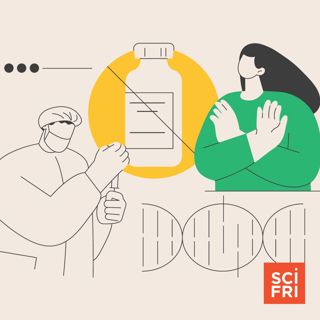
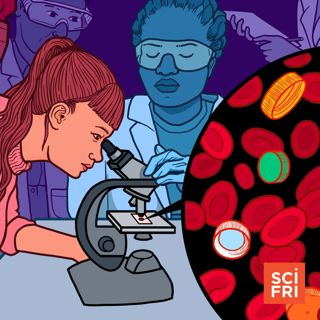
An FDA committee cleared the way for a revolutionary cure for sickle cell disease this week. If given final approval, the treatment would be the first to use CRISPR gene editing in humans. Sickle cell disease is caused by a genetic mutation that causes blood cells to develop into crescent or “sickle” shapes. The extremely painful and often deadly disease disproportionately affects Black and African American people.

Ira talks with Vox staff writer Umair Irfan about the new sickle cell treatment and other top science news of the week, including the link between the auto worker strike and a clean energy transition; new evidence about the moon’s origin; and why starfish don’t have arms.

Your Pain Tolerance May Have Been Passed Down from Neanderthals

There’s a little bit of Neanderthal in most of us. Neanderthals and Homo sapiens had a long history of intermingling, before the former went extinct about 40,000 years ago. That mixing means most modern humans have some amount of Neanderthal DNA—and it accounts for up to 3% of the genome in some people.

While these genetic remnants don’t have much impact on our day-to-day lives, they may be responsible for one surprising effect: pain tolerance. Recent research shows that people with Neanderthal variants in the gene SCN9A have a lower pain tolerance than people without the gene.

This isn’t the only Neanderthal remnant that’s been passed down. A study from earlier this year pinpointed a certain genome region that impacts nose shape. Taller, wider noses were passed down from our Neanderthal ancestors who lived in colder climates. A larger nose warmed air before it hit the sensitive lungs.

Ira speaks with Dr. Kaustubh Adhikari, assistant professor of statistics at the Open University in the United Kingdom, who worked on both of these studies.

To stay updated on all things science, sign up for Science Friday's newsletters. Transcripts for each segment will be available the week after the show airs on sciencefriday.com.

Subscribe to this podcast. Follow our show on Instagram, TikTok, Facebook, and Bluesky @scifri and sign up for our newsletters. Got a science question that’s keeping you up at night? Call us: 877-472-4374


Hosted by Simplecast, an AdsWizz company. See pcm.adswizz.com for information about our collection and use of personal data for advertising.

Det här avsnittet är hämtat från ett öppet RSS-flöde och publiceras inte av Podme. Det kan innehålla reklam.

Avsnitt(1342)

That chlorine smell at the pool? It’s pee

That chlorine smell at the pool? It’s pee

On a hot summer day, there’s nothing better than a dip in a cold pool. But you know who can ruin that for you? A scientist who studies pool chemistry. What chemical reactions are happening in that swi...

25 Juni 12min

Under proposed rule, science funding must pass political review

Under proposed rule, science funding must pass political review

The federal Office of Management and Budget (OMB) has proposed rule changes that would bring a major shift in how scientific grants are awarded by U.S. government agencies. Under the current process, ...

24 Juni 12min

Can you learn to love the scorpion?

Can you learn to love the scorpion?

If you have arachnophobia, consider this your opportunity to try exposure therapy: A new study suggests that 415 million years ago, in modern-day England and Wales, a scorpion the length of a golden r...

23 Juni 18min

FDA approves a well-known sunscreen ingredient—finally

FDA approves a well-known sunscreen ingredient—finally

The FDA recently approved a sunscreen ingredient called bemotrizinol, or BEMT, that’s been used in Europe and Asia for years. This is the first new sunscreen ingredient approved in the United States i...

22 Juni 12min

Why do sports announcers talk like that?

Why do sports announcers talk like that?

If you watch sports, whether the recent NBA finals or the ongoing World Cup matches, you may have noticed that the athletes aren’t the only ones putting on a show. The announcers seem to be playing a ...

19 Juni 13min

Swords, cannibalism, poison: inside the world of killer microbes

Swords, cannibalism, poison: inside the world of killer microbes

There is a murderous crime spree happening right under—and perhaps inside—our noses. Killer microbes armed with weapons are eviscerating, assassinating, and detonating their fellow microbes. And the n...

18 Juni 21min

When music transports you to a different place

When music transports you to a different place

Do you ever hear a song that transports you to a specific place and time? This auditory wormhole has a name: musical daydreams. Music cognition expert Elizabeth Margulis studies why they happen, and w...

17 Juni 18min

A vast whale graveyard + Zombie sea cucumbers

A vast whale graveyard + Zombie sea cucumbers

Researchers just published details of a massive undersea graveyard of whales deep in the Indian Ocean. Spanning about 1,200 kilometers (745 miles), it contains whale remains dating back more than 5 mi...

16 Juni 18min

Populärt inom Vetenskap

p3-dystopia
dumma-manniskor
allt-du-velat-veta
kapitalet-en-podd-om-ekonomi
medicinvetarna
doden-hjarnan-kemisten
svd-nyhetsartiklar
rss-kriminologerna
bildningspodden
ufo-sverige
sexet
dumforklarat
rss-spraket
rss-vetenskapsradion
rss-arkeologi-historia-podden-som-graver-i-vart-kulturlandskap
4health-med-anna-sparre
rss-ufobortom-rimligt-tvivel
vetenskapsradion
rss-tidslinjen-podcast
hacka-livet