40 Years Of Sounding The Alarm On Nuclear Winter
Science Friday6 Nov 2023

40 Years Of Sounding The Alarm On Nuclear Winter

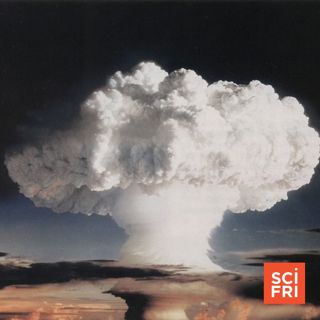
This week holds anniversaries for two important milestones in nuclear warfare. On November 1, 1952, the United States detonated a massive hydrogen bomb in the Marshall Islands. The new weapon vaporized a whole island, leaving behind a mile-wide crater. That bomb was around 700 times more powerful than the one dropped on Hiroshima seven years prior, and it renewed fears of nuclear annihilation, which would grip the world for generations to come.

Three decades later, on October 30, 1983, millions of Americans flipped open the Sunday paper to find a shadowy, apocalyptic photo with the words: “Would nuclear war be the end of the world?”

Legendary scientist Dr. Carl Sagan, writing for Parade Magazine, introduced the world to “nuclear winter,” the terrifying climate changes that might be brought on by nuclear war.

Sagan conducted some of the first research on nuclear winter, and he spent years warning politicians, world leaders, and the general public about it. Today, with thousands of nuclear weapons still in existence, the risk of nuclear winter isn’t zero.

Ira talks with another pioneer in nuclear winter research, Dr. Alan Robock, a climate scientist and distinguished professor at Rutgers University, about the science of nuclear winter, how fear of those consequences shaped policies, and what’s happening with the world’s nuclear arsenal now.

To stay updated on all things science, sign up for Science Friday's newsletters. Transcripts for each segment will be available the week after the show airs on sciencefriday.com.

Subscribe to this podcast. Follow our show on Instagram, TikTok, Facebook, and Bluesky @scifri and sign up for our newsletters. Got a science question that’s keeping you up at night? Call us: 877-472-4374


Hosted by Simplecast, an AdsWizz company. See pcm.adswizz.com for information about our collection and use of personal data for advertising.

Det här avsnittet är hämtat från ett öppet RSS-flöde och publiceras inte av Podme. Det kan innehålla reklam.

Avsnitt(1342)

That chlorine smell at the pool? It’s pee

That chlorine smell at the pool? It’s pee

On a hot summer day, there’s nothing better than a dip in a cold pool. But you know who can ruin that for you? A scientist who studies pool chemistry. What chemical reactions are happening in that swi...

25 Juni 12min

Under proposed rule, science funding must pass political review

Under proposed rule, science funding must pass political review

The federal Office of Management and Budget (OMB) has proposed rule changes that would bring a major shift in how scientific grants are awarded by U.S. government agencies. Under the current process, ...

24 Juni 12min

Can you learn to love the scorpion?

Can you learn to love the scorpion?

If you have arachnophobia, consider this your opportunity to try exposure therapy: A new study suggests that 415 million years ago, in modern-day England and Wales, a scorpion the length of a golden r...

23 Juni 18min

FDA approves a well-known sunscreen ingredient—finally

FDA approves a well-known sunscreen ingredient—finally

The FDA recently approved a sunscreen ingredient called bemotrizinol, or BEMT, that’s been used in Europe and Asia for years. This is the first new sunscreen ingredient approved in the United States i...

22 Juni 12min

Why do sports announcers talk like that?

Why do sports announcers talk like that?

If you watch sports, whether the recent NBA finals or the ongoing World Cup matches, you may have noticed that the athletes aren’t the only ones putting on a show. The announcers seem to be playing a ...

19 Juni 13min

Swords, cannibalism, poison: inside the world of killer microbes

Swords, cannibalism, poison: inside the world of killer microbes

There is a murderous crime spree happening right under—and perhaps inside—our noses. Killer microbes armed with weapons are eviscerating, assassinating, and detonating their fellow microbes. And the n...

18 Juni 21min

When music transports you to a different place

When music transports you to a different place

Do you ever hear a song that transports you to a specific place and time? This auditory wormhole has a name: musical daydreams. Music cognition expert Elizabeth Margulis studies why they happen, and w...

17 Juni 18min

A vast whale graveyard + Zombie sea cucumbers

A vast whale graveyard + Zombie sea cucumbers

Researchers just published details of a massive undersea graveyard of whales deep in the Indian Ocean. Spanning about 1,200 kilometers (745 miles), it contains whale remains dating back more than 5 mi...

16 Juni 18min

Populärt inom Vetenskap

p3-dystopia
dumma-manniskor
allt-du-velat-veta
kapitalet-en-podd-om-ekonomi
medicinvetarna
doden-hjarnan-kemisten
svd-nyhetsartiklar
rss-kriminologerna
bildningspodden
ufo-sverige
sexet
dumforklarat
rss-spraket
rss-vetenskapsradion
rss-arkeologi-historia-podden-som-graver-i-vart-kulturlandskap
4health-med-anna-sparre
rss-ufobortom-rimligt-tvivel
vetenskapsradion
rss-tidslinjen-podcast
hacka-livet