AI Helps Find Ancient Artifacts In The Great Lakes | An Artist Combines Indigenous Textiles With Modern Tech
Science Friday25 Jan 2024

AI Helps Find Ancient Artifacts In The Great Lakes | An Artist Combines Indigenous Textiles With Modern Tech

Researchers in Michigan modeled a prehistoric land bridge and used AI to predict where caribou–and humans–might have traveled along it. Also, artist Sarah Rosalena uses Indigenous weaving, ceramics, and sculpture practices to create art that challenges tech’s future.

Using AI To Help Find Ancient Artifacts In The Great Lakes

At the bottom of Lake Huron there’s a ridge that was once above water. It’s called the Alpena Amberley Ridge and goes from northern Michigan to southern Ontario. Nine thousand years ago, people and animals traveled this corridor. But then the lake rose, and signs of life were submerged.

Archaeologists were skeptical they’d ever find artifacts from that time. But then John O’Shea, an underwater archaeologist based at the University of Michigan, found something. It was an ancient caribou hunting site. O’Shea realized he needed help finding more. The ridge is about 90 miles long, 9 miles wide and 100 feet underwater.

“Underwater research is always like a needle in a haystack,” said O’Shea. “So any clues you can get that help you narrow down and focus … is a real help to us.”

That’s where artificial intelligence comes in. He teamed up with computer scientist Bob Reynolds from Wayne State University, one of the premier people creating archaeological simulations. And Reynolds and his students created a simulation with artificially intelligent caribou to help them make predictions.

An Artist Combines Indigenous Textiles With Modern Tech

When multidisciplinary artist Sarah Rosalena looks at a loom, she thinks about computer programming. “It’s an extension of your body, being an algorithm,” she says.

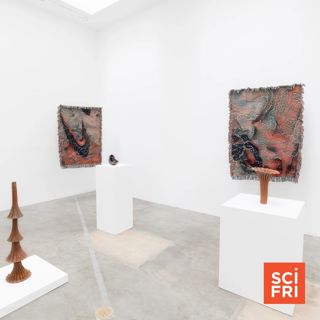
Rosalena, a Wixárika descendant and assistant professor of art at the University of California Santa Barbara, combines traditional Indigenous craft—weaving, beadmaking, pottery—with new technologies like AI, data visualization, and 3D-printing. And she also works with scientists to make these otherworldly creations come to life. She involved researchers at the NASA Jet Propulsion Lab to make 3D-printed pottery with simulated Martian clay. And she collaborated with the Mount Wilson Observatory to produce intricately beaded tapestries based on early-1900s glass plates captured by the observatory’s telescope, which women mathematicians used to make astronomical calculations.

And that’s also a big focus for Rosalena: spotlighting the overlooked contributions women made to computer science and connecting it to how textiles are traditionally thought of as a woman-based craft. When she first started making this kind of art, Rosalena learned that the Jacquard loom—a textile advancement in the 1800s that operated on a binary punch card system which allowed for mass production of intricate designs—inspired computer science pioneer Ada Lovelace when she was developing the first computer program. “[They] have this looped history,” she says. “And when I weave or do beadwork, it’s also recalling that relationship.”

But for Rosalena, there is tension and anxiety in her decision to combine new and ancient mediums. “We’re at this point of the technological frontier and that’s actually terrifying for a lot of people, especially for people from my background and my Wixárika background,” she says. “It’s progress for some, but it’s not for all.”

Part of Rosalena’s work is anticipating future forms of colonization, especially amid rapid change in our planet’s climate and the rise of AI. “What happens when we bring traditional craft or Indigenous techniques with emerging technology to think about current issues that we are facing? Digital technologies are always chasing after ways that we could simulate our reality, which also produces this way that we could re-envision our reality,” she says.

SciFri producer and host of our podcast Universe Of Art D. Peterschmidt sat down with Rosalena to talk about how she approaches her work, why she collaborates with scientists, and how she hopes her art makes people consider today’s technological advancements through an Indigenous lens.

Transcripts for each segment will be available after the show airs on sciencefriday.com.

Subscribe to this podcast. Follow our show on Instagram, TikTok, Facebook, and Bluesky @scifri and sign up for our newsletters. Got a science question that’s keeping you up at night? Call us: 877-472-4374


Hosted by Simplecast, an AdsWizz company. See pcm.adswizz.com for information about our collection and use of personal data for advertising.

Det här avsnittet är hämtat från ett öppet RSS-flöde och publiceras inte av Podme. Det kan innehålla reklam.

Avsnitt(1340)

Can you learn to love the scorpion?

Can you learn to love the scorpion?

If you have arachnophobia, consider this your opportunity to try exposure therapy: A new study suggests that 415 million years ago, in modern-day England and Wales, a scorpion the length of a golden r...

23 Juni 18min

FDA approves a well-known sunscreen ingredient—finally

FDA approves a well-known sunscreen ingredient—finally

The FDA recently approved a sunscreen ingredient called bemotrizinol, or BEMT, that’s been used in Europe and Asia for years. This is the first new sunscreen ingredient approved in the United States i...

22 Juni 12min

Why do sports announcers talk like that?

Why do sports announcers talk like that?

If you watch sports, whether the recent NBA finals or the ongoing World Cup matches, you may have noticed that the athletes aren’t the only ones putting on a show. The announcers seem to be playing a ...

19 Juni 13min

Swords, cannibalism, poison: inside the world of killer microbes

Swords, cannibalism, poison: inside the world of killer microbes

There is a murderous crime spree happening right under—and perhaps inside—our noses. Killer microbes armed with weapons are eviscerating, assassinating, and detonating their fellow microbes. And the n...

18 Juni 21min

When music transports you to a different place

When music transports you to a different place

Do you ever hear a song that transports you to a specific place and time? This auditory wormhole has a name: musical daydreams. Music cognition expert Elizabeth Margulis studies why they happen, and w...

17 Juni 18min

A vast whale graveyard + Zombie sea cucumbers

A vast whale graveyard + Zombie sea cucumbers

Researchers just published details of a massive undersea graveyard of whales deep in the Indian Ocean. Spanning about 1,200 kilometers (745 miles), it contains whale remains dating back more than 5 mi...

16 Juni 18min

Should we bring mountain lions back to the Northeast?

Should we bring mountain lions back to the Northeast?

Big cats used to roam the entire United States. You might know them as mountain lions, pumas, cougars, or catamounts. Though they go by many names, they're actually all the same species.  Their curren...

15 Juni 12min

Blue Origin explosion hits NASA timeline + Artemis III crew

Blue Origin explosion hits NASA timeline + Artemis III crew

When Blue Origin’s New Glenn spacecraft exploded in an enormous fireball during a ground test a couple weeks ago, it sent shockwaves not only through the air, but through NASA’s timeline for the upcom...

12 Juni 12min

Populärt inom Vetenskap

p3-dystopia
dumma-manniskor
doden-hjarnan-kemisten
allt-du-velat-veta
medicinvetarna
svd-nyhetsartiklar
rss-kriminologerna
kapitalet-en-podd-om-ekonomi
sexet
bildningspodden
ufo-sverige
rss-ufobortom-rimligt-tvivel
rss-vetenskapsradion-2
dumforklarat
rss-vetenskapsradion
4health-med-anna-sparre
halsorevolutionen
rss-arkeologi-historia-podden-som-graver-i-vart-kulturlandskap
hacka-livet
rss-ronden