Syphilis Cases Up 80% Since 2018 | The Largest Deep-Sea Coral Reef In The World
Science Friday2 Feb 2024

Syphilis Cases Up 80% Since 2018 | The Largest Deep-Sea Coral Reef In The World

There has been a boom of syphilis cases, including a 180% increase in congenital syphilis cases, despite other STI levels staying stable. Also, the world's largest deep-sea reef stretches for hundreds of miles in near-freezing waters and total darkness, but it’s bustling with life.

Syphilis Cases Are Up 80% Since 2018

Syphilis is rearing its ugly head again in the United States. A new report on sexually transmitted infections (STIs) from the Centers for Disease Control and Prevention shows a shocking statistic: Cases of syphilis are up by nearly 80% among adults since 2018. Congenital syphilis cases, which occur when an infection is passed from parent to child during pregnancy, are up by more than 180%.

Strangely, cases of other STIs have stayed about the same or decreased in the same timeframe. Rachel Feltman, host of “The Weirdest Thing I Learned This Week,” joins Ira to talk about this and other science stories from the week, including the first cases of transmitted Alzheimer’s disease, and why closing the toilet seat doesn’t keep aerosolized viruses from contaminating other bathroom surfaces.

Revealing The Largest Deep-Sea Coral Reef In The World

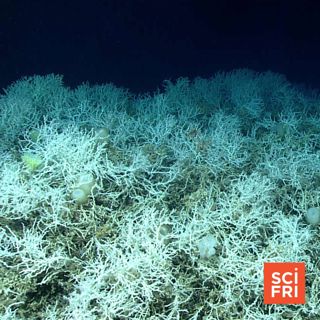
Scientists recently discovered the largest known deep-sea coral reef in the world. It’s called Million Mounds, and it stretches from Miami, Florida, to Charleston, South Carolina, covering around 6.4 million acres of the seafloor.

Unlike the colorful reefs found in sunlit tropical waters, this one is mostly made up of a stony coral that’s usually found from about 650 to 3,300 feet underwater—depths where it’s very cold and pitch black.

Ira Flatow talks with Dr. Erik Cordes, marine biologist and professor at Temple University in Philadelphia, Pennsylvania, who collaborated on the study. They discuss what makes deep-sea corals different from those found in shallower waters, why it’s important to map them, and what it’s like to visit one in a submarine.

Transcripts for each segment will be available after the show airs on sciencefriday.com.

Subscribe to this podcast. Follow our show on Instagram, TikTok, Facebook, and Bluesky @scifri and sign up for our newsletters. Got a science question that’s keeping you up at night? Call us: 877-472-4374


Hosted by Simplecast, an AdsWizz company. See pcm.adswizz.com for information about our collection and use of personal data for advertising.

Det här avsnittet är hämtat från ett öppet RSS-flöde och publiceras inte av Podme. Det kan innehålla reklam.

Avsnitt(1340)

Can you learn to love the scorpion?

Can you learn to love the scorpion?

If you have arachnophobia, consider this your opportunity to try exposure therapy: A new study suggests that 415 million years ago, in modern-day England and Wales, a scorpion the length of a golden r...

23 Juni 18min

FDA approves a well-known sunscreen ingredient—finally

FDA approves a well-known sunscreen ingredient—finally

The FDA recently approved a sunscreen ingredient called bemotrizinol, or BEMT, that’s been used in Europe and Asia for years. This is the first new sunscreen ingredient approved in the United States i...

22 Juni 12min

Why do sports announcers talk like that?

Why do sports announcers talk like that?

If you watch sports, whether the recent NBA finals or the ongoing World Cup matches, you may have noticed that the athletes aren’t the only ones putting on a show. The announcers seem to be playing a ...

19 Juni 13min

Swords, cannibalism, poison: inside the world of killer microbes

Swords, cannibalism, poison: inside the world of killer microbes

There is a murderous crime spree happening right under—and perhaps inside—our noses. Killer microbes armed with weapons are eviscerating, assassinating, and detonating their fellow microbes. And the n...

18 Juni 21min

When music transports you to a different place

When music transports you to a different place

Do you ever hear a song that transports you to a specific place and time? This auditory wormhole has a name: musical daydreams. Music cognition expert Elizabeth Margulis studies why they happen, and w...

17 Juni 18min

A vast whale graveyard + Zombie sea cucumbers

A vast whale graveyard + Zombie sea cucumbers

Researchers just published details of a massive undersea graveyard of whales deep in the Indian Ocean. Spanning about 1,200 kilometers (745 miles), it contains whale remains dating back more than 5 mi...

16 Juni 18min

Should we bring mountain lions back to the Northeast?

Should we bring mountain lions back to the Northeast?

Big cats used to roam the entire United States. You might know them as mountain lions, pumas, cougars, or catamounts. Though they go by many names, they're actually all the same species.  Their curren...

15 Juni 12min

Blue Origin explosion hits NASA timeline + Artemis III crew

Blue Origin explosion hits NASA timeline + Artemis III crew

When Blue Origin’s New Glenn spacecraft exploded in an enormous fireball during a ground test a couple weeks ago, it sent shockwaves not only through the air, but through NASA’s timeline for the upcom...

12 Juni 12min

Populärt inom Vetenskap

p3-dystopia
dumma-manniskor
doden-hjarnan-kemisten
allt-du-velat-veta
medicinvetarna
svd-nyhetsartiklar
rss-kriminologerna
kapitalet-en-podd-om-ekonomi
sexet
bildningspodden
ufo-sverige
rss-ufobortom-rimligt-tvivel
rss-vetenskapsradion-2
dumforklarat
rss-vetenskapsradion
4health-med-anna-sparre
halsorevolutionen
rss-arkeologi-historia-podden-som-graver-i-vart-kulturlandskap
hacka-livet
rss-ronden