
The Octopus Overlooked By Science | Squid With ‘Giant’ Eggs Could Be New Species
Science Friday27 Juni 2024

The Octopus Overlooked By Science | Squid With ‘Giant’ Eggs Could Be New Species

The larger Pacific striped octopus is unusually social. But it wasn’t recognized by scientists until 2015, despite one man’s efforts. And, a deep-sea squid in the family Gonatidae was filmed cradling large eggs for its body size, which suggests it’s an entirely new species.

Why It Took Decades For This Octopus To Be Recognized

Octopus mating behaviors can be quite deadly. Many species are cannibalistic, making the entire prospect of mating dangerous, and female octopuses often die after laying one clutch of eggs. Their cannibalistic tendencies mean that octopuses don’t socialize as much as other animals.

But the larger Pacific striped octopus (LPSO) is different. For one, they live together in colonies. And mating is not only a safer proposition, it involves beak-to-beak “kissing.” Plus, females can lay eggs repeatedly, even tending to embryos at various stages of development.

But because these behaviors are so uncharacteristic of most octopuses, the scientific community didn’t officially recognize their existence until 2015, despite the decades-long effort of a Panamanian diver and artist named Arcadio Rodaniche. When he tried to share his findings about the LPSO at a symposium and publish them in a journal, he was flatly rejected. But his persistent research and documentation of the species would eventually be validated when researchers were able to obtain and observe the octopuses in captivity.

SciFri producer Kathleen Davis sits down with freelance science writer Kenna Hughes-Castleberry to talk about an article she reported for Science Friday about the late Rodaniche and his yearslong effort to get official scientific recognition for the LPSO.

Read the story at sciencefriday.com.

Squid With ‘Giant’ Eggs Could Be A New Species

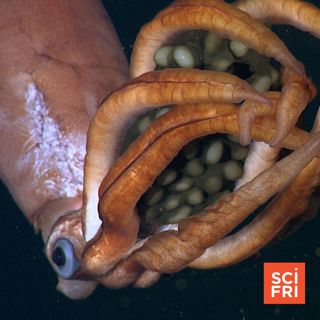
To finish up our celebration of Cephalopod Week we wanted to share a bit of squid news. A group of researchers recently identified a potentially new squid species in the family Gonatidae. Scientists took a closer look at some video footage captured back in 2015 and found a deep-water squid that was cradling some rather large eggs, which was not in line with other squid of the same family.

John Dankosky talks with Dr. Bruce Robison, midwater ecologist and senior scientist at the Monterey Bay Aquarium Research Institute, about this new discovery.

Transcripts for each segment will be available after the show airs on sciencefriday.com.

Subscribe to this podcast. Follow our show on Instagram, TikTok, Facebook, and Bluesky @scifri and sign up for our newsletters. Got a science question that’s keeping you up at night? Call us: 877-472-4374


Hosted by Simplecast, an AdsWizz company. See pcm.adswizz.com for information about our collection and use of personal data for advertising.

Det här avsnittet är hämtat från ett öppet RSS-flöde och publiceras inte av Podme. Det kan innehålla reklam.

Avsnitt(1339)

FDA approves a well-known sunscreen ingredient—finally

FDA approves a well-known sunscreen ingredient—finally

The FDA recently approved a sunscreen ingredient called bemotrizinol, or BEMT, that’s been used in Europe and Asia for years. This is the first new sunscreen ingredient approved in the United States i...

22 Juni 12min

Why do sports announcers talk like that?

Why do sports announcers talk like that?

If you watch sports, whether the recent NBA finals or the ongoing World Cup matches, you may have noticed that the athletes aren’t the only ones putting on a show. The announcers seem to be playing a ...

19 Juni 13min

Swords, cannibalism, poison: inside the world of killer microbes

Swords, cannibalism, poison: inside the world of killer microbes

There is a murderous crime spree happening right under—and perhaps inside—our noses. Killer microbes armed with weapons are eviscerating, assassinating, and detonating their fellow microbes. And the n...

18 Juni 21min

When music transports you to a different place

When music transports you to a different place

Do you ever hear a song that transports you to a specific place and time? This auditory wormhole has a name: musical daydreams. Music cognition expert Elizabeth Margulis studies why they happen, and w...

17 Juni 18min

A vast whale graveyard + Zombie sea cucumbers

A vast whale graveyard + Zombie sea cucumbers

Researchers just published details of a massive undersea graveyard of whales deep in the Indian Ocean. Spanning about 1,200 kilometers (745 miles), it contains whale remains dating back more than 5 mi...

16 Juni 18min

Should we bring mountain lions back to the Northeast?

Should we bring mountain lions back to the Northeast?

Big cats used to roam the entire United States. You might know them as mountain lions, pumas, cougars, or catamounts. Though they go by many names, they're actually all the same species.  Their curren...

15 Juni 12min

Blue Origin explosion hits NASA timeline + Artemis III crew

Blue Origin explosion hits NASA timeline + Artemis III crew

When Blue Origin’s New Glenn spacecraft exploded in an enormous fireball during a ground test a couple weeks ago, it sent shockwaves not only through the air, but through NASA’s timeline for the upcom...

12 Juni 12min

Why can I handle tequila but not rum?

Why can I handle tequila but not rum?

‘Tis the season for porch beers and happy hours, and we’re taking on listener questions about how alcohol affects us. Like, is a glass of wine at dinner really good for you? And why do sugary drinks g...

11 Juni 21min

Populärt inom Vetenskap

p3-dystopia
dumma-manniskor
doden-hjarnan-kemisten
allt-du-velat-veta
kapitalet-en-podd-om-ekonomi
medicinvetarna
rss-kriminologerna
rss-ufobortom-rimligt-tvivel
sexet
svd-nyhetsartiklar
rss-vetenskapsradion-2
dumforklarat
ufo-sverige
bildningspodden
rss-vetenskapsradion
rss-spraket
4health-med-anna-sparre
hacka-livet
vetenskapsradion
rss-ronden