
SpaceX’s Starship Completes In-Orbit Engine Test | Resuscitating Shipwrecked Rye Seeds
Science Friday22 Nov 2024

SpaceX’s Starship Completes In-Orbit Engine Test | Resuscitating Shipwrecked Rye Seeds

This was the sixth test launch of the Starship vehicle, which could eventually carry humans and cargo to the moon. It was extremely loud. Also, divers have recovered seeds of a long-lost rye variety from a 146-year-old shipwreck in Lake Huron. Scientists hope to bring it back to life.

SpaceX’s Starship Completes In-Orbit Engine Test

On Tuesday, the rocket company SpaceX conducted another test flight of its Starship spacecraft. In the uncrewed mission, the sixth test of the system, the company was seeking to test its ability to restart the Starship engines while in orbit, a function that’s necessary for in-space maneuvering. The rocket did launch successfully, and the engine test worked. However, at the last minute the company elected not to try to repeat an October maneuver in which it caught a returning SuperHeavy rocket booster at the launch tower, citing safety concerns.

SciFri’s Charles Bergquist joins guest host Kathleen Davis to talk about the launch, and related research into the tremendous sound created by the system’s launch and reentry. They also discuss other stories from the week in science, including the discovery of a saber-toothed kitten in Siberian permafrost, efforts to use light to help destroy PFAS chemicals, a company using Pokemon Go game data to train an AI, and more.

Michigan-Based Team To Resuscitate Shipwrecked Rye Seeds

In 1878, a wooden schooner named the James R. Bentley set sail from Chicago to Buffalo, New York. But strong winds and rough waters damaged the ship, and it sank to the bottom of Lake Huron. The crew was saved, but the ship’s cargo—a large shipment of rye—sank with it. In the years since the shipwreck, that particular variety of rye has faded out of existence.

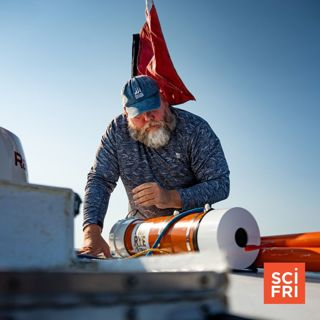
Now, almost 150 years later, a Michigan-based team is trying to bring the long-lost rye back to life. They dove to the shipwreck, retrieved a tube full of seeds, and are planning to use gene technology to recreate the rye variety. Their goal is to encourage farmers to grow it, so that distillers can use it to make whiskey.

SciFri producer Kathleen Davis talks with Dr. Eric Olson, professor of wheat breeding and genetics at Michigan State University, and Chad Munger, founder and CEO of Mammoth Distilling.

Transcripts for each segment will be available after the show airs on sciencefriday.com.

Subscribe to this podcast. Follow our show on Instagram, TikTok, Facebook, and Bluesky @scifri and sign up for our newsletters. Got a science question that’s keeping you up at night? Call us: 877-472-4374


Hosted by Simplecast, an AdsWizz company. See pcm.adswizz.com for information about our collection and use of personal data for advertising.

Det här avsnittet är hämtat från ett öppet RSS-flöde och publiceras inte av Podme. Det kan innehålla reklam.

Avsnitt(1338)

Why do sports announcers talk like that?

Why do sports announcers talk like that?

If you watch sports, whether the recent NBA finals or the ongoing World Cup matches, you may have noticed that the athletes aren’t the only ones putting on a show. The announcers seem to be playing a ...

19 Juni 13min

Swords, cannibalism, poison: inside the world of killer microbes

Swords, cannibalism, poison: inside the world of killer microbes

There is a murderous crime spree happening right under—and perhaps inside—our noses. Killer microbes armed with weapons are eviscerating, assassinating, and detonating their fellow microbes. And the n...

18 Juni 21min

When music transports you to a different place

When music transports you to a different place

Do you ever hear a song that transports you to a specific place and time? This auditory wormhole has a name: musical daydreams. Music cognition expert Elizabeth Margulis studies why they happen, and w...

17 Juni 18min

A vast whale graveyard + Zombie sea cucumbers

A vast whale graveyard + Zombie sea cucumbers

Researchers just published details of a massive undersea graveyard of whales deep in the Indian Ocean. Spanning about 1,200 kilometers (745 miles), it contains whale remains dating back more than 5 mi...

16 Juni 18min

Should we bring mountain lions back to the Northeast?

Should we bring mountain lions back to the Northeast?

Big cats used to roam the entire United States. You might know them as mountain lions, pumas, cougars, or catamounts. Though they go by many names, they're actually all the same species.  Their curren...

15 Juni 12min

Blue Origin explosion hits NASA timeline + Artemis III crew

Blue Origin explosion hits NASA timeline + Artemis III crew

When Blue Origin’s New Glenn spacecraft exploded in an enormous fireball during a ground test a couple weeks ago, it sent shockwaves not only through the air, but through NASA’s timeline for the upcom...

12 Juni 12min

Why can I handle tequila but not rum?

Why can I handle tequila but not rum?

‘Tis the season for porch beers and happy hours, and we’re taking on listener questions about how alcohol affects us. Like, is a glass of wine at dinner really good for you? And why do sugary drinks g...

11 Juni 21min

AI + turfgrass science in the most high-tech World Cup yet

AI + turfgrass science in the most high-tech World Cup yet

The 2026 World Cup will be the largest one yet, and FIFA is trying to make it the most high-tech, too. The federation has partnered with tech giant Lenovo to launch Football AI Pro, which is designed ...

10 Juni 19min

Populärt inom Vetenskap

p3-dystopia
dumma-manniskor
doden-hjarnan-kemisten
allt-du-velat-veta
kapitalet-en-podd-om-ekonomi
medicinvetarna
rss-kriminologerna
rss-ufobortom-rimligt-tvivel
rss-vetenskapsradion-2
sexet
svd-nyhetsartiklar
dumforklarat
rss-vetenskapsradion
bildningspodden
ufo-sverige
rss-spraket
vetenskapsradion
rss-ronden
hacka-livet
ideer-som-forandrar-varlden