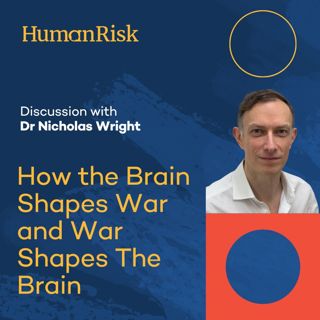
Dr Nicholas Wright on How the Brain Shapes War and War Shapes The Brain

Dr Nicholas Wright on How the Brain Shapes War and War Shapes The Brain

What can war teach us about how the human brain really works? And why is human decision-making a more significant factor than military strength in wars?

Episode Summary
On this episode, I'm exploring how the human brain truly manifests in conflict—and what that reveals about everyday decision-making. Dr Nicholas Wright, a neurologist-turned-neuroscientist who advises the Pentagon Joint Staff, joins me to discuss his new book Warhead: How the Brain Shapes War and War Shapes the Brain.

In our conversation, Nick explains why fear is functional, how “will to fight” can outweigh superior force, and why democracies remain capable of catastrophic decisions. He also explains how perception operates as a controlled hallucination anchored to reality rather than a simple sensory feed, and why that distinction matters for strategy, leadership, and risk.

Moving from fruit flies to front lines, Nick shows how simple neural chemicals regulate aggression, how the brain’s grid cells create literal maps to navigate danger and opportunity, and how both biological and organisational models can mislead when mistaken for reality. The discussion ranges from 1940 France to Kyiv, from Stalingrad to Gaza, and from deception as a vice to deception as a civic virtue.

Nick makes a compelling case for metacognition — the ability to think about one’s own thinking— as the conductor of the brain’s internal orchestra and argues that wisdom—not merely cleverness — must be deliberately designed into leaders and into the next generation of artificial intelligence.

We end with practical insights: cultivating “better ignorance,” inviting real dissent in the spirit of Churchill, and creating deliberate spaces for reflection like (I'm delighted to report) long train journeys.

Guest Biography
Dr Nicholas Wright, MRCP, PhD, is a neuroscientist researching the intersections of the brain, technology, and security at University College London, Georgetown University, and the Center for Strategic & International Studies in Washington, DC. He also serves as an adviser to the Pentagon Joint Staff. Beyond academia, Wright leads projects connecting neuroscience, artificial intelligence, and strategy, and has advised the Pentagon Joint Staff for more than a decade.

He consults on AI for SAP and edited Artificial Intelligence, China, Russia, and the Global Order (Air University Press, 2019).

His latest book, Warhead: How the Brain Shapes War and War Shapes the Brain, is published by St. Martin’s Press (US) and Pan Macmillan (UK).

AI_Generated Time-stamped Summary
[00:00:00] Introduction
[00:01:00] Nick Wright’s journey from neurologist to defense advisor, applying neuroscience to strategy and AI.
[00:04:29] How evolution shaped the human brain for survival and combat — we’re “built to win or survive a fight.”
[00:05:59] Fear as a vital yet double-edged emotion; anxiety as a side effect of peace.
[00:08:26] Origins of the book Warhead and cultural perceptions of its title.
[00:09:39] Why war remains relevant; critique of overconfidence in peace and Pinker’s “Better Angels” thesis.
[00:12:01] Lessons from France’s WWII defeat — cognition and morale outweigh material strength.
[00:14:41] Ukraine’s resistance as an example of will to fight; psychology as a decisive factor.
[00:15:42] Creativity and emotion as essential tools in decision-making; the brain as an orchestra balancing logic and instinct.
[00:18:10] What fruit flies reveal about aggression and shared neural circuitry with humans.
[00:21:13] Structure of Warhead — using neuroscience to reinterpret history and warfare.
[00:26:37] Mental models and how the brain simulates reality to guide choices.
[00:30:37] Perception vs. reality — the brain generates, not records, the world we see.
[00:35:31] The “uncanny valley” and prediction errors — why imperfect mimicry unsettles us.
[00:36:17] Moral symmetry in conflict — both sides perceive their cause as just.
[00:38:00] Deception and fog of war — manipulating human perception as a timeless weapon.
[00:41:00] WWII story of René Carmille — lying as moral resistance.
[00:43:59] Social media, attention, and the loss of reflection — the modern “disease of abundance.”
[00:45:41] Wisdom versus cleverness — Churchill’s reflective habits and valuing dissent.
[00:48:11] “Better ignorance” and intellectual humility as foundations of wise leadership.
[00:51:26] Cognitive diversity, AI, and the need to embed wisdom—not just intelligence—into machines.
[00:58:28] From WWII to China today — the enduring need for wisdom in navigating global conflict.

Links
Nick's website -
https://www.intelligentbiology.co.uk/

WarHead Nick's book -
https://www.intelligentbiology.co.uk/books

Nick on LinkedIn -
https://www.linkedin.com/in/nicholas-d-wright-bba3a065/

If you liked this episode, you might also like my discussion with Dr Mike Martin - https://www.humanriskpodcast.com/dr-mike-martin-on-war-politics/

Det här avsnittet är hämtat från ett öppet RSS-flöde och publiceras inte av Podme. Det kan innehålla reklam.

Avsnitt(368)

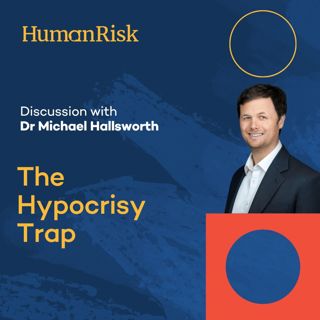
Dr Michael Hallsworth on The Hypocrisy Trap

Dr Michael Hallsworth on The Hypocrisy Trap

We all intuitively know that hypocrisy is a bad thing. But what if it isn’t a flaw, but a feature? But maybe the real problem isn’t hypocrisy, it’s how we think about it.Episode SummaryOn this episode...

16 Nov 202558min
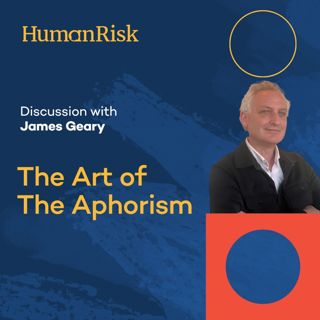
James Geary on The Art of The Aphorism

James Geary on The Art of The Aphorism

Can a single sentence change the way you see the world? My guest on this episode, James Geary thinks so.Episode SummaryOn this episode, I speak with writer and journalist James, whose lifelong fascina...

9 Nov 20251h 4min
Dr Nikolay Kukushkin on Memory

Dr Nikolay Kukushkin on Memory

What if your body is learning things your mind doesn’t know? What if memory wasn't just something that our brain has?Episode Summary On this episode, I'm exploring a bold idea with neuroscientist Dr N...

25 Okt 20251h 6min
Richard Chataway on Designing AI for Humans

Richard Chataway on Designing AI for Humans

What if the biggest AI risk isn’t bias or data, but human behaviour itself? How might AI impact the people using it and what does that mean for how we design solutions and deploy the technology?Episod...

18 Okt 20251h 8min

Tom Hardin On Turning A Crime Into A Calling

Tom Hardin On Turning A Crime Into A Calling

What happens when the worst thing you’ve ever done becomes the foundation for your life’s work?Episode SummaryMy guest on this episode is Tom Hardin, otherwise known as Tipper X.  He's been on the sho...

5 Okt 202555min
James Healy on BS at Work (Bullshit & Behavioural Science)

James Healy on BS at Work (Bullshit & Behavioural Science)

Why do so many workplaces run on bullshit processes and procedures?  And how might Behavioural Science help resolve them?Episode SummaryIn this episode, I sit down with author, speaker and advisor Jam...

27 Sep 20251h 4min

Pep Rosenfeld on Work Laugh Balance

Pep Rosenfeld on Work Laugh Balance

What if the most powerful tool at work isn’t logic, but laughter? On this episode I'm speaking to a comedian who far from thinking humour is a workplace distraction, thinks it might be one of our most...

6 Sep 20251h 3min

Populärt inom Vetenskap

allt-du-velat-veta
dumma-manniskor
p3-dystopia
ufo-sverige
rss-ufobortom-rimligt-tvivel
kapitalet-en-podd-om-ekonomi
svd-nyhetsartiklar
hacka-livet
paranormalt-med-caroline-giertz
ufo-sverige-2
rss-spraket
sexet
rss-vetenskapsradion
medicinvetarna
det-morka-psyket
rss-vetenskapsradion-2
dumforklarat
rss-dennis-world
rss-tidslinjen-podcast
rss-tidsmaskinen