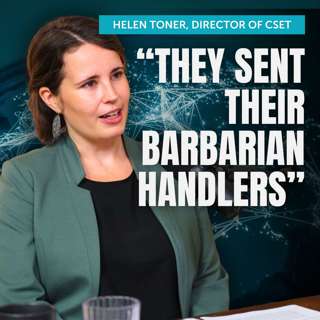

#227 – Helen Toner on the geopolitics of AGI in China and the Middle East

#227 – Helen Toner on the geopolitics of AGI in China and the Middle East

With the US racing to develop AGI and superintelligence ahead of China, you might expect the two countries to be negotiating how they’ll deploy AI, including in the military, without coming to blows. But according to Helen Toner, director of the Center for Security and Emerging Technology in DC, “the US and Chinese governments are barely talking at all.”

In her role as a founder, and now leader, of DC’s top think tank focused on the geopolitical and military implications of AI, Helen has been closely tracking the US’s AI diplomacy since 2019.

“Over the last couple of years there have been some direct [US–China] talks on some small number of issues, but they’ve also often been completely suspended.” China knows the US wants to talk more, so “that becomes a bargaining chip for China to say, ‘We don’t want to talk to you. We’re not going to do these military-to-military talks about extremely sensitive, important issues, because we’re mad.'”

Helen isn’t sure the groundwork exists for productive dialogue in any case. “At the government level, [there’s] very little agreement” on what AGI is, whether it’s possible soon, whether it poses major risks. Without shared understanding of the problem, negotiating solutions is very difficult.

Another issue is that so far the Chinese Communist Party doesn’t seem especially “AGI-pilled.” While a few Chinese companies like DeepSeek are betting on scaling, she sees little evidence Chinese leadership shares Silicon Valley’s conviction that AGI will arrive any minute now, and export controls have made it very difficult for them to access compute to match US competitors.

When DeepSeek released R1 just three months after OpenAI’s o1, observers declared the US–China gap on AI had all but disappeared. But Helen notes OpenAI has since scaled to o3 and o4, with nothing to match on the Chinese side. “We’re now at something like a nine-month gap, and that might be longer.”

To find a properly AGI-pilled autocracy, we might need to look at nominal US allies. The US has approved massive data centres in the UAE and Saudi Arabia with “hundreds of thousands of next-generation Nvidia chips” — delivering colossal levels of computing power.

When OpenAI announced this deal with the UAE, they celebrated that it was “rooted in democratic values,” and would advance “democratic AI rails” and provide “a clear alternative to authoritarian versions of AI.”

But the UAE scores 18 out of 100 on Freedom House’s democracy index. “This is really not a country that respects rule of law,” Helen observes. Political parties are banned, elections are fake, dissidents are persecuted.

If AI access really determines future national power, handing world-class supercomputers to Gulf autocracies seems pretty questionable. The justification is typically that “if we don’t sell it, China will” — a transparently false claim, given severe Chinese production constraints. It also raises eyebrows that Gulf countries conduct joint military exercises with China and their rulers have “very tight personal and commercial relationships with Chinese political leaders and business leaders.”

In today’s episode, host Rob Wiblin and Helen discuss the above, plus:

  • Ways China exaggerates its chip production for strategic gain
  • The confusing and conflicting goals in the US’s AI policy towards China
  • Whether it matters that China could steal frontier AI models trained in the US
  • Whether Congress is starting to take superintelligence seriously this year
  • Why she rejects ‘non-proliferation’ as a model for AI
  • Plenty more.


Learn more and read the full transcript
on the 80,000 Hours website.


This episode was recorded on September 25, 2025.

CSET is hiring a frontier AI research fellow! https://80k.info/cset-role
Check out its careers page for current roles: https://cset.georgetown.edu/careers/

Chapters:

• Cold open (00:00:00)
• Who’s Helen Toner? (00:01:03)
• Helen’s role on the OpenAI board, and what happened with Sam Altman (00:01:32)
• The Center for Security and Emerging Technology (CSET) (00:07:45)
• CSET’s role in export controls against China (00:10:59)
• Does it matter if the world uses US AI models? (00:21:58)
• Is China actually racing to build AGI? (00:27:56)
• Could China easily steal AI model weights from US companies? (00:39:13)
• The next big thing is probably robotics (00:47:45)
• Why is the Trump administration sabotaging the US high-tech sector? (00:49:24)
• Are data centres in the UAE “good for democracy”? (00:52:41)
• Will AI inevitably concentrate power? (01:07:49)
• “Adaptation buffers” vs non-proliferation (01:30:20)
• Will the military use AI for decision-making? (01:38:23)
• “Alignment” is (usually) a terrible term (01:45:11)
• Is Congress starting to take superintelligence seriously? (01:47:42)
• AI progress isn't actually slowing down (01:50:10)
• What's legit vs not about OpenAI’s restructure (01:58:03)
• Is Helen unusually “normal”? (02:01:33)
• How to keep up with rapid changes in AI and geopolitics (02:05:19)
• What CSET can uniquely add to the DC policy world (02:08:29)
• Talent bottlenecks in DC (02:16:03)
• What evidence, if any, could settle how worried we should be about AI risk? (02:19:07)
• Is CSET hiring? (

Det här avsnittet är hämtat från ett öppet RSS-flöde och publiceras inte av Podme. Det kan innehålla reklam.

Avsnitt(340)

We can guess what intergalactic war would look like. And strangely, it matters.

We can guess what intergalactic war would look like. And strangely, it matters.

Intergalactic war is probably billions of years away — yet physics can already tell us how it ends. And strangely that conclusion is relevant to decisions people have to make today.In this video, Rob ...

18 Juni 15min

How AI could create the world’s biggest problems (article by Zershaaneh Qureshi)

How AI could create the world’s biggest problems (article by Zershaaneh Qureshi)

Imagine you’re living 15,000 years ago. Your people are hunter-gatherers and you sleep under the stars. If someone told you humans would one day build cities with millions of people, fly through the a...

11 Juni 1h 29min

What it's really like to run AGI safety at Google DeepMind (and where I disagree with 'doomers') | Rohin Shah

What it's really like to run AGI safety at Google DeepMind (and where I disagree with 'doomers') | Rohin Shah

Most people working on AI safety think without a massive effort AI systems will probably end up with goals catastrophically different from humanity’s. Today’s guest, Rohin Shah — head of AGI Safety an...

2 Juni 2h 48min

What makes for a dream job? | Benjamin Todd

What makes for a dream job? | Benjamin Todd

What actually makes a job fulfilling? It's not what most career advice tells you. "Follow your passion" sounds inspiring, but it's misleading — and the research backs that up.Drawing on hundreds of st...

28 Maj 28min

We’re updating our career advice for the strangest time in history | Benjamin Todd, author of 80,000 Hours

We’re updating our career advice for the strangest time in history | Benjamin Todd, author of 80,000 Hours

The average career is 80,000 hours long. With AI advancing so rapidly, the hours you have left in your career matter more than ever.Some leading AI researchers think there’s a 10% chance that AI syste...

26 Maj 1h 6min

Can AIs already start 'rogue deployments' inside AI companies? (Landmark new METR report)

Can AIs already start 'rogue deployments' inside AI companies? (Landmark new METR report)

A red-teamer was embedded inside Anthropic for three weeks, told to imagine he was an evil Claude, and asked to figure out how to launch a ‘rogue AI deployment’ without getting caught. It’s one part o...

20 Maj 20min

#243 – 'Godfather of AI' Yoshua Bengio: "I now see a path" to safe superintelligent AI

#243 – 'Godfather of AI' Yoshua Bengio: "I now see a path" to safe superintelligent AI

The co-inventor of modern AI and the most cited living scientist believes he's figured out how to ensure AI is honest, incapable of deception, and never goes rogue. Yoshua Bengio – Turing Award Winner...

7 Maj 2h 35min

'95% of AI Pilots Fail': The hidden agenda behind the viral stat that misled millions

'95% of AI Pilots Fail': The hidden agenda behind the viral stat that misled millions

You might have heard that '95% of corporate AI pilots' are failing. It was one of the most widely cited AI statistics of 2025, parroted by media outlets everywhere. It helped trigger a Nasdaq selloff ...

28 Apr 10min

Populärt inom Utbildning

historiepodden-se
rss-bara-en-till-om-missbruk-medberoende-2
det-skaver
nu-blir-det-historia
harrisons-dramatiska-historia
sektledare
not-fanny-anymore
rss-viktmedicinpodden
johannes-hansen-podcast
roda-vita-rosen
allt-du-velat-veta
kan-jag-sa-kan-du-podden
i-vantan-pa-katastrofen
rikatillsammans-om-privatekonomi-rikedom-i-livet
sa-in-i-sjalen
rss-max-tant-med-max-villman
rss-foraldramotet-bring-lagercrantz
rss-ar-det-rimligt
rss-autismandan
rss-i-skenet-av-blaljus